Evolutionary Psychology: Minds in a Changing World
Shared by Arnav Goyal · Research and writing prepared with OpenAI Codex
Contents — choose a chapter
From foundational principles to advanced evidence and debate
An illustrated conceptual guide with modern-day examples
About this book
This book explains evolutionary approaches to mind and behavior through a selective narrative review of research. It does not claim to cover every published paper. Scientific claims are linked to a numbered bibliography. Access limitations and the distinction between full-text and abstract-level review are documented in the research record.
Numbered examples are original teaching scenarios unless explicitly described as research findings. They illustrate concepts and possible tests; they are not invented experiments or evidence that a particular evolutionary interpretation is true.
The book distinguishes established evolutionary principles, supported empirical patterns, contested explanations, and illustrative hypotheses. Evolutionary history does not determine a person's worth, prescribe their goals, or justify harmful behavior.
Prepared 15 October 2026. Research and writing prepared with OpenAI Codex. This is an educational synthesis, not an independently peer-reviewed textbook.
1. What evolutionary psychology asks
A message appears on your phone. It contains no food, changes no temperature, and threatens no immediate physical injury. Yet a few words can make your heart race. An invitation can brighten an afternoon; exclusion from a group can ruin it. A photograph of an unfamiliar meal can cause hunger or revulsion. A stranger's approval can feel surprisingly valuable. The human mind continually translates information into priorities, feelings, and actions.
Evolutionary psychology asks how this capacity came to have its particular structure. Why do some events matter so much? Why are humans capable of attachment, rivalry, generosity, deception, teaching, play, and self-control? What problems did earlier organisms face, and how might those problems have shaped the systems that develop in people today?
These questions are powerful, but they do not answer themselves. It is easy to imagine an ancestral benefit for almost any behavior. A quiet person avoided danger; a talkative person attracted allies. Saving resources prepared for scarcity; spending resources impressed potential partners. Unless we specify conditions and predictions, the same explanatory vocabulary can accommodate every possible outcome. The purpose of this book is to teach both evolutionary reasoning and the discipline needed to keep it informative.
A broad question and a particular research tradition
In its broadest sense, evolutionary psychology is the study of mind and behavior in light of evolutionary processes. In a narrower historical sense, the name identifies a research program especially associated with psychological adaptations, information processing, and mechanisms specialized for recurrent ancestral problems. These meanings overlap, but they are not identical. A scientist can study the evolution of cognition while disagreeing with claims that most cognition consists of numerous specialized, genetically evolved modules.
Confer and colleagues describe the central commitments and defenses of the adaptation-focused program. Bolhuis and colleagues argue for stronger integration with development, neuroscience, genetics, and cultural evolution. Reading these positions together reveals an important distinction: accepting the evolution of the brain does not require accepting every proposed account of its architecture. (17; 11)
Adjacent fields ask related questions with different emphases. Human behavioral ecology often examines how behavior varies with local circumstances and reproductive consequences. Cultural evolution examines how socially transmitted information changes across people and generations. Comparative cognition investigates similarities and differences between species. Behavioral genetics studies sources of variation among individuals. Developmental psychology investigates how capacities emerge. These fields provide complementary tools, but their conclusions cannot simply be substituted for one another.
For instance, discovering that people in different economies share food differently does not immediately identify the psychological mechanism involved. Finding a heritable difference in sociability does not establish why sociability evolved. Showing that a tradition spreads does not establish that it improves biological fitness. A well-constructed explanation keeps track of the question each result actually answers.
Selection shapes capacities, not conscious purposes
Evolution does not give organisms a conscious instruction to maximize descendants. People eat because they are hungry, enjoy flavors, follow routines, share meals, or respond to social expectations. They rarely calculate the reproductive consequences of lunch. A psychological system can have an evolutionary history without its owner knowing that history or pursuing the outcome that originally favored it.
Likewise, a person's present intentions need not reproduce ancestral outcomes. Someone may seek companionship without wanting children. Someone may devote years to a mathematical problem with no clear reproductive payoff. Humans can understand, reinterpret, and resist their motives. Evolutionary explanation concerns the development and history of capacities; it does not replace a person's stated reasons with an allegedly more authentic hidden desire.
The distinction also prevents a common circular argument. If every choice is declared to serve reproduction, including choices that prevent reproduction, the claim has lost its ability to distinguish outcomes. A useful theory specifies the mechanism, its inputs, the response it produces, and circumstances in which it should fail to increase fitness. Modern behavior may reflect learned goals, unusual environments, institutional incentives, by-products, and conflicts among motives.
Example 001. The unread group message
Imagine a student who notices that friends have read a message but have not replied. The student feels rejected and repeatedly checks the conversation. One evolutionary hypothesis is that sensitivity to social exclusion draws on capacities that helped people monitor valuable relationships. But this scenario does not demonstrate a dedicated adaptation for read receipts. The interface is recent, and several explanations remain possible: previous experiences of rejection, uncertainty about group norms, a stressful day, or a learned habit of checking.
A useful study could vary whether delayed replies come from close friends or an automated service, while measuring expectations and earlier rejection experiences. If the response is specifically social, that would narrow the mechanism. It would still leave its evolutionary origin to be investigated through additional evidence. The example illustrates how an evolutionary question guides research without becoming its conclusion.
Four levels of confidence
Throughout the book, distinguish an established principle, a supported empirical pattern, a contested explanation, and an illustrative hypothesis. Natural selection is an established explanatory process. A replicated association between a measured condition and a behavior is an empirical pattern. The proposed selection pressure responsible for the mechanism may remain disputed. Applying that proposal to an individual incident can be only an illustration.
Confidence does not automatically travel upward through those levels. The fact that natural selection occurs does not prove that a specific emotion is an adaptation. A large sample can estimate a modern association precisely without revealing an ancestral cause. An experiment can identify a present causal effect while leaving the historical explanation open.
Nor does uncertainty imply that all explanations are equally good. A proposal that predicts new observations, survives demanding tests, and fits independent evidence deserves more confidence than a story invented after the result. Skepticism should be proportionate and symmetrical. A cultural explanation also needs evidence about learning and transmission; a by-product explanation needs to identify the underlying capacities that generate the by-product.
Example 002. The tempting delivery-app photograph
A person who was not planning to eat sees a vivid photograph of a dessert and orders it. The image may recruit perceptual, motivational, and learned reward processes. The broad idea that feeding systems evolved in relation to obtaining energy is reasonable. The narrower claim that this particular purchase is caused by an ancestral scarcity adaptation is not yet established.
The photograph's color, the customer's recent meal, price discounts, habit, stress, and cultural associations could all matter. An experiment that changes image presentation while holding food and price constant would test an immediate influence. Comparing environments with different food access could address a different question. The evolutionary perspective helps organize these questions, but it does not make commercial design or learning disappear.
Human nature includes development
The phrase human nature can suggest a fixed list of behaviors that every person must express. A more useful starting point is a set of developing capacities, constraints, and sensitivities. Humans generally acquire language, but the language acquired depends on social experience. People form relationships, but their structure depends on opportunities, norms, and individual histories. Similar developmental capacities can produce varied outcomes.
Conversely, similar outcomes can arise through different routes. Two people may avoid a food because one finds its smell unpleasant and the other follows a religious rule. Grouping them together under food avoidance would conceal the causal difference. Behavioral categories are convenient descriptions; they do not guarantee a single mechanism.
Developmental flexibility is itself a phenomenon to explain. Learning requires ways of attending, remembering, generalizing, and responding to feedback. A mind that could learn literally anything equally well would have no basis for deciding what to learn first. But recognizing constraints on learning does not settle how narrow or broad those constraints are. This is an empirical question, revisited in the chapters on cognition and culture.
Example 003. Learning a video-meeting norm
A new employee speaks whenever an idea occurs during online meetings. After several awkward overlaps, the employee learns to use a digital hand-raise button. No ancestor evolved to recognize this icon. The behavior emerges from older capacities for communication, attention, imitation, and learning local rules, operating within a designed institution.
The useful evolutionary question concerns those capacities and the conditions under which they work. Why learn from experienced colleagues? When should a person imitate a majority, and when should personal knowledge override it? The example also shows how people construct environments that make cooperation easier. A small interface change can alter behavior without changing anyone's genes.
Variation is evidence, not an inconvenience
A theory of human psychology should explain both commonalities and differences. If an effect appears in one population but not another, that is an opportunity to investigate boundary conditions. Perhaps the proposed mechanism depends on an input missing from one environment. Perhaps a measurement has a different meaning. Perhaps the original result was unreliable. These possibilities require comparison, not an automatic rescue of the preferred theory.
The influential WEIRD critique drew attention to the limited populations supporting many broad psychological claims. Its central lesson is methodological: evidence from a narrow sample does not license an unrestricted claim about humanity. Later work proposes ways to measure cultural distance more explicitly, rather than treating every non-Western population as an interchangeable contrast. (53; 79)
Variation within a society matters as much as variation between societies. Age, education, work, household structure, disability, geography, and opportunities can affect experience. A national average is not a description of each citizen. Nor does a difference between group averages reveal its genetic or cultural cause. The task is to identify the processes generating the pattern.
Example 004. The generous anonymous donor
Someone gives money anonymously to a stranger's fundraiser. It is tempting to claim that every generous action secretly seeks reputation. An anonymous gift should instead make that simple claim harder to sustain. Other possibilities include empathy, a learned moral commitment, a generalized helping rule, identification with the recipient, or an expectation of indirect social benefits not captured by the researcher.
An evolutionary account can investigate how capacities for caring and norm-following arose without insisting that this donation benefits the donor. Experiments could vary observability, relationship, need, and expectations of future contact. No single comparison establishes the whole history of generosity. The scenario teaches a crucial habit: observations that challenge a simple account should sharpen the theory, not be explained away by redefining selfishness to include every action.
Explanation does not confer permission
The history of a motive does not determine whether acting on it is right. Anger can be understandable while violence is unacceptable. A tendency can be widespread while a community has good reasons to restrain it. Conversely, a practice can be recent and valuable. Literacy, vaccination, disability accommodations, and public institutions do not need ancient pedigrees to matter.
This separation is not a reason to ignore ethical questions in research. Scientists choose categories, measures, interpretations, and public language. Poor choices can stigmatize people or conceal unequal conditions. Responsible evolutionary reasoning asks both whether a claim is supported and whether its implications have been stated accurately.
The book therefore treats humans as agents living in social worlds, with capacities shaped by evolutionary and developmental histories. It does not offer a code for reading every stranger's motives, a ranking of human worth, or a set of supposedly inevitable gender roles. Its practical aim is better questions: What is the behavior? What mechanism produces it? What alternatives exist? What evidence would change our confidence?
Questions to carry forward
Choose an everyday behavior and describe it without explaining it. Then write one immediate mechanism, one developmental influence, and one possible evolutionary hypothesis. Keeping these separate is already progress.
Next, identify an observation that would be surprising if your hypothesis were correct. If no imaginable observation would surprise you, revise the hypothesis until it makes a discriminating prediction.
Finally, consider whether your explanation concerns a population pattern or a particular person. The difference will matter in every chapter that follows.
2. Natural selection, fitness, and trade-offs
Evolutionary explanations become clearer when their biological vocabulary is stripped of everyday associations. Fitness does not mean muscularity, health, happiness, or moral superiority. Selection is not an intentional choice. A successful evolutionary strategy need not be a conscious plan. Adaptation does not mean that an organism can cope with every circumstance.
The core process is straightforward. Individuals vary. Some of that variation is transmitted across generations. If variants systematically differ in their contribution to future generations under particular conditions, their frequencies can change. Over many generations, this process can produce complex functional organization without foresight. Yet it operates alongside mutation, genetic drift, migration, developmental constraints, and historical contingency.
Understanding those qualifications is essential for psychology. A trait's existence is not proof that it was selected for. A person's success in a modern institution is not a direct measure of evolutionary fitness. A behavior that looks costly may have benefits elsewhere, while a behavior that feels rewarding may have no current reproductive advantage.
What changes across generations
Consider a simplified population with two inherited variants that affect how an organism responds to a danger cue. One responds quickly but makes many false alarms. The other responds more slowly and misses some real dangers. Which variant becomes more common depends on the frequency of danger, the costs of responding, the costs of missing it, and any other consequences of the variants.
The quick responder is not universally superior. In a safe environment, repeated escape may waste resources or opportunities. In a dangerous environment, hesitation may be costly. Selection compares consequences under actual conditions; it does not award points for an abstract quality such as caution.
A minimal frequency model makes this concrete. Let p be the proportion carrying variant A, and let wA and wB represent the average reproductive contributions associated with two variants. Under a simple inheritance model, the next generation's proportion of A is:
p_next = pwA / (pwA + (1-p)*wB)
Suppose p is 0.5, wA is 1.1, and wB is 1.0. The next proportion is about 0.524. A modest difference changes frequencies gradually if the conditions persist. These numbers are hypothetical teaching values. Real human traits are usually influenced by many genetic variants and environmental processes, so this equation is a starting point rather than a literal model of a personality trait.
The denominator is important: selection depends on relative contribution. If every type contributes equally more descendants, population size can increase without changing the relative frequencies of the variants. Conversely, a population can shrink while one variant becomes relatively more common.
Example 005. The promotion is not a fitness measurement
An employee becomes a senior manager and earns more money. It would be a mistake to equate this achievement with greater evolutionary fitness. Income, prestige, well-being, and reproduction are different outcomes. They can correlate under some conditions and diverge under others. The employee may use the income to support children, relatives, friends, artistic work, or an intentionally child-free life.
An evolutionary study of status must specify the link it proposes. Does status change access to resources, influence, partnership opportunities, or assistance? Are these consequences actually measured? A title on an organizational chart is evidence about institutional rank. It is not a biological verdict on the person's success or value.
Genes are not miniature decision-makers
Biologists sometimes say that a gene seeks to replicate. This is shorthand for a population process. Genes do not anticipate, desire, or make plans. A genetic variant can influence development in ways that alter reproductive outcomes; variants associated with greater transmission may increase in frequency. Nothing in this description requires conscious selfishness.
The distinction explains why cooperation is compatible with selection. An organism's actions can affect its own reproductive outcomes and those of others. When social partners are genetically associated at relevant loci, helping can influence the transmission of variants shared with those partners. Hamilton's work formalized this insight. (47)
In a simple version, a helping behavior can be favored when:
r*B > C
Here B is the fitness benefit to the recipient, C is the fitness cost to the actor, and r captures genetic relatedness in the relevant population model. These are not ordinary units of money, affection, or effort. Familiar pedigree values such as one-half for a parent and offspring are useful approximations in standard contexts, but relatedness in social-evolution theory is more general than a family label.
If r is 0.5, B is 3, and C is 1 in hypothetical fitness units, then r*B is 1.5, exceeding C. This arithmetic illustrates the logic; it does not advise a person whom to save or how much to love. Real decisions rarely provide direct access to these quantities, and evolved mechanisms would respond to cues rather than perform explicit genetic bookkeeping.
Example 006. Helping a sibling through an exam
A student spends an evening tutoring a sibling. Kin selection is one possible framework for understanding why dispositions to assist relatives could evolve. But the evening itself might be explained by affection, shared upbringing, gratitude, a parent's request, or the satisfaction of teaching. These immediate motives are compatible with several evolutionary histories.
To test a kin-related prediction, researchers would need comparisons that distinguish genetic relationship, familiarity, shared residence, obligation, and reciprocity. Adoptive relatives and close friends are particularly informative because social closeness and genetic kinship are not the same variable. The lesson is to treat inclusive fitness as a theory about selection, not as a claim that people consciously calculate relatedness or care only for genetic relatives.
Trade-offs make perfection impossible
Resources devoted to one activity cannot always be devoted to another. Time spent searching cannot simultaneously be spent resting. A defensive response can prevent injury but consume energy. A highly sensitive detector can notice subtle threats while generating false alarms. Attention devoted to a social interaction may reduce attention to the surrounding environment.
These are trade-offs. They are not merely excuses for imperfect design; they are hypotheses about constraints and competing consequences. A proposed trade-off should identify what is limited, what alternatives compete, and how the consequences vary across conditions.
Observed correlations need not reveal the underlying trade-off. People with abundant resources may invest more in both work and relationships, producing a positive association between the two. Yet any one person may still face a choice about how to spend the next hour. Differences in resource acquisition can conceal differences in allocation. This distinction will become important when we examine life-history theory.
The best outcome may also depend on what other people do. If everyone competes in one niche, a different niche can become more attractive. If cooperation is common, exploitation may pay under some conditions; if exploitation becomes widespread, trust may collapse and change the payoffs. Evolutionary game theory studies such dependencies rather than assuming one permanent best strategy. (87; 4)
Example 007. The always-available friend
A person responds to every friend's request immediately. This can strengthen relationships, but it can also reduce sleep, concentration, and time for other commitments. Another person sets firm limits and sometimes seems less supportive. Neither style is automatically optimal. The consequences depend on need, reciprocity, available support, and the person's resources.
An evolutionary interpretation would ask whether helping decisions respond flexibly to those conditions. A useful study might compare responses to urgent versus routine requests from reliable versus unreliable partners. It should also measure actual costs. A person who can help cheaply may appear more generous than someone facing severe constraints, even if their willingness to help is similar.
Natural selection is not the only source of change
Mutation introduces genetic variation without anticipating what an organism needs. Genetic drift changes frequencies through sampling effects, especially in small populations. Migration changes the distribution of variants between populations. Recombination reshuffles existing genetic material. Selection acts on the resulting variation within developmental and ecological constraints.
This mixture matters because an observed feature can arise in more than one way. It might have been favored directly, accompany another favored trait, persist because selection against it is weak, or result from developmental processes that do not produce an independently optimized component. Gould and Lewontin's critique of adaptationist reasoning emphasized the danger of treating every describable feature as a separate optimized trait. (41)
Historical contingency adds another limitation. Evolution modifies what already exists. It does not redesign an organism from a blank page. Earlier structures and developmental pathways influence which changes are accessible. Similar problems can therefore produce different solutions in different lineages, and similar-looking solutions can arise through different histories.
These principles do not make adaptation impossible to identify. They establish what must be considered before making the claim. Functional organization, comparative evidence, developmental structure, ecological fit, and discriminating predictions can strengthen an adaptation hypothesis. A pleasing story alone cannot.
Example 008. The taste for a new snack
A newly invented snack becomes popular in a city. Its popularity cannot be evidence that humans evolved a specific preference for that product. The product may combine sweetness, texture, salt, familiarity, branding, and peer influence in a way that recruits existing capacities. Its commercial success is a change in purchasing behavior and cultural transmission, not necessarily a genetic change.
The scenario also shows why cultural and biological fitness must be distinguished. A recipe can spread because it is easy to copy or profitable to sell, regardless of whether eating it improves health or reproduction. Explaining the recipe's spread and explaining the human responses it recruits are related but separate tasks.
Fitness is not a purpose for living
Biological fitness is a technical tool for explaining changes in populations. It does not assign people a duty to reproduce, declare nonparents unsuccessful, or rank relationships by legitimacy. Humans can value knowledge, care, justice, pleasure, creativity, and commitments that are not reducible to reproductive outcomes.
Even within biology, fitness is always tied to a model, a time scale, and an environment. Lifetime reproductive success is often informative, but short observations can miss later consequences. Immediate survival can conflict with reproduction. A trait advantageous in one environment can be disadvantageous elsewhere. A variant's effect may depend on other variants and on social partners.
The safest habit is to ask what the researcher measured. Did the study measure offspring, survival, willingness to help, questionnaire preferences, or performance in a game? Each outcome may illuminate a different part of the causal chain. Calling all of them fitness hides rather than solves the inferential problem.
Working through the logic
Suppose a behavior produces an immediate benefit but also a delayed cost. Before calling it adaptive, specify whose outcomes improve, over what period, in which environment, and compared with what alternative. Then ask whether the behavior is inherited genetically, learned socially, or produced by a developing mechanism sensitive to context.
For a second exercise, imagine two people who devote the same proportion of their available resources to helping. One has ten times as many resources. The absolute amount of help will differ even though their allocation rule is identical. This illustrates why raw behavior cannot always reveal underlying motivation.
Finally, return to the frequency equation. If wA and wB become equal, the model predicts no directional selection between the variants. If their values reverse, the direction of change reverses. Evolutionary reasoning becomes useful when it specifies these dependencies rather than attaching a permanent success label to a trait.
3. Four questions about every behavior
Why does a person laugh? Because a remark was unexpected. Because friends are laughing. Because laughter changes the mood of an interaction. Because a nervous system developed through a particular history of experience. Because forms of vocal communication evolved in social animals. These answers do not necessarily contradict one another. They may address different questions hidden inside the word why.
Tinbergen's classic framework distinguishes causation, development, survival value or function, and evolutionary history. In contemporary language, we can ask how a behavior works now, how it develops, what consequences may have favored it, and how its underlying capacities changed across lineages. The framework is useful because answering one question does not automatically answer the others. (114)
This chapter turns that distinction into a practical research tool. We will follow a behavior through four kinds of explanation, identify the evidence appropriate to each, and examine why combining them is more productive than declaring one level the only real cause.
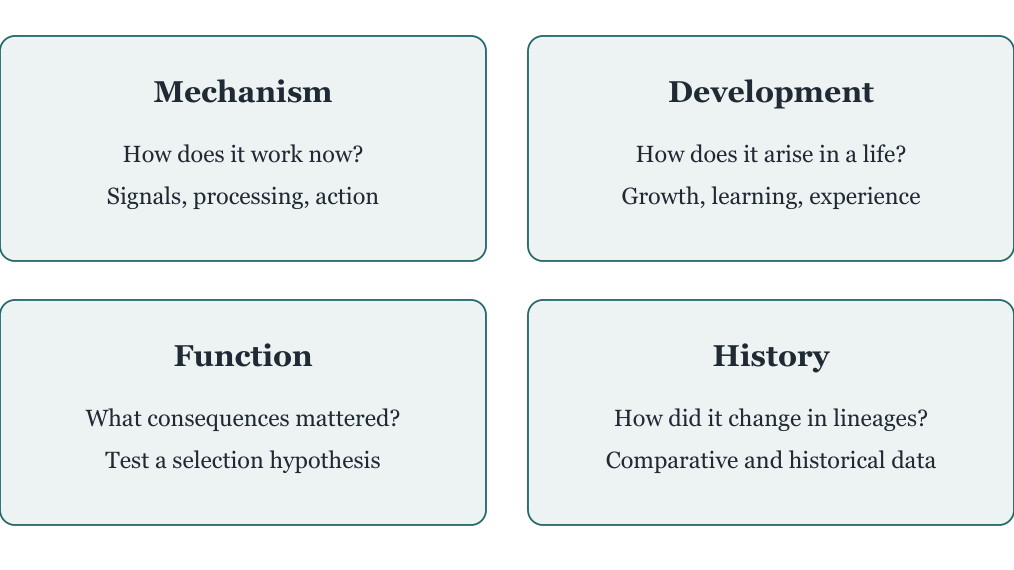
Figure 1. Four complementary questions. Evidence answering one does not automatically answer the others; the boxes are not a hierarchy of importance.
Mechanism: what happens now?
A mechanistic explanation identifies the processes producing a response. It might describe sensory input, attention, memory, appraisal, physiological changes, and action selection. It should do more than rename the behavior. Saying that someone avoids danger because of an avoidance mechanism adds little unless we specify how danger is detected and how avoidance is selected.
Mechanisms can be described at several resolutions. A computational account identifies the information problem and transformations involved. A psychological account identifies representations, learning, and decisions. A neural account identifies circuits and physiological processes. These descriptions should constrain one another, but they need not be identical in vocabulary.
Consider a notification that signals possible social criticism. A mechanistic study could vary the wording and source while measuring attention, interpretation, and behavior. It could test whether the response depends on uncertainty or expected social consequences. A brain image showing activation would add information about implementation, but it would not by itself identify the computation, the developmental history, or the evolutionary function.
Example 009. A presentation alarm
A worker feels anxious before presenting to unfamiliar colleagues. At the mechanistic level, the researcher might examine attention to faces, predictions about evaluation, bodily arousal, and avoidance. At the developmental level, the worker's earlier speaking experiences and workplace learning may matter. At the functional level, one hypothesis concerns the management of costly social evaluation. At the historical level, the question concerns how social monitoring systems arose and changed.
The four accounts can coexist. Importantly, the proposed ancestral value of social monitoring does not establish that this level of anxiety is useful now. The mechanism may be responding to inaccurate expectations, excessive stakes, or conditions outside the range in which its responses work well.
Development: how did this capacity take shape?
Developmental explanation concerns changes across an individual's life. It includes maturation, learning, social relationships, nutrition, stress, and the environments the individual encounters and creates. Development begins before birth and continues through adulthood; it is not merely a period in which a fixed genetic program is unpacked.
To investigate development, researchers might use longitudinal observation, training studies, adoption designs, natural changes in environments, or comparisons across ages. Each method has limitations. Age differences in a single survey can reflect differences between generations rather than changes within people. A training effect can show plasticity without establishing that the same process explains ordinary development. Retrospective reports can be informative but are vulnerable to memory and interpretation.
Early emergence is relevant evidence, but it is not a synonym for genetic specification. Infants have prenatal experience, rapidly learn after birth, and inhabit structured environments. Late emergence is not evidence against evolution either. Some capacities develop only when the relevant bodily or social conditions arise. The key question is what developmental process produces the trait, not whether it wins a contest between innate and learned.
Example 010. A child learns to distrust a sales pitch
A child initially treats an online advertisement as straightforward information. Over time, conversations with adults and experience with disappointing products lead the child to consider the seller's incentives. A developmental explanation would track changes in understanding persuasion, recognizing advertising formats, and evaluating testimony.
An evolutionary question might concern the broader capacity to assess informants whose interests differ from one's own. But the specific skill of recognizing sponsored content requires culturally available information. Comparing children with different experiences could help distinguish general maturation from learning about advertising. The existence of a useful adult skill does not show that its detailed content was present from birth.
Function: what consequences could have favored the system?
A functional explanation asks whether a feature's consequences help account for its maintenance or origin through selection. For a psychological mechanism, the proposal might concern avoiding contamination, choosing social partners, coordinating care, or responding to uncertain threats. The claim is stronger when the mechanism has features that fit the proposed problem and when competing accounts predict different features.
Function should be distinguished from any consequence that happens to occur. Sneezing can interrupt a conversation, but interruption is not therefore its evolved function. A behavior can have beneficial side effects that played no role in its origin. Conversely, a mechanism shaped by past selection can produce harmful outcomes under present conditions.
Testing function requires carefully specified alternatives. Suppose people remember broken promises. A hypothesis about partner choice might predict special sensitivity to intentional betrayal by someone with whom future interaction is likely. A broader emotional-memory account might instead predict strong memory for any upsetting event. These predictions overlap in some situations and diverge in others. The informative study targets the divergence.
The functional question is also about the correct unit. An isolated action may be costly even when the rule producing actions has beneficial average consequences in relevant environments. A smoke alarm that sometimes responds to steam is not necessarily poorly designed. But this analogy only motivates an analysis of costs and error rates; it does not prove that any particular psychological symptom is well calibrated.
History: what changed, and when?
Historical explanation asks how a trait or its components arose and changed across evolutionary lineages. Researchers use comparative anatomy and behavior, phylogenetic methods, archaeology, fossils, genetics, and models. The available evidence varies enormously across traits. Teeth preserve differently from social expectations. A stone tool can reveal technical activity more directly than the emotions of its maker.
Similarity across species can reflect shared ancestry, independent evolution, or superficially similar behavior produced by different mechanisms. To distinguish these possibilities, comparisons should examine the structure and context of the behavior, not merely attach the same label. Teaching, imitation, fairness, and grief all require careful operational definitions when compared across species.
A phylogenetic comparison also must account for shared ancestry. Ten closely related species are not ten entirely independent evolutionary experiments. Similarly, neighboring human societies may share institutions because of contact or common history. Treating every observation as independent can exaggerate evidence for an ecological explanation.
Example 011. The comforting household dog
A person feels calmer while interacting with a familiar dog. Studying the immediate effect of the interaction addresses mechanism and present outcomes. Studying how the relationship formed addresses development. Asking whether social attachment capacities contributed to the response raises a functional question. Asking how domestication altered human-dog interaction introduces a historical question involving both species.
The calming response does not prove that humans evolved specifically to own modern household pets. Existing affiliative capacities, individual learning, selective breeding of dogs, and cultural practices may combine to produce it. This is a useful reminder that modern behaviors can sit at the intersection of several evolutionary and cultural histories.
Why the levels should interact
The four questions are distinctions between explanatory tasks, not sealed compartments. Development can influence which variants selection encounters. Organisms alter their environments, changing conditions for later generations. A social institution can modify learning opportunities and reproductive consequences at the same time.
Laland and colleagues argue that rigid interpretations of the proximate-ultimate distinction can obscure such reciprocal causation. Their critique does not eliminate the usefulness of distinguishing questions; it challenges the idea that causal influence must always run in a single direction from evolutionary history to development to behavior. (69)
For example, a community creates a school. Schooling changes what children learn and the skills they practice. Those skills can affect economic activity and the kinds of institutions the next generation creates. Over longer periods, culturally altered environments may also change selection pressures. One explanation can therefore contain processes operating on different time scales without collapsing them into a single cause.
The practical advantage of the framework is diagnostic. If a theory claims an evolutionary function but provides only a present correlation, we can identify the missing link. If a critic supplies a learning explanation, we can ask whether it conflicts with the proposed evolutionary account or describes how an evolved learning capacity develops. Apparent disputes sometimes dissolve once the question is specified; others become sharper.
Example 012. A team adopts a public checklist
A hospital or engineering team introduces a checklist that everyone can see. Members become more consistent about completing a sequence of tasks. At the immediate level, the checklist changes memory demands and accountability. Developmentally, repeated use creates routines. Functionally, researchers might ask how capacities for shared attention and monitoring support coordinated action. Historically, the checklist itself is a cultural invention with a traceable institutional history.
Calling it an adaptation without specifying whether one means an evolved human capacity, an individual adjustment, or an institutional improvement creates confusion. The same word is used in all three contexts, but the evidence differs. The checklist's effectiveness can be tested directly without settling the evolutionary origin of every capacity it recruits.
A complete explanation need not arrive all at once
No single study must solve all four questions. A tightly designed experiment on one mechanism can be valuable even if its evolutionary history remains unknown. A comparative study can constrain historical hypotheses without identifying every neural detail. Progress comes from connecting appropriately limited findings.
The danger is overclaiming. A study can move from a task result to a broad evolutionary narrative so smoothly that the inferential steps disappear. Readers should reconstruct those steps. What was manipulated? What was measured? Which mechanism was inferred? What historical evidence was supplied? What assumptions connect them?
It is equally unhelpful to demand impossible completeness from one field while accepting partial explanations elsewhere. Historical sciences routinely infer past events from present evidence. The question is not whether we can directly watch an ancient selection process; it is whether competing histories make sufficiently different predictions about the evidence available now.
A four-question research worksheet
Start with a precise observation: who did what, under which conditions? Avoid a broad label such as aggression when the actual observation is that participants chose a louder sound for a competitor after an insult. The operational description prevents a task from silently becoming a complete account of everyday behavior.
Then write four separate questions. For mechanism, identify the inputs and processes. For development, identify the experiences and changes that could build them. For function, state a proposed historical consequence and at least one alternative. For history, identify comparisons or records that could distinguish possible origins.
Finally, mark the evidence you possess and the evidence you lack. A blank space is not a failure. It is a research agenda. Much of scientific maturity consists in knowing which part of an explanation has actually been tested.
4. Adaptations, by-products, and competing explanations
A useful object need not have originated for its present use. A heavy book can hold a door open. Its effectiveness as a doorstop does not explain why books were invented. This simple distinction becomes more difficult when the object is a psychological capacity and the history stretches across many generations.
An adaptation is a feature whose form can be explained, at least in relevant part, by selection for the effects it produced. A by-product accompanies other features without having been selected for the effect under discussion. An exaptation is a feature recruited for a role different from the one, if any, responsible for its earlier origin. Noise, drift, and developmental constraints provide additional possibilities. These categories are tools for historical inference, not visible labels attached to behaviors. (14)
The same complex capacity may contain components with different histories. A present behavior can recruit an old adaptation, a learned skill, and a cultural invention simultaneously. Consequently, the useful question is often not whether a whole activity is an adaptation, but which parts of its causal organization require which explanations.
Begin by identifying the trait
Before asking why something evolved, define what the thing is. Is jealousy an emotion, a pattern of attention, a set of appraisals, a physiological response, a motivation, or a family of behaviors? Is altruism a costly action, a compassionate intention, or an effect on reproductive outcomes? Different definitions produce different research questions.
Broad everyday categories can hide mechanistic diversity. A person may share food because of affection, a household rule, a request, expected reciprocity, or fear of criticism. The outward action looks similar, but the causal organization may differ. Conversely, a single mechanism may produce different actions: protecting a relationship could involve reassurance, apology, compromise, withdrawal, or seeking help.
Researchers should therefore move between levels carefully. A task measures a particular response under particular conditions. The inference to a psychological mechanism requires validation. The inference from that mechanism to an evolutionary history requires further evidence. Skipping either step produces a more confident narrative than the data warrant.
Example 013. Enjoying a horror film
Two viewers enjoy the same frightening film. One likes suspense and the relief that follows it; the other values discussing the film with friends. The fact that both buy tickets does not show a single evolved horror-film preference. Several existing capacities may be involved: threat simulation, curiosity, emotional regulation, social affiliation, and aesthetic learning.
An adaptation hypothesis about safe threat rehearsal would need predictions beyond the observation that people sometimes enjoy frightening stories. It might predict particular learning outcomes or preferences under specified conditions. An entertainment-by-product account might predict enjoyment without those outcomes. A well-designed comparison can make the hypotheses differ, whereas the bare claim that horror was useful to ancestors cannot.
Functional fit is evidence, not magic
An adaptation hypothesis gains strength when a mechanism exhibits coordinated features that solve a specified recurring problem. These features might include sensitivity to relevant cues, an appropriate response pattern, calibration to costs, and developmental organization that makes the response available when needed.
But functional fit has to be evaluated against alternatives. General learning can sometimes produce apparently specialized performance. A culturally taught rule can resemble an inherited preference. A measurement procedure can favor one kind of response. A proposed design feature is most informative when rival explanations would not readily predict it.
The standard is not perfect performance. Selection is constrained, environments vary, and traits have costs. Nor is imperfection automatically evidence of a trade-off. If every success proves adaptation and every failure proves a hidden trade-off, the theory becomes difficult to challenge. Specify the trade-off before examining its consequences whenever possible.
The classic debate over adaptationism illustrates this tension. Gould and Lewontin criticized the habit of inventing an optimizing story for each feature. Defenders of adaptationist research argue that functional hypotheses can generate precise and productive tests. The productive lesson is to use adaptation as a research hypothesis with evidentiary requirements, while treating alternatives with equal seriousness. (41; 14)
Example 014. The compulsive spreadsheet sorter
An office worker repeatedly rearranges a spreadsheet into increasingly elaborate categories. The activity may recruit categorization, order preferences, task avoidance, professional training, or concern about mistakes. Its organization does not itself prove that each sorting habit is an adaptation.
A useful analysis asks what the worker is trying to accomplish and what changes the behavior. Does sorting improve accuracy? Does it persist when it has no practical value? Does time pressure reduce it or intensify it? These questions identify the present mechanism and its consequences before attaching a historical story. The example warns against treating any patterned behavior as evidence of an independently selected psychological device.
Universality is neither sufficient nor always necessary
If a behavior appears across many populations, it deserves attention. Yet widespread occurrence does not establish a dedicated adaptation. People across societies encounter gravity, fatigue, social learning, and material constraints. Shared environments and common learning processes can produce widespread outcomes. Cultural practices can also spread widely through contact.
Conversely, an evolved capacity may produce different outcomes depending on sex, age, condition, experience, or context. A conditional mechanism need not be expressed identically by everyone. The challenge is to specify the conditions rather than invoking flexibility after every inconvenient result.
The strongest version of a conditional hypothesis predicts the interaction. For example, it might predict that a response rises with a particular cue only when a relevant opportunity exists. Researchers can then test the combined pattern. Merely observing that people vary is not evidence for a specific adaptive calibration rule.
Heritability provides a different kind of evidence and should not be substituted for universality. A highly heritable individual difference need not be an adaptation. A species-typical adaptation can show little heritable variation within a sample. Heritability concerns variation under sampled conditions; adaptation concerns historical explanation. Chapter 5 develops this distinction.
Current benefit is not historical origin
A capacity can be useful now even if it did not originate for that use. Reading is an especially clear case because writing is historically recent compared with many underlying visual and language capacities. Dehaene and colleagues found that literacy is associated with changes in cortical responses to visual and language stimuli, including in people who became literate as adults. The study supports the importance of experience in organizing these capacities; it does not imply a recently evolved dedicated gene for reading. (24)
This also shows why biological and cultural explanations need not compete. A cultural practice can recruit and reshape biological systems. Those systems can constrain which cultural forms are easy to learn. Over longer periods, cultural environments may change selection pressures. The resulting account is interactive rather than a choice between biology and culture.
Example 015. Reading tiny text on a phone
A commuter reads a dense message on a small screen. The task recruits visual discrimination, language knowledge, attention, and learned conventions about punctuation and interface design. It is successful behavior in a modern environment, but no specific ancestral smartphone-reading adaptation is needed to explain it.
Changing font size or line spacing could improve performance immediately. Training and familiarity could improve it over time. These mechanisms are testable in the present. A broader evolutionary account concerns the capacities that make such learning possible and the constraints that persist. The example illustrates reuse and plasticity rather than a separate evolutionary explanation for each modern task.
Prediction must discriminate
A prediction is especially useful when another plausible explanation predicts something different. Suppose people detect violations of social rules more easily than violations of abstract rules. A specialized social-exchange account is one possibility. Familiarity, pragmatic understanding, permission schemas, or differences in attention may also contribute.
Cosmides's experiments on reasoning about social exchange were designed to compare predictions against alternatives, including permission-schema and availability accounts. Their importance lies partly in this attempt at discriminating tests. The results stimulated an extensive debate about the architecture and development of reasoning. A task advantage should not be treated as a complete map of the mind. (18)
Consider a hypothetical research design with three conditions: a familiar social rule, an unfamiliar social rule, and an equally comprehensible nonsocial rule. If the hypothesis requires social content, familiarity alone should not account for the effect. If the effect disappears when comprehension is matched, the interpretation changes. The strongest experiments anticipate such possibilities rather than adding them only after criticism.
This logic also applies to negative results. A null result may reflect a weak manipulation, an imprecise measure, inadequate power, or an incorrect hypothesis. The conclusion depends on the design's ability to detect the predicted effect. Neither a positive nor a negative result interprets itself.
Example 016. Remembering the colleague who took credit
An employee vividly remembers a colleague taking credit for shared work. A theory about tracking exploitative partners might predict especially good memory for the person's identity and future opportunities to interact. A general emotional-memory explanation might predict enhanced memory for any upsetting event, regardless of whether a social partner caused it.
A study could compare intentional credit-taking, accidental administrative error, and an equally unpleasant nonsocial setback. It would need to match emotional intensity and attention as well as possible. This is an original teaching design, not a report of an existing experiment. Its purpose is to show how rival explanations can be turned into competing predictions.
Build a network of evidence
One result rarely establishes an evolutionary explanation. Stronger cases draw on independent methods that have different weaknesses. Experiments can isolate present causal relationships. Developmental studies can reveal how capacities emerge. Cross-cultural studies can test generality and contextual variation. Comparative work can constrain historical possibilities. Formal models can expose assumptions and derive consequences.
Convergence is most persuasive when the evidence is genuinely independent. Ten studies using nearly identical questionnaires in similar student samples may share the same limitation. A review that cites those studies does not create a new independent test. Likewise, different measures that all depend on the same self-report tendency can appear to converge while reflecting a common bias.
The aim is cumulative constraint. Each kind of evidence should eliminate some possibilities or sharpen the conditions under which a theory applies. A successful explanation becomes more specific as research progresses. It should not expand indefinitely to accommodate every result.
A disciplined adaptation argument
For any proposed adaptation, write down the feature, the recurrent problem, the mechanism, and the expected consequences. Then identify at least two alternatives: for example, a general learning process and a by-product of another capacity. State what each predicts in the same setting.
Next, distinguish evidence about present usefulness from evidence about historical selection. List the assumptions connecting them. If ancestral conditions are uncertain, explain how the prediction changes across plausible conditions rather than choosing the one most favorable to your theory.
Finally, decide what would count against the claim. Perhaps the proposed specialization fails to appear when familiarity is controlled. Perhaps the developmental pathway differs from the theory's prediction. Perhaps cross-cultural variation tracks an alternative variable. A hypothesis with identifiable vulnerabilities is stronger science than a story protected from every possible outcome.
5. Genes, development, and plasticity
The question of whether a behavior comes from genes or the environment is usually too crude to be useful. Genes participate in development through cellular processes. Those processes occur in environments, from the chemical conditions within a cell to relationships, institutions, and physical surroundings. A developing person is not assembled from a genetic portion and an environmental portion that could be separated after the fact.
Yet genetic and environmental differences can still be studied scientifically. The key is to distinguish the development of a trait in an individual from the sources of variation among individuals. These are related questions with different answers. Confusing them creates many of the most persistent misunderstandings in evolutionary psychology.
From DNA to behavior is a developmental pathway
DNA sequences contribute to the production and regulation of molecules. Their consequences depend on cellular context, other genetic variants, developmental timing, and environmental conditions. A complex behavioral outcome is many steps downstream. There is rarely a simple chain in which one gene specifies one everyday psychological trait.
Pleiotropy means that a genetic variant can influence multiple outcomes. Polygenicity means that many variants contribute to variation in a trait. Both complicate attempts to tell a one-gene, one-behavior evolutionary story. Selection on a variant could involve consequences other than the psychological outcome that happens to interest a researcher.
Gene expression also changes across tissues and circumstances. Having the same DNA sequence in many cells does not make those cells identical. Regulatory processes influence when and where genetic material is used. The relevant scientific question is how a developmental system produces an outcome, not whether the outcome can be assigned to DNA in isolation.
This does not make genes unimportant. It makes their importance mechanistic rather than magical. A sound genetic explanation identifies a pathway or a statistical association with clear limitations. It does not use the word genetic as a substitute for specifying causation.
Example 017. Two siblings, different study habits
Two siblings grow up in the same household. One studies in a quiet room; the other learns best in group discussions. Their difference might reflect genetic variation, different teachers, peer groups, opportunities, prior successes, or combinations of these. The shared address does not mean they experienced an identical environment.
Even the same parental behavior can have different consequences for different children. A competitive remark may motivate one and discourage the other. A useful study would measure experiences and behavior over time rather than assume that everything not shared must be genetic. The example introduces a central distinction: families share some conditions, but development is experienced individually.
What heritability measures
Heritability is a property of variation in a population under particular conditions. Broad-sense heritability concerns the proportion of phenotypic variance associated with genetic variance in a specified model. Narrow-sense heritability concerns additive genetic variance. Neither is the percentage of an individual's trait caused by genes.
A simplified expression is:
h_squared = additive genetic variance / phenotypic variance
The denominator depends on the population and its environments. If environmental conditions become more uniform, the relative share associated with genetic differences can increase even when the biology of development has not changed. If environments become more varied, the estimate may change in the other direction. Measurement error and model assumptions also matter.
The large twin-study synthesis by Polderman and colleagues found substantial genetic contributions across many measured traits. Its broad scope is valuable evidence that genetic variation matters, but an average across traits is not a personal genetic percentage and should not be assigned to a specific psychological characteristic without examining the relevant data. (95)
Heritability does not measure immutability. A trait can show substantial heritable variation and still respond to an intervention. Nor does low heritability mean that genes are unnecessary for its development. If nearly everyone has the relevant genetic prerequisites, those prerequisites may explain little of the variation within the sample.
Example 018. Heritable vision and corrective lenses
Imagine a population in which inherited differences contribute to variation in visual acuity. Providing corrective lenses can greatly change people's performance on a reading task. The intervention's effectiveness does not contradict genetic influence. It changes the environment in a way that alters the consequences of the underlying variation.
The same logic applies to psychological research, although the mechanisms and interventions may be more complex. A heritability estimate cannot tell us whether a teaching method, accommodation, or social change will work. That requires direct evidence about the intervention and its target. The example separates a statistical description of existing variation from a prediction about what can be changed.
Twin studies, adoption studies, and genomic studies
Twin designs compare resemblance among relatives with different expected genetic similarity. Their interpretation depends on assumptions about environmental similarity, mating patterns, measurement, and how genetic effects combine. Adoption designs can help separate some aspects of genetic relationship from rearing environment, but placement practices and restricted environmental ranges introduce their own challenges.
Genome-wide association studies examine associations between measured genetic variants and outcomes across many individuals. For complex traits, individual associations are often small, so large samples are needed. A polygenic score combines information from many associations into a statistical predictor. It is not a direct measurement of a person's destiny, motivation, or moral character.
Population structure, indirect parental effects, and correlations between environments and genetic variation can complicate interpretation. A genetic association is not automatically the direct biological effect of that variant on a trait. Within-family comparisons can help address some confounding, though they bring other limitations, including reduced precision and narrower questions.
Transfer across populations is also a substantive issue. Martin and colleagues documented limitations in the portability of then-current polygenic scores associated with the ancestry composition of discovery samples. Rosenberg and colleagues explain why population differences in scores do not straightforwardly identify genetic explanations for observed phenotypic differences. These are reasons to examine the design and assumptions of each inference. (74; 101)
Gene-environment correlation and interaction
Gene-environment correlation occurs when genetic differences are statistically associated with differences in environments. Parents provide both genes and aspects of a rearing environment. A child's characteristics can evoke responses from other people. Individuals also seek activities and relationships compatible with their interests and abilities. These pathways can make experience and genetic variation correlated without making experience causally irrelevant.
Gene-environment interaction means that the consequences of genetic differences depend on environmental conditions, or equivalently that environmental effects differ across genotypes. The concept is straightforward, but demonstrating a specific interaction reliably can be difficult. Measurement, sample size, multiple testing, and replication all matter.
The history of candidate-gene research provides a caution. Border and colleagues tested prominent candidate-gene and gene-by-environment hypotheses for depression in much larger samples than many earlier studies and did not find support for those historical claims. This result challenges particular hypotheses and research practices; it does not show that genes or environments are irrelevant to depression. (12)
Example 019. The musician's expanding environment
A child enjoys rhythmic play, receives encouragement, practices an instrument, and joins a music group. Initial interests, family resources, instruction, and social rewards become linked over time. The child's behavior helps shape the environment that subsequently develops the skill.
This is a feedback process, not a choice between talent and training. A researcher could follow early interests, access to lessons, practice, and performance longitudinally. The important question is how the pathway unfolds and which interventions expand opportunity. Inferring that successful musicians simply possess a music gene would ignore both the complexity of genetic influence and the environments that sustain learning.
Plasticity has structure and costs
Plasticity is the capacity to develop different phenotypes under different conditions. A reaction norm describes how a genotype's phenotype changes across environments, although real human research rarely observes all relevant combinations directly. Plasticity can be narrow or broad, reversible or difficult to reverse, rapid or slow.
Learning is one form of plasticity, but the concept also includes physiological and developmental responses. Maintaining the ability to adjust can carry costs. Cues may be unreliable, adjustments may take time, and an environment experienced early in life may not predict later conditions. Selection for plasticity therefore depends on the structure of environmental variation and the usefulness of available information.
Sensitive periods are intervals during which particular experiences have especially strong effects. A sensitive period does not necessarily mean an absolute deadline after which change is impossible. Nor does the existence of a developmental response prove that it is an adaptive forecast of the future. It could reflect damage, constraint, immediate coping, or a combination of processes.
This distinction becomes crucial in discussions of adversity. A child can develop a skill useful in a difficult setting while also suffering serious costs. Recognizing the skill does not make the adversity beneficial overall. Chapter 27 examines these questions through competing models of developmental environments.
Example 020. Learning a second language as an adult
An adult begins learning a new language for work. Prior language knowledge, attention, motivation, instruction, and opportunities for conversation all influence progress. Age-related differences may affect aspects of learning, but they do not make adult learning impossible or uniform.
An evolutionary perspective asks why humans possess powerful language-learning capacities and how their development is organized. It does not predict the learner's outcome from age alone. The scenario illustrates a structured form of plasticity: experience changes performance, but the rate and pattern of change depend on the learner and the task.
Epigenetics without exaggeration
Epigenetic processes concern regulation associated with features such as DNA methylation and chromatin organization. They help explain how cells with similar DNA can differ in activity and how experience can be associated with changes in biological regulation. The term is often used much more loosely in popular discussion.
Evidence that an exposure is associated with an epigenetic marker does not establish that the marker caused a behavioral outcome. The marker may be a consequence, a correlate, or part of a more complicated pathway. Tissue matters: a measure from blood is not automatically a direct measurement of regulation in relevant brain cells.
Claims about inheritance across generations require additional care. Shared environments, parental behavior, pregnancy conditions, and direct exposure of developing reproductive cells can produce intergenerational patterns without demonstrating stable transgenerational inheritance of a specific acquired psychological trait. Developmental and evolutionary theories can incorporate multiple inheritance pathways, but each proposed pathway needs its own evidence. (70)
What this changes about evolutionary explanation
Evolutionary psychology need not predict a separate gene for every proposed mechanism. Selection can shape developmental systems whose outcomes depend on experience. However, invoking such a system is the beginning of a mechanistic account, not its completion. Researchers should ask which inputs matter, how the response develops, and whether the predicted pattern appears.
Likewise, evidence of heritable variation does not establish a particular selection history. Variation can persist through multiple processes, including mutation, trade-offs, environmental heterogeneity, and weak selection. A genetic study can constrain a theory without validating every functional interpretation attached to the trait.
When you encounter a genetic claim, ask four practical questions. What population was sampled? What outcome was measured? What kind of genetic evidence was used? What inference is being made beyond the measured association? These questions keep a fascinating field from becoming a vocabulary of inevitability.
6. Reconstructing ancestral environments
The phrase ancestral environment often evokes a single scene: a small group on an open grassland, men hunting, women gathering, and social life organized in one familiar way. Human evolutionary history cannot be reduced to that picture. Different capacities have different time depths, and our ancestors inhabited changing environments, encountered other populations, and developed diverse ways of living.
The challenge is to reconstruct enough of that history to make useful predictions without pretending to know details that the evidence cannot reveal. This requires cooperation among archaeology, paleoanthropology, genetics, ecology, and the study of living societies. It also requires distinguishing an observation from the model used to interpret it.
There is no single ancestral date
Some features of human cognition depend on systems with deep vertebrate or mammalian histories. Others involve capacities elaborated in primates or hominins. Human-specific patterns may have emerged gradually, with different components appearing at different times. More recent cultural changes have continued to alter development and selection pressures.
The environment of evolutionary adaptedness, often abbreviated EEA, is most usefully treated as the distribution of conditions relevant to a trait's selection history. It is not necessarily one place or one period. The relevant history for a visual system differs from the history relevant to a particular social-learning capacity.
Even this statistical interpretation is demanding. To predict a mechanism's organization, we need some knowledge of the problems, available cues, costs, and opportunities that recurred. Broad facts may be secure while detailed reconstructions remain uncertain. Ancestors needed food and care; the exact social arrangements, distributions of risk, and patterns of interaction varied.
Consequently, evolutionary hypotheses should state which historical assumptions they require. Some need only broad conditions, such as repeated opportunities for social interaction. Others require specific claims about group structure, mating patterns, or ecological predictability. The more specific the assumption, the more directly it needs support.
Example 021. The claim that an open-plan office is ancestral
A company argues that an open-plan office suits humans because ancestors lived in groups. The inference is much too broad. Living socially does not imply that constant visibility, noise, interruptions, or a particular desk arrangement improves work. Ancestral social environments included variation in activity, privacy, mobility, relationship, and task demands.
The office design should be evaluated through its actual effects on communication, concentration, well-being, and performance. Evolutionary ideas might suggest variables to examine, such as control over social exposure or access to trusted collaborators. They do not supply a ready-made floor plan. This example shows how vague ancestral claims can conceal missing evidence about a modern intervention.
What archaeology can reveal
Archaeology studies material traces of past activity. Tools can provide evidence about manufacturing sequences, resource use, transport, and technical knowledge. Remains of food and habitation can inform models of diet, mobility, and settlement. Repeated patterns across dated sites can reveal change over time.
The interpretation is rarely one-to-one. A tool transported a long distance may reflect travel, exchange, or movement through several intermediaries. A repeated design may reflect copying, common constraints, or independent invention. An absence of artifacts may reflect poor preservation or limited sampling rather than absence of the behavior.
Material evidence is particularly difficult to translate directly into specific emotions or beliefs. An object may support an inference about symbolic activity without revealing its exact meaning. Researchers gain confidence by combining context, dating, comparison, and explicit models rather than relying on resemblance to a modern practice.
The difference between a capacity and its preserved expression also matters. A population may have been capable of a technique that left no durable trace. Conversely, a sophisticated artifact may depend on a network of cultural knowledge rather than a sudden genetic change in individual intelligence.
Example 022. Reconstructing a vanished online community
Imagine future researchers trying to understand an online community from a few surviving screenshots. They might identify symbols, repeated formats, and exchanges between users. But they could misinterpret an ironic phrase as a sincere belief or assume that the most visible users represented everyone.
The analogy is not exact, but it clarifies an archaeological problem: surviving traces are selected fragments of activity. Context and preservation affect what can be inferred. A careful reconstruction considers several explanations and asks which additional evidence would distinguish them. The same discipline should accompany claims about ancient social life.
Fossils and genomes answer different questions
Fossils can reveal anatomy and changes in morphology. They can sometimes support inferences about growth, injury, diet, or movement. They do not provide direct recordings of cognition. Braincase shape and size are informative biological features, but neither is a simple score for intelligence or a map of particular mental modules.
Genetic data provide another window into population history. Models use patterns of variation to infer relationships, migration, population size, and selection. Different demographic models can produce similar observations, so comparison among models is essential. Estimates are conditional on sampling, assumptions, and methods.
Scerri and colleagues argued that fossil, archaeological, and genetic evidence is more compatible with a geographically structured African history than with a simple origin in one isolated location. Ragsdale and colleagues later compared demographic models and supported a weakly structured ancestral population history with continuing gene flow. These studies differ in methods and details, but both challenge an overly simple single-population narrative. (106; 98)
The important implication for psychology is modest but consequential: ancestral conditions should not be treated as uniform by default. These studies do not identify the evolutionary history of a particular modern preference. They constrain the broader historical setting within which such hypotheses must operate.
Living societies are not preserved ancestors
Research with foraging, pastoralist, horticultural, and other communities is essential for understanding human variation. Such communities can reveal ways of organizing work, care, exchange, and knowledge that are poorly represented in industrialized samples. But contemporary people have contemporary histories. They are not living fossils.
Trade, migration, colonialism, state policies, land loss, technology, and neighboring populations can influence any community. Even without recent external changes, groups vary in ecology, institutions, and social organization. Selecting one population as the model of ancestral humanity risks turning a useful comparison into an unsupported universal claim.
The more productive approach is comparative. Which patterns recur across different circumstances? Which vary with ecology, institutions, or cultural history? Which measures have equivalent meanings? Researchers should collaborate with communities in defining questions and interpreting findings rather than treating people merely as sources of exotic data.
Example 023. A modern camping trip as a test of ancient life
A group spends a weekend camping and finds cooperation difficult. Some members conclude that humans are naturally selfish; others blame modern comforts. Neither conclusion follows. The group has limited experience, unfamiliar equipment, a short time horizon, and relationships formed elsewhere. Its situation differs from that of people with extensive ecological knowledge and established systems of cooperation.
The trip can reveal how these particular people coordinate under these conditions. It cannot recreate ancestral life by removing electricity for two days. The example illustrates why simulations and naturalistic experiences need careful interpretation: changing a few visible features does not reproduce an entire developmental and social environment.
Ecological flexibility is part of the story
A variable environment does not make evolutionary explanation impossible. It changes what kinds of mechanisms might be favored. If conditions fluctuate and cues are informative, flexible learning can be useful. If cues are unreliable or adjustment is costly, other responses may be favored. The relevant prediction depends on the pattern of variation, not simply its existence.
A 2025 analysis combined dated archaeological sites with models of environmental suitability and inferred an expansion in the range of habitats used by humans within Africa before the later major dispersal beyond the continent. The study supports a role for ecological flexibility in that historical process. It does not establish that every modern response to novelty is optimal. (46)
Flexibility may depend on social resources. A person entering a new habitat can learn from experienced people, use inherited tools, and cooperate with others. Adaptation to diverse environments therefore need not be explained by individual problem-solving alone. Cultural knowledge can change the problems that individual minds must solve.
Evolution did not stop with agriculture
Agriculture, settlement, domestication, and population growth altered diets, disease exposure, social arrangements, and environments. Genetic and cultural evolution continued. The well-established general principle of gene-culture interaction undermines a literal claim that all human biology has remained unchanged since a single prehistoric cutoff. (68)
This does not mean that every recent social change produced a genetic adaptation. Evolutionary responses depend on heritable variation, selection, generation time, constraints, and the consistency of conditions. A technology can transform behavior far faster than a specific genetic response could spread. The appropriate question is which processes explain the change in a particular case.
Equally, evidence of recent selection on a gene expressed in the brain does not establish a recent adaptation for a named psychological trait. Genes can have multiple effects, and expression in a tissue is not a functional explanation. The pathway from genetic evidence to cognitive interpretation must be demonstrated rather than assumed.
Example 024. The supposedly universal ancestral diet
A social-media post promotes one menu as the diet all humans evolved to eat. The claim overlooks variation in habitats, seasonal availability, food processing, cultural knowledge, and more recent biological history. A broad evolutionary interest in food acquisition does not identify one historically universal menu.
Questions about a modern diet's effects require present evidence about the diet, the people eating it, and relevant outcomes. Historical reconstruction can generate hypotheses, but ancestral resemblance is not itself a health trial. The example shows why origin stories should not substitute for direct evaluation of current claims.
Reasoning under historical uncertainty
When several ancestral scenarios are plausible, ask whether a prediction holds across them. If it does, the hypothesis may be robust to that uncertainty. If it depends on one narrow scenario, the scenario needs stronger support. Formal models can help reveal where a conclusion changes as assumptions vary.
For instance, a theory of cooperation may depend on the probability of meeting a partner again. Instead of declaring that ancestors always lived in small stable groups, examine how the predicted strategy changes across plausible interaction patterns. Network structure, mobility, partner choice, and information flow can matter as much as group size.
Historical uncertainty should neither be ignored nor used to dismiss every evolutionary question. We often know enough to rule out some proposals while remaining uncertain among others. A disciplined account makes that resolution visible. It says what is constrained, what is inferred, and what remains open.
Building a defensible ancestral claim
Write an ancestral assumption in concrete terms. Replace people lived in tribes with the specific condition your theory requires, such as repeated interaction with identifiable partners or access to information about their past behavior. Then identify evidence relevant to that condition and explain how variable it may have been.
Next, ask whether the proposed mechanism could also arise through learning or cultural transmission under those conditions. Historical plausibility is one part of the argument, not the whole argument. Finally, examine the modern test: does it actually measure the predicted mechanism, or merely a behavior that could have many causes?
The goal is an evolutionary account detailed enough to be useful and restrained enough to remain answerable to evidence. The next part of the book applies that approach to the architecture of cognition, learning, emotion, and survival.
7. Cognitive architecture and modularity
You can recognize a friend, understand a sentence, remember a promise, and plan a route. These achievements all involve the brain, but that does not mean they use one undifferentiated process. Cognitive architecture is the organization of the processes that make such achievements possible: what information they use, how they transform it, and how they interact.
Evolutionary psychology has often argued that recurrent problems favor specialized solutions. Detecting a face, assessing a possible contaminant, and evaluating an exchange do not require exactly the same information. Critics reply that flexible learning, shared computations, and developmental construction can explain much of the apparent specialization. The disagreement is partly empirical and partly about what counts as a module.
Specify the kind of specialization
A system can be specialized in several ways. It may preferentially process a type of input, perform a particular computation, respond to a particular goal, or develop through a characteristic pathway. These properties need not all occur together. A process might accept information from several senses while performing one narrowly defined operation.
Domain specificity concerns the range of information or problems to which a process applies. Informational encapsulation concerns how much information outside the process can influence it. Automaticity concerns whether it operates without deliberate initiation or control. Neural localization concerns where it is implemented. These are different claims and require different evidence.
Barrett and Kurzban argue that functional specialization, rather than a rigid checklist of isolation, automaticity, and fixed location, should organize the modularity debate. Their account allows modules to develop and interact. This matters because evidence against a completely encapsulated device does not automatically refute every form of functional specialization. (9)
The reverse qualification is equally important. If a module is defined so broadly that any distinguishable process counts, the claim that the mind is modular becomes less informative. Researchers must specify what the proposed organization predicts that another architecture would not.
Example 025. Recognizing a colleague behind a mask
A person recognizes a colleague despite a face covering by combining eyes, hairstyle, voice, gait, and context. Successful recognition does not show that the mind lacks specialized face processing. Nor does it prove that a self-contained face module solved the entire task. Several sources of information may contribute.
A study could vary the availability of facial, vocal, and contextual cues, then examine accuracy and the pattern of errors. Different architectures predict different effects of cue removal and conflict. The modern scenario illustrates why a behavior that feels like one act can depend on interacting processes.
Three levels of a computational explanation
An information-processing account can be developed at three useful levels. First, specify the problem: what must the system accomplish, given what information and constraints? Second, specify the representations and operations: what is encoded, compared, updated, or selected? Third, specify the physical implementation: how do neural and bodily processes realize those operations?
Consider assessing whether a partner has fulfilled an agreement. The problem might require identifying the parties, the promised action, the relevant condition, and what actually happened. An algorithm could compare a representation of the agreement with observations and update trust. Neural research would then investigate how these representations and updates are implemented.
An evolutionary proposal adds a historical question: why might a system with these properties have been favored? It can help specify a computational problem, but it does not determine the algorithm by itself. Different algorithms can solve similar problems, and one algorithm can be reused across several domains.
The brain need not literally contain digital instructions resembling a computer program. Computational language is a modeling tool for making transformations explicit. Its value depends on whether the model predicts behavior and connects productively with evidence about development and implementation.
General processes are not structureless
A domain-general learning system is not a blank slate that can learn everything without constraints. It still requires representations, attention, memory, update rules, and ways to identify relevant information. Generality is relative: a process may apply across many tasks while remaining limited in the kinds of relations it can learn.
For example, a rule that updates expectations when an outcome is surprising can be used in several settings. Its inputs may come from more specialized perceptual systems, and its learning rate may depend on uncertainty or context. A broad computation and specialized inputs can coexist within the same architecture.
Heyes emphasizes the possibility that powerful, broadly applicable developmental processes construct more specialized adult skills through experience, especially social experience. This is an alternative to assuming that every specialized adult competence corresponds to a separately inherited cognitive device. It remains a research program whose claims must be tested for particular capacities. (56)
Example 026. Learning a new game interface
A player learns that a blue icon predicts a temporary advantage and that another player's gesture often precedes an attack. The first association concerns an artificial visual symbol; the second concerns social behavior. Some learning operations may be shared, while attention to agents and intentions may add distinct processes in the social case.
To distinguish these possibilities, researchers could match predictability, exposure, and reward across social and nonsocial cues. Faster learning in the social condition would be informative only after such differences were considered. The example illustrates how a comparison can investigate architecture instead of assuming either complete generality or complete specialization.
The social-exchange reasoning case
A conditional statement has the form: if P, then Q. To test whether it has been violated, one must consider cases with P and cases without Q. In abstract tasks, people often inspect information that could confirm the rule rather than the information that could falsify it. Socially meaningful versions can produce different performance.
Cosmides investigated whether reasoning about social exchange has a distinctive structure, comparing predictions against alternative accounts. The work helped make content effects a central issue in debates about reasoning and evolved cognition. Its significance is the proposed mapping between a recurrent social problem and a pattern of information search, not a demonstration that all reasoning is handled by one cheater detector. (18)
The task also exposes an important distinction between logical form and pragmatic interpretation. People may understand a statement as a descriptive regularity, a permission, an obligation, or a contract. Those interpretations can change what information seems relevant. A theory must explain the interpretation as well as the final choice.
Example 027. Checking a subscription entitlement
A service promises that anyone who has paid receives access to a course. To identify customers denied their entitlement, an administrator should investigate people who paid and people who lack access. Checking only people who already have access would not reliably reveal the relevant violation.
Now reverse the concern: the administrator wants to find people receiving access without paying. The useful checks change with the social rule and the party whose entitlement is at stake. The example demonstrates that reasoning depends on representations of benefits, obligations, and perspective. It does not by itself determine whether those representations arise from specialized evolved machinery, learned schemas, or an interaction between them.
What brain evidence can and cannot show
If a brain region responds more strongly during one task, it does not follow that the region exists exclusively for that task. Many regions participate in multiple networks, and a task may recruit several processes at once. Inferring a precise mental state solely from activation in a region is often an underconstrained reverse inference.
Patterns of impairment can be more informative when they dissociate capacities. If an injury disrupts one function while sparing another, the result suggests some separability. But interpretation still requires attention to task difficulty, network effects, compensation, and the details of the injury. A double dissociation strengthens the case for distinct processes without necessarily identifying their evolutionary origins.
Developmental changes provide another source of evidence. A specialized adult response may emerge through prolonged practice. Dehaene and colleagues' literacy research illustrates how acquired cultural skills can be associated with changes in cortical organization. Specialization in an adult brain is therefore not sufficient evidence that the specialization was fully specified before experience. (24)
Integration is a problem to explain
Specialized processes must interact when behavior requires multiple kinds of information. Choosing whether to approach someone can involve perception, memory, goals, emotional state, social knowledge, and anticipated consequences. An architecture made of components needs an account of how their outputs are combined and how conflicts are resolved.
This need does not require a miniature person inside the head making all decisions. Such a homunculus would merely postpone the explanation: how does the inner person decide? Models instead specify interactions, competition, thresholds, recurrent processing, or other operations that can generate a coordinated response.
Nor does integration prove that all processes are identical. A team can coordinate while its members perform different tasks. The analogy is limited, but it helps separate two questions: whether components differ and how their activity becomes behavior.
Example 028. Ignoring a tempting notification
A student hears a notification while working on an important assignment. The cue draws attention, but the student remembers a deadline and continues writing. The outcome may involve learned cue value, competing goals, attention, and control. Describing one process as ancient impulse and another as modern reason would oversimplify the interaction.
An informative study might vary the notification's expected value, the task's importance, fatigue, and the availability of a later break. The resulting pattern could help identify how priorities are combined. The example shows why an architecture must explain flexible coordination, not merely list separate motives.
How to evaluate an architectural claim
Ask what the claim predicts about input, computation, development, and interaction. Does the proposed system respond to a particular content category, a relation among items, or a learned cue? Does it operate under distraction? Can training change it? What happens when relevant information arrives through a different sense?
Then compare models at the same level of detail. A detailed specialized model should not be compared with an undefined general intelligence, and a detailed learning model should not be dismissed by naming an adaptive problem. Each account must explain the same observations and make additional predictions.
The likely scientific outcome is not one slogan about the entire mind. Different capacities may exhibit different degrees and forms of specialization. The useful evolutionary question is how selection, development, and culture jointly produce that organization. The next chapter follows this approach into learning and memory, where general operations and content-sensitive effects meet directly.
8. Learning, memory, and attention
A memory system that preserved every detail equally would not necessarily be useful. A learner needs to extract regularities, update expectations, distinguish important events from background variation, and retrieve information when it can guide action. Attention, learning, and memory help solve these problems together.
An evolutionary perspective asks why these systems have their characteristic strengths and limitations. It also asks how learning reduces the need for every useful response to be genetically specified. An organism that can use experience can adjust to conditions its ancestors did not encounter in exactly the same form.
Learning depends on information and feedback
Associative learning concerns relationships between events, cues, actions, and outcomes. A cue can predict an outcome; an action can change its probability. Learning is often sensitive to the difference between what was expected and what occurred. This prediction error provides information about whether an expectation should change.
A simple update rule is:
new expectation = old expectation + learning rate * prediction error
Suppose a learner expects a value of 4, experiences a value of 10, and uses a learning rate of 0.25. The prediction error is 6, so the expectation rises to 5.5. These are invented units illustrating a model, not measurements of a particular brain signal. The equation makes an assumption explicit: the learner moves partway toward the new observation.
The learning rate matters. A high rate responds rapidly but can chase noise. A low rate is stable but slow to adjust when the environment changes. A sophisticated learner may distinguish ordinary variability from a change in the underlying situation. Evolutionary questions concern the conditions under which such flexibility is worth its costs.
Example 029. Updating a commute estimate
A commuter expects a bus to take twenty minutes, but several recent trips take thirty. If the delay is a one-off event, revising the estimate completely would overreact. If a new construction project has changed the route, a slow update would be unhelpful.
The commuter can use more than a running average: a notice about roadworks provides causal information about why the pattern changed. The example distinguishes learning from repeated outcomes from reasoning about a change in the environment. Both can improve prediction, and neither requires a dedicated ancestral bus-timing mechanism.
Exploration and exploitation
A learner faces a recurring choice between using an option known to work and trying an uncertain alternative. Exploitation collects the expected benefit of existing knowledge. Exploration can improve future decisions but may impose immediate costs. The best balance depends on uncertainty, the time available to use new information, and the cost of mistakes.
Imagine two food sources with uncertain returns. Sampling the less familiar source can be worthwhile if it might be substantially better and there will be many future opportunities to use it. The same experiment may be wasteful if only one decision remains. This is why time horizon belongs in a model of curiosity or experimentation.
Social information changes the calculation. Watching someone else try an option may reduce personal risk, although the other person's goals or circumstances may differ. Copying is useful only if the information transfers. Later chapters examine how people choose whom to learn from and how knowledge accumulates socially.
Example 030. Choosing an unfamiliar software tool
A designer knows one reliable application but hears that another might improve collaboration. Trying the new tool costs time and could disrupt a deadline. With an urgent project, using the familiar tool may be sensible. During a quieter period, exploration may produce benefits across many future projects.
A colleague's recommendation provides information, but its relevance depends on whether the colleague performs similar work. The scenario illustrates a general decision problem rather than an adaptation for software choice. It also shows why a preference for novelty or routine cannot be judged without considering opportunities, constraints, and time horizon.
Attention selects what can be learned
The environment contains more information than can be processed in equal detail. Attention prioritizes some inputs and actions over others. Priorities can reflect physical salience, current goals, learned relevance, emotional significance, and social information. These influences can cooperate or compete.
A bright moving object can capture attention, but so can a quiet cue that predicts an important outcome. Expertise can change what is noticed. A trained technician sees a meaningful pattern where a novice sees clutter. Such differences show why attention cannot be understood solely from the visible properties of a stimulus.
Attention also affects what later appears to be a memory difference. If one condition makes participants inspect an item more carefully, improved recall may reflect encoding rather than a separate storage mechanism. Researchers must distinguish selection of information, transformation during learning, retention, and retrieval.
The evolutionary question is not whether attention always selects the objectively most important event. A system operates with limited cues and learned expectations. A cue that usually predicts something valuable can capture attention even when it is irrelevant on a particular occasion.
The survival-processing finding
Nairne and colleagues asked participants to rate words for relevance to a survival scenario and compared later memory with control tasks. In their experiments, survival-related processing improved retention relative to the tested alternatives. This result helped establish an influential research program on adaptive memory. (80)
The finding and its interpretation should be separated. A survival scenario may encourage planning, self-reference, imagery, unusual associations, or the generation of multiple possible uses. These processes could explain part of the advantage. A review by Kazanas and Altarriba describes both replications and boundary conditions, emphasizing that the advantage does not extend uniformly to every stimulus and task. (63)
A mechanistic explanation of the advantage is compatible with an evolutionary interest in memory. Identifying elaboration as a process would not make evolution irrelevant. It would change the question from whether survival content has a special effect to why and how the relevant encoding processes developed and are recruited.
Example 031. Remembering an emergency-kit list
A person reads a list containing a torch, a bottle, a blanket, and a battery. Merely repeating the words is one encoding strategy. Imagining how each item would help during a power cut creates relationships, purposes, and retrieval cues. The second strategy may support memory through several processes, including elaboration and planning.
This example is not a claim that imagining danger always improves learning or that fear should be introduced into education. To test the specific contribution of survival relevance, compare it with an equally vivid, practical, and engaging non-survival scenario. Otherwise, the comparison may confound survival content with the amount and quality of processing.
Remembering is reconstruction
Memory supports action by retaining and reconstructing information, not by functioning as a perfect video archive. Retrieval depends on cues, context, later information, and the structure of what was learned. A useful generalization can sometimes come at the expense of precise detail.
For example, remembering the gist of a meeting can help plan the next step even if exact wording is lost. But a dispute about who promised what may require details that gist memory does not preserve. Whether a memory process is useful depends on the task, and an error in one task does not by itself identify an evolutionary function for the error.
False memories can arise when a plausible inference is experienced as part of an event. They should not be treated as proof that memory is generally worthless, nor romanticized as necessarily adaptive. A system that integrates information can be useful overall while producing serious mistakes in particular settings.
Forgetting also has several explanations. Information may not have been encoded well, retrieval cues may be inadequate, competing memories may interfere, or representations may change. Saying that the brain forgets because forgetting is adaptive is not sufficient to distinguish these processes.
Example 032. Recalling a shared project conversation
Two colleagues remember agreeing on different deadlines. One recalls the first date proposed; the other remembers a later suggestion as the final agreement. Their confidence may reflect the coherence of their own reconstruction rather than a deliberately false report.
A written record can help resolve the disagreement by adding an external memory source. The evolutionary relevance is broader: humans use tools and institutions to compensate for cognitive limitations. The existence of an evolved memory system does not mean that relying on unaided memory is always the best modern strategy.
Prepared learning and general learning
Not all associations are learned equally easily, and the relevance of a cue can depend on an organism's sensory and ecological history. Research on fear learning, discussed next, has been especially influential in arguments about preparedness. But preparedness does not require a fully formed fear of every relevant stimulus at birth.
At the other extreme, a general learning rule does not imply identical performance across all inputs. Differences in attention, prior knowledge, perceptual organization, and motivation can produce content-sensitive learning even when some update operations are shared. A strong model specifies which part of the process differs.
This is why learning and evolutionary explanation fit together naturally. Selection can influence what is attended to, which outcomes matter, how quickly expectations update, and how information is generalized. Experience supplies much of the specific content. Culture can organize that experience through teaching, language, and designed environments.
Applying the ideas without turning them into slogans
The useful application is to analyze a learning task. What information must be acquired? What feedback is available? How costly are errors? Will the environment remain stable? Does the learner need exact recall, transferable understanding, or skilled performance under time pressure?
These questions lead to more precise comparisons than appeals to learning the ancestral way. A method useful for remembering a word list may not improve complex reasoning. A strategy that accelerates short-term performance may not produce durable knowledge. The outcome and time scale must match the intended use.
For an exercise, design two ways to learn the same material while holding time and engagement as constant as possible. Identify the mechanism each method is intended to change. Then choose a test that measures the desired outcome rather than merely how familiar the material feels.
Learning systems make human behavior flexible, but flexibility still operates under constraints. The next chapters examine how emotion and defensive responses alter priorities when opportunities, danger, and uncertainty make some decisions especially consequential.
9. Emotion, motivation, and decision-making
A decision requires more than representing facts. The organism must also prioritize outcomes. Food, safety, social connection, status, curiosity, and rest can compete for action. Emotion and motivation help organize those priorities, altering what is noticed, remembered, expected, and attempted.
An evolutionary approach asks how such coordination could improve responses to recurrent situations. Fear may prioritize protection; anger may respond to perceived mistreatment; affection may sustain care; curiosity may promote information gathering. These are functional proposals about families of processes, not a complete inventory of independent emotion modules.
Components of an emotional episode
An emotional episode can involve an appraisal of a situation, a subjective feeling, changes in attention and physiology, action tendencies, expression, and communication. These components need not move in perfect synchrony. Someone can feel anger without displaying it, show a smile without feeling happy, or experience bodily arousal without a clear emotion label.
Appraisal concerns what an event means for an individual's goals and circumstances. The same event can have different meanings for different people. A delayed train may be a minor inconvenience, a threat to an important appointment, or unexpected time to rest. The physical event alone does not uniquely determine the emotional response.
Action tendencies are also distinct from actions. An impulse to withdraw can be overridden, redirected, or expressed indirectly. People regulate emotion through interpretation, attention, habits, social support, and changes to the environment. These regulatory capacities belong within an account of human emotion rather than being treated as an external victory over biology.
Example 033. Two reactions to the same feedback
Two employees receive identical critical comments. One interprets the feedback as useful guidance from a trusted mentor. The other interprets it as public humiliation from an unreliable manager. Their responses differ because the information is embedded in different expectations, relationships, and goals.
An evolutionary model might investigate sensitivity to social evaluation or unfair treatment, but it must include the appraisal process that distinguishes these situations. Measuring only the words spoken would miss much of the relevant input. The example illustrates how context changes the meaning of a cue without requiring a different basic emotion system for each workplace.
Categories, dimensions, and cultural concepts
Researchers describe emotion using categories such as fear and gratitude, dimensions such as pleasantness and arousal, or combinations of both. Categories can capture meaningful differences, while dimensions can describe similarities and gradual transitions. The choice depends partly on the question and the measurement.
Cowen and Keltner analyzed self-reported responses to a large set of videos and identified a richer structure than a few basic categories, with continuous transitions among reported experiences. Their finding concerns the structure of reports elicited by those stimuli; it does not establish a final universal count of biological emotions. (19)
Emotion concepts and measurement procedures also matter across cultures. Gendron and colleagues found that sorting posed facial expressions depended on cultural and conceptual context. Such evidence challenges a simple one-face, one-emotion decoding rule. It does not imply that people from different cultures share no affective capacities or cannot understand one another. (38)
Evolutionary theories therefore need to distinguish common biological processes from the culturally learned categories used to describe them. Similar bodily and motivational processes may be interpreted differently, while the same emotion word can cover varied experiences. Translation of a questionnaire does not automatically preserve its psychological meaning.
Emotion can change the decision problem
Emotion is often contrasted with rationality, as though good decisions occur only when feelings disappear. A more useful question is whether a response improves the decision under the relevant conditions. A rapid alarm can be valuable when delay is costly. Deliberation can be valuable when time permits comparison and the consequences are complicated.
Emotions influence decisions by changing attention, expected outcomes, the value assigned to options, and readiness to act. Those changes can help or hinder. Anger might increase willingness to confront unfair treatment but also make ambiguous intentions seem hostile. Anxiety might encourage preparation while also drawing attention toward unlikely threats.
The appropriate benchmark must be explicit. A choice can maximize immediate reward, long-term welfare, social approval, or a biological outcome, and these objectives can conflict. Calling a decision rational without specifying the objective conceals the most important part of the analysis.
Example 034. Anger over unequal workload
A team member repeatedly receives extra tasks while others receive credit. Anger may focus attention on the imbalance and motivate a request for change. A bargaining account would predict sensitivity to perceived undervaluation, available alternatives, and the other party's ability to change the arrangement.
But the emotion does not guarantee an accurate interpretation or an effective response. The workload may reflect an unnoticed scheduling problem, and a hostile confrontation may damage cooperation. A study could vary intentionality, fairness, and the availability of repair. This makes the functional proposal testable while separating the emotion's possible role from the wisdom of any particular action.
A specific theory of anger
Sell and colleagues proposed that anger helps recalibrate how much weight another person places on one's welfare. Their research tested predictions relating bargaining-relevant characteristics to anger and conflict. The theory is more specific than saying anger evolved because it was useful: it identifies a proposed problem and variables expected to influence the response. (109)
Its interpretation still depends on the evidence. Associations among strength, self-reported anger, and conflict history do not by themselves reveal the full causal pathway or exclude learning and social treatment. A complete account must also explain anger on behalf of others, anger in situations where bargaining is impossible, and cultural variation in expression and regulation.
The broader methodological lesson is constructive. Functional theories become informative when they specify the structure of a response and the conditions that alter it. Their limitations then become questions for further work rather than reasons to substitute a vague story.
Heuristics and ecological rationality
A heuristic is a simplified decision procedure that uses some information and ignores other information. Ignoring information is not always an error. When data are noisy, time is limited, or additional information is costly, a simple rule can perform well. Its success depends on the structure of the environment.
Gigerenzer and Gaissmaier review formal models and evidence showing that simple heuristics can sometimes outperform more elaborate strategies under specified conditions. The relevant claim is conditional, not that intuition is always superior. A rule should be assessed against alternatives in the environment where it will be used. (40)
For example, choosing the first option that meets a satisfactory threshold can save search costs. It may work well when many options are adequate and comparison is expensive. It can work poorly when a rare, much better option is easy to identify or when the threshold is miscalibrated. The evolutionary interest is in how organisms manage limited information and effort.
Example 035. Choosing a lunch place during a short break
A worker has twenty minutes and needs an affordable meal nearby. Selecting a familiar restaurant that meets those requirements may be better than comparing every available option. The simplified rule saves time, and the cost of missing the best possible lunch is small.
Now change the task to selecting a venue for a large event with dietary requirements and a substantial budget. The same shortcut may be inadequate. The example demonstrates ecological rationality: evaluate the fit between the decision rule and the problem, rather than labeling the rule universally clever or biased.
Present rewards and future consequences
People often value an immediate outcome differently from a delayed one. Delay can introduce uncertainty, opportunity costs, and changes in need. Discounting the future is therefore not automatically irrational. The important questions concern its magnitude, context, and consequences.
A person with reliable access to future resources may reasonably make different choices from someone facing unstable conditions. Yet a correlation between hardship and present-focused decisions does not establish an evolved developmental program. Current constraints, stress, available options, and learned expectations may all contribute.
Commitment devices alter the decision environment. A person can make a plan, remove a temptation, arrange accountability, or schedule a future action. Such strategies illustrate how humans anticipate their own changing priorities. The capacity to regulate motivation can be as important as the motive being regulated.
Example 036. Scheduling a distraction-free work session
A student places a phone in another room before beginning a difficult assignment. The student is not eliminating the underlying interest in messages. The action changes the immediate cost and visibility of checking, making the intended task easier to sustain.
This is a small example of environmental self-design. An evolutionary account can investigate competing rewards and limited attention, while the practical explanation concerns how the arrangement changes behavior now. The strategy's usefulness can be tested without assuming that every distraction reflects an ancestral mismatch.
Mixed motives are ordinary
One action can serve several goals. Giving a gift can express affection, maintain a relationship, follow a custom, and enhance reputation. These motives need not be mutually exclusive, and some may not be consciously represented. A research design that assumes one motive must exclude all others can miss the structure of the behavior.
Conflicts among motives can also explain ambivalence. A person may want social contact and privacy, novelty and security, fairness and loyalty. There is no requirement that a mind shaped by multiple constraints produce a single consistent preference across every context.
However, explaining inconsistency requires more than listing possible motives. A model should predict which goal becomes influential when particular conditions change. Otherwise, mixed motives become another way of explaining every outcome after it occurs.
From emotion theory to evidence
To evaluate a functional claim about emotion, separate the eliciting situation, the appraisal, the experience, the action tendency, and the actual consequence. A study may measure only one or two of these. A self-report of anger is not a direct measure of bargaining success, and a facial movement is not a complete measure of subjective feeling.
Then ask whether the proposed function predicts features beyond the emotion's name. Does the response change when intentionality, controllability, uncertainty, or relationship value changes? Are the predictions supported across methods and populations? Do alternative appraisals explain the same pattern?
Emotions make decisions matter to an organism. Evolutionary research is most useful when it explains the organization of that concern without treating every feeling as accurate, every impulse as beneficial, or every category as a fixed biological box.
10. Fear, vigilance, and defensive systems
An organism cannot wait for perfect certainty before responding to danger. By the time a threat is unmistakable, an opportunity to avoid it may have disappeared. Yet reacting to every ambiguous cue would also be costly. Defensive systems face a decision problem involving uncertainty, information, and unequal consequences of mistakes.
This problem provides one of the clearest examples of how evolutionary reasoning can connect to a formal model. It also reveals why a protective system can produce false alarms without every false alarm being a sign of malfunction. The model's usefulness depends on its assumptions, and it should not be turned into a claim that all anxiety is beneficial.
Two kinds of error
A detector can respond when danger is present, fail to respond when danger is present, respond when danger is absent, or correctly remain inactive. These outcomes are commonly called a hit, a miss, a false alarm, and a correct rejection.
The response threshold determines how much evidence is required before action. Lowering it generally increases hits and false alarms. Raising it generally reduces false alarms but increases misses. Improving the quality of information can sometimes improve both kinds of performance, making real danger easier to distinguish from background variation.
The optimal threshold depends on the costs of outcomes and the frequency of danger. A rare but catastrophic event can justify a different threshold from a common but harmless inconvenience. The calculation concerns expected consequences over repeated uncertain situations, not whether one alarm happens to be correct.
Example 037. A suspicious login alert
A person receives an alert about an unfamiliar account login. Investigating costs a few minutes; ignoring a genuine intrusion could be much more costly. A cautious response can therefore be sensible even if many alerts turn out to be harmless.
This is an engineered modern analogue of a defensive decision problem, not evidence that humans evolved an account-security module. It helps isolate the logic: unequal error costs can justify a low response threshold. Better information, such as the device and approximate location, may reduce unnecessary alarm without requiring the person to become generally less cautious.
A simple expected-cost model
Assume that a protective response costs C, that an unprevented danger costs D, and that the response completely prevents the danger. Let p be the estimated probability of danger. Responding has expected cost C; not responding has expected cost p*D. Under these assumptions, response is favored when:
p > C / D
For a hypothetical example, suppose a check costs 2 units and a missed danger costs 200. The threshold is 0.01, or one percent. This does not mean the person should believe danger is likely. It means that even a low probability can justify a cheap protective action when the alternative loss is large.
The assumptions are restrictive. Protection may be incomplete, the response may cause harm, repeated responses may accumulate costs, and the probability estimate may be inaccurate. Changing these assumptions changes the decision rule. The calculation illustrates the logic of asymmetric costs; it is not a clinical assessment tool.
Nesse's smoke-detector principle applies this general reasoning to defensive regulation. It explains why low-cost protective responses may sometimes be expressed under uncertainty even when danger is absent. The principle helps frame a question about calibration, but it does not establish that a particular person's symptoms are optimally regulated. (82)
Sensitivity and bias are different
A sensitive detector distinguishes danger from safety well. A biased or liberal detector responds readily. These properties can vary independently. Someone may react frequently because they detect genuine differences accurately, because their threshold is low, or both.
This distinction matters in experiments. More responses to threat-related stimuli do not automatically show better threat detection. Researchers need both danger-present and danger-absent trials to distinguish accuracy from response tendency. The same logic applies to detecting deception, social rejection, or hostile intent.
Base rates also matter. Even a detector with apparently good performance can generate many false positives when the target event is rare. Interpreting an alarm requires considering how often danger occurs, not only how strongly the cue resembles danger.
Example 038. Hearing a noise at night
A person hears a sudden sound in an unfamiliar building. Checking the door may be a reasonable low-cost response. But whether continued vigilance is useful depends on additional evidence: a loose window, a known pet, an expected visitor, or signs of intrusion.
The response should change as information changes. A system that remains equally alarmed after repeated, reliable evidence of safety raises a different question from one that briefly checks an ambiguous cue. The example distinguishes initial precaution from sustained calibration and shows why the consequences of a response must be assessed over time.
Preparedness and fear learning
Some researchers propose that fear-learning systems are prepared to acquire certain associations more readily because of recurrent threats in evolutionary history. Ohman and Mineka developed an influential account of evolved fear learning, drawing on conditioning, attention, and comparative evidence. Their model made claims about preferential activation, automaticity, control, and neural organization. (89)
Preparedness should not be confused with a fully developed fear present without experience. An organism may attend readily to a stimulus, learn an association quickly, or retain it strongly without initially fearing it. These are distinct predictions. A study of looking time cannot by itself establish a subjective experience of fear.
Developmental reviews have questioned simple interpretations of infants' responses to snakes, spiders, heights, and strangers. LoBue and Adolph emphasize the roles of context, perceptual features, and learning, arguing that behaviors often labeled fearful can have other interpretations. This evidence encourages more precise measures rather than a blanket rejection of evolutionary influences on attention or learning. (73)
Example 039. A child notices a spider in a cartoon
A child quickly spots a spider-shaped character on a screen but laughs rather than withdraws. Rapid detection is evidence about attention, not necessarily fear. The shape may be visually distinctive, familiar from stories, or interesting for other reasons.
A study of fear would need additional measures and appropriate comparisons, such as avoidance, facial and bodily responses, context, and prior experience. Even those measures require careful interpretation. The scenario illustrates why the labels used by researchers should not outrun the behavior actually observed.
Social learning can spread caution
People learn about danger through direct experience, observation, testimony, and institutions. This can reduce the cost of learning by trial and error. A warning about an unsafe road can be useful without personally experiencing a crash. But socially transmitted information can also be inaccurate, exaggerated, or detached from the conditions in which it was originally useful.
The reliability of the source and the specificity of the warning matter. A person with direct experience may provide better information than a widely repeated rumor. Yet confidence, vividness, and repetition can affect attention independently of accuracy. Defensive learning therefore interacts with social cognition and cultural transmission.
Comparative research on observed fear learning, including work with rhesus monkeys, helped motivate questions about which cues and models shape acquisition. Human fear learning adds language, explicit explanations, and complex institutions, so animal findings should guide rather than substitute for human evidence. (89)
Imminence changes the problem
A distant possible threat and an immediate unavoidable threat require different responses. Monitoring, avoidance, escape, freezing, and defensive confrontation involve different opportunities and constraints. It is therefore misleading to describe all defensive behavior as a single fight-or-flight switch.
Distance is not merely physical. A threat may be temporally distant, uncertain, socially mediated, or difficult to control. Anticipating a future evaluation differs from reacting to an approaching object. The common theme is prioritizing protection, but the information and available actions differ.
Functional models should explain these differences. Which cues indicate imminence? What actions remain possible? How does uncertainty affect information seeking? A model that predicts only increased fear misses much of the organization of defense.
Example 040. Preparing for a severe-weather warning
A household receives a warning about possible severe weather the next day. At that stage, useful actions may include checking reliable updates and preparing supplies. If dangerous conditions arrive, the relevant actions change. Repeatedly refreshing an uncertain forecast is not equivalent to taking a protective action appropriate to the current situation.
The scenario illustrates how time horizon and controllability alter defensive decisions. It is not a claim that a single emotional response determines what people do. Knowledge, access to resources, trust in institutions, and practical constraints also shape the response.
Adaptive origin, present calibration, and disorder
Three questions must be kept separate. Did a defensive capacity have a protective evolutionary history? Is its current response calibrated to the environment? Is the person's experience causing substantial distress or impairment? An affirmative answer to the first does not settle the other two.
A normally useful capacity can become dysregulated, respond to misleading cues, or impose costs that outweigh its benefits. Conversely, a distressing response can sometimes be proportionate to a genuinely dangerous situation. Evolutionary theory contributes hypotheses about vulnerability and regulation; it does not diagnose an individual from a brief description.
The same distinction applies to interventions. Showing that a response can serve a protective role does not imply that reducing it is always harmful. Nor does the occurrence of false alarms imply that protection can be removed without consequence. Decisions about treatment require evidence about the condition and intervention, beyond a general evolutionary analogy.
Testing a defensive hypothesis
A useful study varies the evidence of danger and the costs of responding or failing to respond. It measures both accurate detections and false alarms. If a proposed mechanism tracks costs, its threshold should change in a predicted direction when those costs change, provided participants understand the manipulation.
Developmental and cross-cultural comparisons can then examine how thresholds are learned and calibrated. Researchers should distinguish real environmental differences from stereotypes about which populations are dangerous or fearful. The relevant variables are exposures, information, resources, and institutional conditions.
The central insight is precise: uncertainty and unequal error costs can produce precautionary responses. Turning that insight into a claim about a particular emotion requires evidence about the information, the costs, the mechanism, and its development. The next chapter considers another protective system, one that often produces avoidance before contact with a potential contaminant.
11. Disgust, food, and pathogen avoidance
Disgust often creates distance before contact occurs. A smell, texture, sight, or thought can make a person stop eating, withdraw a hand, or avoid an object. This is different from an immune response that acts after pathogens enter the body. Behavioral avoidance can reduce exposure, although the cues it uses are imperfect.
The evolutionary problem is difficult because microbes are usually not directly visible. A person must infer risk from proxies: signs of decay, bodily substances, unfamiliar preparation, or information from other people. Some dangerous exposures have no obvious sensory warning, while some harmless objects resemble contaminants. Avoidance must also be balanced against the costs of missing food, care, and social contact.
Cues, inference, and avoidance
A pathogen-avoidance account predicts sensitivity to cues historically associated with infection risk. It also predicts that responses may vary with the perceived costs of contact and avoidance. These are testable ideas about information processing, not a claim that disgust accurately measures microbial danger.
Curtis and colleagues used an online survey comparing images with different apparent disease relevance. Participants generally rated disease-relevant images as more disgusting than comparison images. The result supports a relationship between disgust and perceived contamination, while the survey's sampling and image comparisons limit what can be inferred about mechanisms and universality. (23)
The broader behavioral immune system proposal concerns psychological processes that reduce contact with possible pathogens. It includes attention, inference, emotion, and behavior rather than a literal second immune organ. Schaller and Park reviewed evidence and proposed social consequences of such processes. Those proposed consequences vary in evidential support and should be assessed separately. (107)
Example 041. The harmless stain on a cafeteria tray
A diner avoids a tray with a dark stain even after being told that it is a permanent mark on clean plastic. The visual cue may continue to evoke an aversive response despite explicit knowledge. Alternatively, the diner may simply doubt the reassurance or prefer another available tray at almost no cost.
A study could compare verified stains, visible dirt, and clean trays while varying the cost of obtaining an alternative. The scenario illustrates how avoidance can depend on both cue appearance and decision costs. It does not establish that the stain is dangerous or that every aversion is an inflexible instinct.
The omnivore's information problem
Eating requires openness to resources and protection against harmful substances. Familiar foods can be reassuring because previous experience supplies information, but excessive reluctance to try anything new can limit access to useful nutrition. Food choice therefore combines sensory responses, learning, bodily state, social information, and practical constraints.
Taste and smell contribute information, but they do not provide a complete safety test. Cultural practices can add knowledge about preparation, storage, combinations, and contexts. A person may safely consume something only because other people have developed and transmitted a method of processing it.
Food preferences can also change with repeated experience and social meaning. A smell welcomed in one cuisine may be unfamiliar or unpleasant to a newcomer. This variation does not eliminate biological influences on eating. It shows that the developing system incorporates learned information about what is edible, desirable, and appropriate.
Example 042. Encountering an unfamiliar fermented food
A traveler encounters a fermented food with a strong smell and initially refuses it. Local diners regard the food as ordinary and enjoyable. The difference may reflect familiarity, knowledge of preparation, expectations, and cultural associations as well as sensory sensitivity.
An evolutionary account can frame the general problem of accepting useful foods while avoiding harm. It cannot determine the safety of this particular meal from the traveler's disgust. That requires information about the food and its preparation. The example separates a protective emotion from reliable knowledge of actual risk.
Several meanings of disgust
People use disgust language for contaminants, unwanted sexual situations, and moral violations. Researchers disagree about how far these uses reflect distinct evolved systems, extensions of one system, shared affective processes, or linguistic and cultural learning.
Tybur and colleagues developed a three-domain framework and measurement approach distinguishing pathogen, sexual, and moral disgust. Their work illustrates how an everyday emotion label can be decomposed into theoretically different functions and individual differences. A factor structure in questionnaire responses, however, does not by itself establish three separately evolved neural modules. (119)
The distinction between language and mechanism is particularly important for moral disgust. Someone saying that corruption is disgusting may express condemnation without the same physiological or behavioral pattern elicited by spoiled food. A study must identify which components overlap and which differ. Shared words are a starting point for inquiry, not proof of a shared mechanism.
Example 043. Calling an unfair decision disgusting
A spectator calls a referee's corrupt decision disgusting. The reaction might involve anger at unfairness, contempt for the official, concern about a valued institution, or visceral revulsion. The word alone cannot distinguish these possibilities.
Researchers could measure appraisals, bodily sensations, action tendencies, and willingness to approach or punish the offender. Comparing those responses with reactions to contamination would test overlap directly. The example prevents an easy but unsupported inference from metaphorical language to a pathogen-based explanation of morality.
Avoidance competes with other goals
People do not avoid all potentially contaminating contact. Caring for an infant, helping an ill relative, preparing food, and working in healthcare can involve close contact with bodily substances or possible infection. The relevant question is how avoidance is regulated in relation to relationship, need, knowledge, and protective practices.
A functional model should therefore predict conditional behavior. If the benefits of care are high and effective precautions are available, avoiding the person entirely may be less useful than changing how contact occurs. Expertise can alter both perceived risk and the available response.
This is one reason to avoid depicting disgust as a simple irrational force opposing compassion. The psychological and institutional problem is to manage exposure while preserving care. People can use knowledge, equipment, norms, and professional routines to coordinate both goals.
Pathogen concerns and prejudice: a contested extension
Some theories link disease-avoidance processes to reactions toward unfamiliar or socially marked people. This extension is especially vulnerable to overgeneralization. Visible difference is not a reliable measure of infection, and social stereotypes can shape the very judgments being studied.
A 2026 meta-analysis by Howard and colleagues distinguished perceived infectability from germ aversion across 74 sources. Perceived infectability showed a small association with disgust but no statistically significant association with outgroup perceptions in the pooled analysis; germ aversion showed larger associations. The result challenges treating these constructs as interchangeable evidence for one broad pathogen-prejudice pathway. (58)
The lesson is methodological and substantive. A questionnaire measuring discomfort around germs may capture different processes from one measuring beliefs about personal susceptibility. An association between either measure and an attitude does not establish that disease concern caused the attitude. Social learning, political beliefs, personality, and measurement overlap can contribute.
Example 044. A misleading rumor about a neighborhood
A rumor claims that residents of a particular neighborhood are unclean. Some people begin avoiding its businesses. The behavior could reflect misinformation, group stereotypes, conformity, and perceived contamination, but its occurrence does not validate the rumor or demonstrate that the neighborhood poses a health risk.
A responsible study would distinguish actual exposure information from social labels and examine how correcting misinformation changes behavior. The scenario shows how a potentially protective motive can be recruited by inaccurate cultural information. Explaining that process neither justifies the resulting discrimination nor makes it inevitable.
Measurement choices change conclusions
Disgust research uses images, imagined scenarios, self-reports, facial and bodily measures, and avoidance tasks. These methods capture different aspects of a response. A high questionnaire score may not predict the same behavior in every setting, especially when avoidance carries substantial costs.
Stimulus matching is difficult. A contamination image may differ from its comparison in color, complexity, emotional intensity, or familiarity. A convincing design tries to isolate the proposed cue while acknowledging what remains confounded. Cross-cultural work must also investigate whether an image or scenario carries the same meaning across participants.
Sex and age differences, where observed, require similar care. An average difference in a measure does not tell us how a particular individual will respond, nor does it identify a unique evolutionary explanation. Experience, roles, exposure, and reporting can affect the pattern. The useful question is how competing accounts predict variation under controlled comparisons.
Cultural knowledge extends protective behavior
Many effective protective practices depend on information that unaided senses cannot supply. Knowledge about invisible transmission, storage temperatures, water treatment, and sanitation can change behavior beyond what immediate disgust would prompt. Institutions can also make safe behavior easier by changing infrastructure and access.
This is a clear case in which a modern practice need not resemble an ancestral one to be valuable. An evolutionary account explains why avoiding harmful exposure matters to organisms. It does not imply that intuition is the best guide to present risk or that natural-looking conditions are safer.
The interaction between emotion and knowledge is therefore a central research problem. When does explicit information override a cue? When does an aversion persist? When can a rule compensate for the absence of a warning sensation? These questions connect disgust research with learning, cognition, and public behavior.
A useful way to analyze an aversion
Identify the cue, the inferred hazard, the emotion, and the action separately. Then ask whether the cue predicts the hazard in the setting being studied. Finally, examine the costs of avoidance and the alternatives available.
For a study-design exercise, imagine comparing reactions to identical food described with different preparation histories. The manipulation changes information while holding appearance constant. A complementary study could change appearance while holding verified preparation constant. Together, the designs help distinguish sensory cues from learned beliefs.
Disgust provides a plausible and productive example of evolved protection, but its social extensions require careful evidence. The next chapter broadens the question: what happens when systems shaped in earlier environments encounter technologies and institutions that change the relationship between cues, actions, and outcomes?
12. Mismatch in a technological world
A mechanism can work well in one environment and poorly in another. A rule that once linked a cue to a useful outcome may become misleading when the environment changes. Evolutionary mismatch is the proposal that features shaped under earlier conditions can produce reduced performance or harmful consequences under different current conditions.
The idea is attractive because modern environments have changed rapidly. But novelty alone is not evidence of mismatch. Many recent inventions improve lives by providing better information, reducing danger, or extending human capacities. A mismatch claim must identify the mechanism, the environmental change, and the outcome by which the mismatch is judged.
Three time scales of adjustment
An organism can track conditions through immediate physiological responses, development and learning, and evolutionary change across generations. These processes operate on different time scales and have different constraints. A failure to adjust can therefore occur in more than one way.
Developmental mismatch concerns a possible divergence between conditions that shape development and conditions encountered later. Evolutionary mismatch concerns a divergence between selection environments and current environments. Physiological mismatch concerns the fit of a current regulatory state to present demands. A 2023 review by Griffiths and Bourrat integrates these distinctions and emphasizes failures of adaptive tracking across time scales. (43)
These categories can interact, but they should not be collapsed. A person struggling after an abrupt schedule change may not require an explanation involving prehistoric selection. An individual learned expectation can be outdated even when the broader learning system remains flexible and useful.
Example 045. Notifications without a natural stopping point
A person checks a messaging application for an important reply and then continues through unrelated updates. The design may combine learned reward expectations, social relevance, low effort, and a continuous supply of new material. The absence of a clear stopping cue can change how the activity unfolds.
A mismatch hypothesis would need to specify which underlying process is poorly calibrated to that design and what outcome worsens. An experiment could compare the same content with and without a stopping prompt or bundled delivery. The result would test a present mechanism; further evidence would be required to establish the proposed evolutionary history.
Cue-reward separation
Many decisions rely on cues that imperfectly predict outcomes. In a changed environment, the cue can remain compelling while its relationship to the outcome changes. A visual sign of popularity might no longer indicate the quality of information. A vivid food image might appear independently of hunger or nutritional need. A familiar social signal might be generated automatically.
The important variable is the relationship between cue and consequence. If a technology supplies a useful cue more accurately, it may improve decision-making. If it amplifies a cue while weakening its reliability, it may create problems. The same general capacity can therefore support beneficial and harmful applications.
This analysis also avoids a vague claim that technology hijacks the brain. The metaphor may suggest loss of agency without identifying a process. A scientific account should specify the learning contingencies, attentional effects, social incentives, or decision costs that change behavior.
Example 046. A popularity counter mistaken for expertise
A user sees that an account has many followers and assumes its advice is reliable. Popularity can sometimes provide useful information, but it may also reflect entertainment value, advertising, controversy, or manipulation. The cue's reliability depends on the domain and how the count was produced.
An evolutionary hypothesis about learning from prestigious people may help motivate the question, while the immediate mechanism involves interpretation of a visible metric. A study could compare judgments when follower counts are available, hidden, or accompanied by relevant credentials. The example distinguishes a social-learning cue from the actual expertise the user wants to infer.
Food environments: direct evidence and historical interpretation
Food-related mismatch claims often combine several ideas: preferences for energy-rich foods, low costs of access, large portions, rapid eating, marketing, and changes in activity. These are distinct mechanisms. A study can test some without validating all of them.
Hall and colleagues conducted an inpatient randomized crossover trial in 20 adults, comparing two-week periods on ultra-processed and unprocessed diets offered for unrestricted consumption. Participants consumed more energy and gained weight during the ultra-processed condition. The study provides causal evidence about those diet conditions, but it did not isolate the cause of the intake difference, and its controlled setting limits generalization to everyday choices. (45)
The evolutionary interpretation is an additional step. The trial does not identify a specific ancestral adaptation or show that every processed food has the same effect. It demonstrates that changing an environment can alter intake under controlled conditions. That finding is more precise than a general story about humans being unable to resist modern food.
Economic conditions matter as well. Time, cost, access, cooking facilities, work schedules, and household responsibilities affect what people can eat. A psychological explanation that ignores these constraints can mistake limited options for a defective preference.
Example 047. The larger default snack portion
A workplace replaces individually portioned snacks with a large open container beside a frequently used machine. Employees may consume more because access is easier, cues recur more often, or portion boundaries are less clear. These are testable features of the environment.
The evolutionary relevance concerns feeding and reward systems encountering altered cues and costs. But the practical comparison should measure actual consumption under the two arrangements. It should not assume that workers lack self-control or that an ancestral story identifies the best intervention. The scenario locates the behavior in an environment that can be changed and evaluated.
Digital social life: avoid one-number explanations
Time spent online combines very different activities: maintaining a close relationship, studying, being harassed, creating art, watching entertainment, or compulsively monitoring feedback. A single duration measure can obscure these differences. The same amount of use may have different meanings and consequences for different people.
Orben and Przybylski's 2019 analysis reported small associations between broad digital-technology use and adolescent well-being in the datasets they examined. Odgers and Jensen's 2020 review emphasized the limitations of causal inference in much of the literature. These were assessments of evidence available at those times, not permanent verdicts on every platform or pattern of use. (91; 88)
A 2024 systematic review and meta-analysis synthesized 143 studies on social-media use and internalizing symptoms. It found small positive associations in the studied clinical samples and highlighted their limited representation. Because the review excluded experiments and randomized trials, its pooled associations do not independently establish that social-media use caused the symptoms. (31)
The evolutionary mismatch proposal can guide more specific questions about comparison, exclusion, reputation, and repeated cues. It should not replace the need to identify content, design, vulnerability, and causal direction. Distress may influence use as well as result from it, and both may reflect other conditions.
Example 048. Comparing an ordinary day with curated highlights
A person compares a tiring weekday with photographs of other people's celebrations and achievements. The comparison set is selective: it contains visible highlights rather than a representative sample of those lives. Repeated exposure may alter perceived norms or personal evaluation.
A study could manipulate whether participants see curated highlights, more representative material, or contextual information about selection. It would need to measure outcomes and differences between individuals. An evolutionary interest in social comparison helps formulate the hypothesis, but the modern selection process in the feed is itself an important cause that can be investigated directly.
The reference environment must be specified
To call something mismatched, identify what it is mismatched to. A vague contrast between natural and modern cannot do the work. Ancestral conditions were variable, and present environments differ enormously. The relevant comparison may concern a particular cue distribution, activity pattern, social network, or developmental expectation.
Outcome choice matters too. A behavior can increase immediate pleasure while reducing sleep, improve income while increasing stress, or support social connection while creating privacy costs. Evolutionary fitness, health, happiness, and individual goals are not interchangeable measures of success.
A clear claim might state that a cue-sensitive process produces excessive responding when cue frequency increases beyond a specified range, leading to a measurable cost. Such a claim can be tested. Saying that modern life is unnatural offers no comparable precision.
Humans also construct solutions
People change environments as well as respond to them. Tools, laws, education, public infrastructure, and social norms can reduce the costs of cognitive limitations. Written records support memory. Scheduling systems coordinate activity. Safety standards reduce exposure to hazards that intuition alone would not reliably detect.
This capacity for environmental construction is itself part of human evolutionary history. A model that treats humans only as passive victims of novelty misses how culture changes the relationship between capacities and tasks. Chapter 26 examines this process in more detail.
The practical implication is empirical. A proposed intervention should be tested for its actual effects and unintended consequences. An ancestral analogy can generate a candidate design, but it does not certify the design's value. Sometimes the useful solution is entirely novel.
A checklist for a substantive mismatch claim
State the mechanism and the relevant earlier conditions. Identify the current environmental change. Specify the predicted behavioral response and the outcome that makes it costly. Then consider whether ordinary learning, present incentives, resource constraints, or another process explains the same pattern without the historical claim.
Finally, ask whether changing the environment changes the outcome as predicted. This does not by itself establish the entire evolutionary history, but it gives the proposal practical and causal content. A mismatch hypothesis becomes useful when it tells us something more specific than that old capacities meet new circumstances.
The following part turns to reproduction and relationships. These topics have generated some of evolutionary psychology's best-known findings and most exaggerated popular claims. We will separate biological principles, observed population patterns, individual variation, and the additional assumptions needed to connect them.
13. Sexual selection and parental investment
Why survival is not the whole explanation
An organism can survive well and leave no descendants. Conversely, a trait that makes survival more difficult can spread if its contribution to reproduction outweighs that cost. Sexual selection concerns differences in reproductive success arising through competition for mates or fertilizations. It is part of evolutionary explanation, not a separate force with a purpose of its own.
Competition includes more than fighting. Access can depend on courtship, timing, territory, social alliances, or another individual's choice. Choice and competition also interact: what potential partners prefer changes which competitive behaviors succeed. Selection can continue after mating through processes affecting fertilization. A complete account therefore asks which stage of reproduction a proposed trait influences.
For human psychology, the difficult step is connecting this framework to a particular capacity. Calling humor, ambition, or creativity attractive does not establish that sexual selection originally produced it. A trait can acquire a courtship use after evolving for another reason. Evidence about present appeal is one part of an evolutionary argument, not its historical conclusion.
Anisogamy is a starting condition
Anisogamy means reproduction involving gametes of different sizes. In the relevant biological classification, females produce the larger gametes and males the smaller ones. This describes reproductive organization; it is not a complete description of a person's body, identity, psychology, or social role.
The asymmetry can create different reproductive constraints. Producing many small gametes does not, however, make successful reproduction costless. Finding partners, maintaining condition, competing, and caring can all require substantial resources. Larger gametes do not imply that females never compete or gain from additional mating. Moving from gamete size to behavior requires a model of the intervening conditions.
Human gestation adds a major biological asymmetry. Yet the allocation of feeding, protection, teaching, paid work, and household labor depends on additional capacities and circumstances. One cannot derive a particular modern division of labor from gamete size alone. The evolutionary question concerns how costs and opportunities shaped responsiveness to conditions, as well as any average differences.
Investment is defined by its opportunity cost
Trivers's influential account connected parental investment with sexual selection. Its central contribution was to treat investment in offspring as a trade-off: assistance that benefits one offspring can reduce a parent's capacity to invest elsewhere. Investment includes more than the production of gametes. Protecting or feeding young can alter the balance of reproductive opportunities. (117)
An opportunity cost is the value of a foregone alternative. Hours of care are a convenient observable measure, but they are not themselves an evolutionary currency. The same hour can have different consequences depending on available food, other carers, competing demands, and the child's needs. Money spent is likewise an imperfect measure of both parental effort and child benefit.
To analyze a decision, separate three quantities: what the action costs the caregiver, what it changes for the offspring, and what alternatives were available. A costly action may provide little benefit; a cheap action may prevent a large loss. Evolutionary models become clearer when they do not treat expenditure and benefit as identical.
Example 049. Two parents arranging leave
Imagine two employed parents arranging care after a birth. One has paid leave, while the other would lose most of the household's income by taking time away. A difference in time at home need not reveal a difference in affection or a fixed difference in caregiving motivation. The alternatives have different costs.
Now imagine both employers provide equally usable leave. If the allocation changes, the original arrangement was partly responsive to institutional conditions. This illustration identifies measurable variables: leave access, income replacement, health needs, available help, preferences, and actual care. It does not predict that every family will respond alike. The lesson is that investment must be understood within the options people actually possess.
The reproductive return from another mating
One important question is how reproductive success changes with mating success. A Bateman gradient describes the statistical relationship between number of mates and number of offspring in a specified sample. A steeper relationship suggests that additional mates are associated with greater reproductive returns. It is different from simply counting how variable people's outcomes are.
Suppose, in an invented animal population, one group has many individuals with no offspring and a few with many. That distribution gives an opportunity for selection, but it does not identify which traits caused the variation. Random encounters or unequal survival could contribute. Researchers need information about traits, mating, parentage, and ecological conditions to connect the distribution to a mechanism.
A comparative meta-analysis by Janicke and colleagues examined 72 studies covering 66 animal species. Overall, males showed steeper Bateman gradients and greater variance in reproductive success, but the overall sex difference in variance of mating success was not statistically significant. The study also reported associations with parental care and sexual dimorphism. These results support broad comparative patterns while leaving substantial variation and exceptions. They do not supply a direct estimate of human psychological differences. (59)
The distinction matters because different claims require different evidence. A relationship between mating and offspring counts does not by itself demonstrate that increasing mating causes the observed increase: characteristics that affect both can contribute. Nor does a pattern across sampled species determine what any particular human wants.
Both sides of a relationship have alternatives
A mating system is an interacting system. If many individuals seek a relatively small number of available partners, each competitor cannot assume abundant opportunities. An attractive alternative in isolation may become unprofitable when everyone pursues it. This is frequency dependence: the return to a strategy changes with how common relevant strategies are.
Kokko and Jennions showed why parental investment cannot be explained simply by saying that the sex that has already invested more must continue. Their models also distinguish the adult sex ratio from the operational sex ratio, which concerns individuals currently available for mating. Mortality, parentage, and competition can change the balance between care and further mating. (66)
Past expenditure alone is not a reason for future investment. What matters to a model of the next decision is what additional effort can now accomplish compared with alternatives. Past events matter when they change those future consequences. This is the same logical distinction between a sunk cost and information about present conditions.
Example 050. A dating event with uneven attendance
At an invented dating event, many attendees are interested in a small subset of other attendees. The number of people in the room is not the number of mutually available partners. Some are already committed elsewhere, some seek different relationships, and some are not attracted to each other.
Counting registrations alone would therefore misdescribe the opportunities. A better analysis distinguishes attendance, willingness to interact, mutual interest, and subsequent meetings. The example illustrates why a demographic ratio cannot automatically predict a person's behavior. It also shows why mating opportunities are relational: one person's available option depends on another person's choice.
Mutual choice and several dimensions of value
Both partners can be selective when a relationship requires substantial commitment or when partners differ in relevant characteristics. They need not evaluate identical dimensions or use identical thresholds. A person's desirability is also not a single objective quantity. Compatibility can depend on plans, communication, practical circumstances, and preferences specific to the pair.
This makes a simple ranking model incomplete. Imagine that one person prefers an adventurous partner and another prefers predictable routines. A single league table cannot represent both preferences without discarding meaningful information. Even where people agree on a desirable trait, they may weight it differently relative to others.
Choice is constrained by who is encountered, who is available, and who reciprocates. Observed couples are the result of this joint process. Treating each couple as the unconstrained expression of one partner's ideal would confuse an outcome with the mechanism that produced it. Chapter 14 develops this distinction through research on preferences and attraction.
Example 051. A profile that advertises commitment
A person writes that they want a long-term relationship and enjoy caring for family members. Another person finds the profile appealing, but the claim is easy to make. Repeated considerate behavior during ordinary interactions may be more informative than the description alone.
The proposed mechanism is assessment under uncertainty. A test could compare responses to stated intentions with responses to independently observed reliability. It should also examine whether reliability matters outside romance, because the same evidence may guide friendship and employment decisions. A courtship use does not establish a courtship-specific adaptation.
Competition can be cooperative
People may become attractive partners partly by being good collaborators. Helping, maintaining relationships, and handling conflict can be valued in a partner. Competition for being chosen therefore need not look hostile. It can involve demonstrating qualities that make joint activity more successful.
However, a benefit to attractiveness does not show that mating is the person's motive. Someone can care sincerely about helping while receiving social or romantic benefits from doing so. An evolutionary consequence and a consciously intended goal belong to different explanatory levels. Reducing every generous act to concealed seduction would erase that distinction and make the theory impossible to test.
The useful research question is conditional: does the behavior change with relevant audiences or opportunities, and do alternative explanations predict the same change? Even a clear audience effect may reflect reputation, politeness, or general self-presentation. Carefully chosen comparison conditions are more informative than an imaginative story about a single incident.
Example 052. Organizing a community event
An adult volunteers to coordinate a neighborhood event and meets a future partner through the work. Several causal paths are possible. Organizing may reveal competence and consideration. It may simply create repeated contact. Or the two may share an interest that independently explains both volunteering and attraction.
Compare these explanations by measuring contact, prior interests, observed behavior, and attraction over time. The eventual relationship does not establish that the volunteering evolved or was undertaken to attract a mate. This example distinguishes a reproductive consequence from a demonstrated reproductive function.
What sexual selection explains, and what remains open
Sexual selection supplies questions about competition, preferences, reproductive returns, and trade-offs. Parental investment adds a way to analyze care in relation to other opportunities. Their strongest applications specify a population, available alternatives, and measurable outcomes rather than treating men and women as two uniform strategies.
Human relationships also include contraception, commitments independent of reproduction, diverse sexual orientations, and institutions that change opportunities. An evolutionary account must accommodate these realities through an account of mechanisms and development. It cannot define them away because a simplified reproductive model does not describe them.
The next chapter turns from broad theory to measurement. When someone says what they want in a partner, when they feel attracted to a stranger, and when they form a lasting relationship, researchers are observing three different outcomes. Understanding their connection is essential to evaluating evolutionary accounts of human mating.
14. Mate preferences and actual partner choice
Three questions that sound like one
What qualities do people say they want? Which people attract them when they meet? With whom do they form and maintain relationships? These are related questions, but they concern different outcomes. A study of one cannot automatically answer the others.
A preference questionnaire records a judgment under a particular set of instructions. A speed-dating study records reactions to a limited set of encounters. A study of established couples observes relationships that have survived earlier opportunities, choices, and separations. Each design can reveal something valuable. Their differences become a problem only when the findings are treated as interchangeable.
Evolutionary explanations of partner choice often begin with the potential consequences of a partner's characteristics. Reliability, attraction, practical support, and compatibility could affect the benefits of forming a relationship. However, a proposed historical advantage does not specify exactly how people combine information in a present encounter. That requires psychological evidence.
What a cross-cultural survey shows
Walter and colleagues studied 14,399 participants in 45 countries. They found average sex differences in stated ideal long-term partner characteristics: women rated financial prospects more highly, while men rated physical attractiveness more highly. Both valued kindness, intelligence, and health highly. The study also examined actual partner age, which must be distinguished from an ideal-age preference. Most predicted country-level relationships involving gender equality and pathogen prevalence did not receive robust support. The samples were not nationally representative probability samples. (120)
This supports a recurring average pattern within the sampled settings. It does not mean every man and woman differs in the predicted direction, or that the most discussed sex differences identify the most important qualities overall. A modest difference on a shared preference can coexist with broad similarity across other dimensions.
It is useful to imagine two overlapping distributions rather than two boxes. Knowing a group average can improve a limited statistical prediction while leaving considerable uncertainty about an individual. Replacing that uncertainty with a stereotype is an error about the data, not a stronger version of evolutionary reasoning.
Relative importance is not absolute indifference
Suppose one group gives a trait an average rating of six and another gives it five on a seven-point scale. The first group rates it more highly; neither treats it as irrelevant. Now suppose another trait receives averages of six-and-a-half in both groups. A report focused only on the group difference can obscure the trait both value most.
Survey format also matters. Rating traits independently allows someone to rate everything highly. Ranking forces trade-offs even when someone values several characteristics similarly. A fixed-budget task forces explicit allocation, while a minimum-threshold task asks which deficiencies would rule a partner out. These formats address different features of preference.
For this reason, an adequate interpretation should state the question participants actually answered. An ideal trait level, the importance of that trait, and willingness to sacrifice another trait for it are not identical measures. The psychological model should explain why a chosen measure captures the proposed decision process.
Example 053. The ideal-partner checklist
A person lists kindness, humor, physical attraction, financial stability, and shared interests as important. On separate rating scales, all receive high scores. When asked to consider a real person, however, they must evaluate a particular combination rather than maximize everything independently.
Imagine that they reject someone who matches their hobbies but repeatedly behaves dismissively. This is consistent with a minimum standard for considerate treatment. A model that simply adds all positive traits could predict the wrong result. The example illustrates why the structure of preferences matters: a threshold, a weighted sum, and a rule allowing one trait to compensate for another can produce different choices from the same checklist.
From an ideal to a live encounter
In Eastwick and Finkel's speed-dating research, participants expressed familiar sex differences in ideal preferences, but those differences did not appear in the associations between romantic interest and the attractiveness or earning prospects of people they actually encountered. Their pre-event ideals also failed to predict what generated desire at the event. This result concerns the particular measures and contexts studied; it is not a demonstration that all preferences are meaningless. (25)
A later review and meta-analysis by Eastwick and colleagues likewise found that physical attractiveness and earning prospects predicted romantic evaluations without the expected sex differences in those associations. The review emphasized that the predictive value of ideals depends on measurement and relationship stage. (27)
One reason the distinction is conceptually important is that a living person provides an interacting bundle of information. Voice, responsiveness, expressions, and conversational timing can change how a trait is perceived. A verbal description fixes information that a real encounter unfolds over time. The two tasks may recruit overlapping capacities while placing different demands on them.
Example 054. An unexpectedly enjoyable conversation
Before a social event, someone says that a shared profession is essential. At the event, they enjoy talking to a person from an unrelated field and want to meet again. This does not necessarily mean the earlier answer was dishonest. They may have used shared profession as an imperfect proxy for something else, such as feeling understood.
A useful follow-up would measure both the stated trait and the underlying experience. Does perceived understanding predict attraction better than occupational similarity? Does the same pattern persist after several meetings? The illustration shows how a failed literal prediction can motivate a more precise account, provided that the revised account is tested on new evidence rather than invented to fit every result.
Selection before the researcher arrives
People do not encounter a random sample of all possible partners. Geography, language, education, work, friendship networks, family expectations, and digital filters affect who meets whom. Availability then restricts the set further, and mutual interest determines which interactions continue.
This produces a problem of restricted variation. If a platform has already filtered out everyone below a specified criterion, that criterion may have little remaining ability to explain choices within the displayed set. Its weak association with later choices would not show that it had no role earlier. Conversely, a strong association between partners' traits can arise partly because people meet within similar environments.
Researchers therefore need to distinguish several stages: entry into an encounter pool, initial attention, interaction, mutual selection, relationship formation, and persistence. A trait might matter at one stage but not another. Combining all stages into one outcome can conceal the mechanism or make two findings seem inconsistent when they concern different decisions.
Example 055. A distance filter on a dating service
A user chooses to see profiles only within a short commuting distance. Among those profiles, they respond to people with similar interests. A researcher analyzing only the responses might conclude that distance does not matter because nearly everyone shown lives nearby.
Yet distance mattered at the filtering stage. To estimate its role, the researcher needs the initial settings and the profiles excluded as well as the final messages. This is an illustration of selection bias, not a claim about a particular service's algorithm. It also shows why studying the visible choices alone may miss important earlier decisions made by the user or by the system.
Preferences, constraints, and explanations
Two people may have similar ideals but different options. One lives near many compatible potential partners; another faces isolation or strong restrictions on social contact. Different outcomes do not necessarily imply different preferences. Conversely, similar outcomes do not establish similar preferences if constraints force both people toward the same small set of options.
An evolutionary model and a social-role model can sometimes predict the same observed preference difference. The task is to identify conditions under which their predictions diverge. This might involve changes in resources, caregiving responsibilities, or exposure to relevant information. Researchers must specify the expected direction and timing in advance rather than treat any pattern as confirmation.
Country-level comparisons can contribute, but a national average is not a direct measurement of an individual's experience. A country may contain large differences in wealth, security, family organization, and gendered opportunities. Treating a national indicator as if everyone encounters the same conditions can weaken a test of either explanation.
Longitudinal data help establish temporal order: a change in circumstances can be measured before a change in preferences. Experiments can isolate responses to information. Neither automatically reconstructs evolutionary history, but both can clarify the mechanism that a historical account needs to explain.
Relationship quality is another outcome
The traits associated with first attraction need not be those that best predict satisfaction years later. An encounter rewards rapidly available information. A continuing relationship supplies evidence about reliability, conflict, shared responsibilities, and responsiveness under changing circumstances.
Joel and colleagues combined 43 longitudinal couple datasets. People's reports of relationship-specific experiences were useful predictors of relationship quality, but changes in quality over time were largely unpredictable from the self-report variables examined. This distinguishes predicting a level from predicting a trajectory. It also cautions against turning correlational predictors into guaranteed advice about how to improve a relationship. (60)
Example 056. A promising first date and a difficult schedule
Two people enjoy a first date and want to continue seeing each other. Over subsequent months, incompatible schedules make shared time difficult. Their initial attraction can have been real even if the relationship becomes unsatisfying. Formation and maintenance depend partly on different conditions.
A study that records only the first date cannot explain the later difficulty. A study that begins with dissatisfaction may miss the original attraction. Following the pair over time, including changes in schedules and expectations, would allow a better account. The example shows why a successful model of initial choice is not automatically a model of relationship success.
How to read a claim about mate preferences
Identify who participated, what relationship context was specified, how preferences were measured, and what outcome was predicted. Then ask whether the study measured encountered options and reciprocal interest. Finally, distinguish an average association from a causal explanation and from a prediction about an individual.
This approach preserves what the findings genuinely establish. Recurring survey differences deserve explanation. Failures of ideals to predict live attraction also deserve explanation. A useful theory must accommodate both without changing its claims after every result. The next chapter examines the processes that sustain attraction and attachment once people become more than hypothetical partners.
15. Attraction, attachment, and pair bonds
A relationship contains several processes
Finding someone attractive, wanting sex with them, trusting them, seeking comfort from them, and deciding to share a future are distinguishable experiences. They can reinforce one another, but none guarantees all the others. A theory of human relationships becomes more informative when it explains their connections rather than treating them as one undifferentiated mating drive.
This distinction also matters across species. Pair living describes a social arrangement. Reproductive exclusivity describes a pattern of reproduction. A pair bond describes a selective, enduring relationship. Sandel's 2025 synthesis emphasizes the need to distinguish these phenomena and to investigate the affective processes behind social bonds. Similar-looking arrangements need not involve identical experiences or mechanisms. (104)
For humans, marriage is also an institution, with culturally variable expectations and rules. A marriage record is not a direct measure of affection, attraction, or exclusivity. Likewise, two people can maintain a strong bond without sharing a home or reproducing. Studies should identify which component they are measuring before claiming to explain the relationship as a whole.
From evaluation to a particular person
Attraction has both shared and person-specific components. People can agree that a characteristic is appealing while disagreeing about the appeal of a particular individual. A 2025 review by Eastwick and colleagues distinguishes factors associated with positive evaluations on average from factors whose desirability varies between people. It also treats evaluation as something that changes across relationship stages. (26)
Conceptually, a person's response to a potential partner can be divided into several contributions: how positively that person tends to evaluate others, how positively the potential partner tends to be evaluated, and what is distinctive about their particular interaction. The last contribution is what a simple ranking of universally desirable traits misses.
For example, an energetic conversational style may be enjoyable to one listener and exhausting to another. A quiet style may be interpreted as reassuring in one interaction and uninterested in another. Context and compatibility can therefore alter the consequences of the same visible characteristic. An account that predicts average appeal and an account that predicts a specific pairing face different tasks.
Example 057. The person who becomes attractive over time
Two colleagues initially feel no romantic attraction. Over several months, they discover a shared sense of humor and repeatedly help each other solve difficult problems. One eventually experiences attraction that was absent during their first meeting.
Several changes could matter: increased familiarity, new information about the other person's qualities, shared rewarding experiences, or a change in circumstances. The example does not establish that any one caused the attraction. It shows why a photograph rating taken on the first day would be an incomplete measurement of a developing relationship. A longitudinal design would need repeated evaluations and records of interaction to distinguish these possibilities.
Attachment as regulation of access to support
Attachment theory began with the problem of maintaining access to caregivers. In an attachment account, separation or threat can activate behavior directed toward restoring access to a trusted person. The same relationship can provide comfort during difficulty and a basis from which to explore unfamiliar situations.
Hazan and Shaver helped extend this framework to adult romantic relationships. Their questionnaire studies examined whether differences in romantic experience fit an attachment account involving expectations about the self and other people. This was an influential theoretical extension, not a demonstration that adult romance is identical to infant-caregiver attachment. (49)
An adult relationship is typically more reciprocal. Either partner may seek support or provide it, and the relationship can include sexuality, shared decisions, and negotiated commitments. An evolutionary connection between caregiving and adult bonding would therefore involve modification and integration of capacities, not simply replaying infancy.
The concept of a working model describes expectations used to interpret interactions: whether others will be available, whether asking for help will be effective, and whether closeness is safe. These expectations can guide attention and interpretation. They are hypotheses about how relationships work, not necessarily conscious beliefs expressed in a single sentence.
Example 058. Calling after a difficult day
After a stressful presentation, someone calls their partner. The conversation does not change the presentation's outcome, yet feeling understood helps them return to other tasks. In an attachment interpretation, contact has helped regulate distress.
To study this process, separate the presence of contact from its quality. An unanswered call, a dismissive response, and a supportive conversation may have different effects. Also ask whether a friend or sibling provides the same function. The example illustrates access to support; it does not imply that every supportive interaction is romantic or that a romantic partner should be someone's only source of support.
Dimensions are more useful than rigid boxes
Adult attachment research often describes anxiety about availability or rejection and avoidance of dependence or closeness. These are dimensions on which people can differ by degree. Lower insecurity on both dimensions is commonly described as security. A dimensional approach permits combinations and intermediate positions rather than forcing everyone into a few mutually exclusive types.
Fraley and colleagues' taxometric investigation supported dimensional rather than categorical models of general and relationship-specific attachment orientations. This is relevant to the popular tendency to turn attachment terminology into fixed identities. A score summarizes measured responses; it does not establish an immutable kind of person. (35)
Measurement also needs a time frame and a relationship target. Feeling secure with a long-standing friend and uncertain with a new partner is not logically inconsistent. Nor does a response to one stressful event provide enough information to assign a general attachment pattern. Researchers distinguish enduring tendencies from variation across situations and relationships.
Fraley's review identifies developmental continuity, the sources of security and insecurity, and possible evolutionary functions of attachment variation as continuing research questions. An adaptation claim about a particular insecure pattern requires evidence beyond the observation that the pattern exists. (36)
Commitment changes a repeated decision problem
A continuing relationship involves uncertainty about future behavior. Someone who makes a costly contribution today may benefit only if the other person continues to cooperate tomorrow. Emotional commitment could help sustain investment by making a particular relationship valuable even when alternatives are temporarily attractive.
Fletcher and colleagues develop the hypothesis that romantic love functions partly as a commitment mechanism supporting pair bonds and the demands of human care. Their synthesis connects relationship psychology with broader evolutionary arguments. The proposed historical account should be distinguished from the narrower observation that attachment and commitment can help maintain a relationship. (34)
Commitment does not mean permanent agreement. People can value a relationship while disagreeing about plans or revising an arrangement. A mechanism that promotes persistence must operate alongside capacities to detect harm, renegotiate responsibilities, and leave unsuitable situations. Persistence alone is therefore not a sufficient measure of relationship quality.
Example 059. Coordinating a move
One partner receives an opportunity in another city. Moving would benefit that person's work but disrupt the other's plans. They discuss timing, alternatives, and how to distribute the costs. The decision depends partly on expectations of future cooperation, not just the immediate benefits of the move.
This is an illustrative commitment problem. Clear agreements can make future behavior easier to predict, while a history of reliability can make assurances more credible. The example does not predict which decision is correct. It shows how a relationship changes the time horizon over which people evaluate actions and why joint decisions cannot be reduced to two independent preference lists.
Hormones participate in feedback systems
Hormones are often described as if one concentration directly determines a social role. A more useful model allows physiology and experience to influence each other. Relationship formation, caregiving, sleep, age, health, and daily timing can all complicate the interpretation of a hormone measurement.
Gettler and colleagues followed men in the Philippines and found that testosterone predicted later transitions into partnered fatherhood, while becoming a father was associated with subsequent declines. The longitudinal pattern supported a bidirectional relationship rather than a simple claim that low testosterone alone causes fatherhood. A later meta-analysis by Grebe and colleagues found lower testosterone, on average, among pair-bonded men and fathers, while considering methodological variation. These are population-level findings, not tests of an individual's capacity for love or care. (39; 42)
The distinction between within-person and between-person comparisons is essential. Comparing one person's levels before and after a transition asks a different question from comparing two groups at one time. A group difference could reflect prior differences, consequences of the transition, or both. Longitudinal observations improve temporal information but still need attention to accompanying changes.
A disputed link between hormones and preferences
One influential proposal held that women's preferences for facial masculinity shift with fertility-related hormonal changes. Such a claim requires repeated measurements that can connect variation within a person to variation in preferences. Calendar estimates, single assessments, and direct hormone measurements do not provide identical evidence.
Jones and colleagues studied 584 women longitudinally and found no compelling evidence linking changes in salivary steroid hormones to facial-masculinity preferences. Their sample and digitally manipulated face task limit generalization. The result challenges the specified preference-shift hypothesis; it does not establish that hormones never affect desire or that menstrual cycles have no psychological consequences. (61)
Example 060. A headline about an attraction hormone
A reader sees a headline claiming that one hormone explains why people choose particular partners. Before accepting it, they ask what was actually measured: hormone levels, ratings of altered photographs, interest in real people, or subsequent relationships.
They also distinguish a correlation between people from a change within the same person. If the original result concerns photograph judgments, the headline has added several unsupported steps by describing actual partner choice. This example illustrates how to translate a biological claim back into its measured variables. Naming a molecule gives a proposed mechanism biological detail; it does not eliminate the need to establish the causal links.
What a good account of bonding must explain
A useful account connects selective attention, attraction, expectations, support, and commitment while preserving their differences. It must explain how a particular relationship becomes valuable, how experience updates expectations, and why bonds vary across people and circumstances.
No single reproductive scenario describes every meaningful bond. Evolutionary history can shape capacities that people use in friendships, same-sex relationships, nonreproductive partnerships, and other arrangements. Studying these variations can reveal which mechanisms are general and which depend on a particular relationship context. The next chapter examines what happens when interests diverge and how jealousy research must accommodate this diversity.
16. Jealousy, conflict, and sexual diversity
Shared interests do not eliminate disagreement
Two partners can benefit from maintaining a relationship while disagreeing about how to allocate time, attention, money, or care. Cooperation and conflict are therefore compatible features of the same relationship. Their coexistence is not evidence that either affection or disagreement is unreal.
Evolutionary models distinguish shared reproductive interests from differences in the consequences of particular actions. Psychological research then asks how people perceive those consequences, negotiate them, and respond to uncertainty. Neither level requires that individuals consciously calculate reproductive fitness.
The term sexual conflict has a narrower biological meaning than ordinary relationship conflict: it concerns differences between male and female evolutionary interests over reproduction. Not every argument between partners is an instance of that process. A disagreement about a holiday may be explained by work schedules and preferences without a claim about historically sex-specific selection. The explanatory level should match the evidence.
Jealousy concerns a threatened relationship
Jealousy commonly involves a valued relationship and a perceived rival or competing attachment. Envy concerns wanting an advantage someone else possesses. The experiences can overlap, but the underlying situations differ. Researchers also need to distinguish jealousy from anger, sadness, humiliation, fear of abandonment, and distress about broken promises.
An evolutionary hypothesis asks whether responses to relationship threats helped protect important social or reproductive benefits. A psychological hypothesis asks which cues activate those responses and how beliefs shape their interpretation. A person need not face an actual threat to experience jealousy; the response depends partly on perceived rather than verified circumstances.
This makes uncertainty central. The same ambiguous event can be interpreted differently depending on prior experience, agreed boundaries, and expectations about a partner. A functional account must explain both sensitivity to real threats and costly responses to mistaken interpretations. Calling an emotion protective does not establish that its intensity is appropriate in every instance.
Example 061. An ambiguous message notification
Someone notices that their partner has received a friendly message from an unfamiliar person. They feel uneasy but know little about the interaction. The message could be routine, a close friendship, or something that violates an agreement. The emotional response arrives before the uncertainty is resolved.
This example separates cue detection, interpretation, emotion, and action. A study might measure each stage rather than assume that feeling jealous proves either infidelity or irrationality. Asking for clarification and secretly accessing private messages are also different actions; an explanation of the feeling does not make them ethically interchangeable.
A prominent sex-difference hypothesis
One influential account proposes that historical differences in reproductive risks shaped average differences in responses to sexual and emotional infidelity. In its familiar form, uncertainty about genetic parentage is emphasized for men, while loss of a partner's investment is emphasized for women. These are proposed selection pressures, not complete descriptions of contemporary reasons for distress.
Testing the proposal requires a precise prediction. The relevant claim often concerns a relative difference between responses to two kinds of infidelity, not which sex experiences more jealousy overall. Both groups can react strongly to both situations. A difference in their relative responses does not divide people into two exclusive emotional types.
In an original hypothetical illustration, group A averages eight units of distress about one violation and six about another. Group B averages nine and eight. Group B reports greater distress about both, yet the gap between violations is larger in group A. Overall intensity and the difference between conditions answer separate questions. Neither arbitrary scale values nor this illustration constitute empirical evidence.
Why measurement became controversial
A forced-choice question asks which of two events would be more upsetting. Separate rating scales ask how upsetting each would be. These methods need not produce identical-looking results, because one requires a ranking while the other retains information about absolute intensity. A very small preference between two highly distressing events can become a categorical answer in forced choice.
Harris's 2003 review challenged a strong modular interpretation, emphasizing inconsistent evidence across measures and proposing social-cognitive alternatives. Sagarin and colleagues' later meta-analysis found a small average difference in the predicted direction using continuous measures as well, including a smaller body of research on actual infidelity. Effect sizes varied with the emotion measured and other study characteristics. The later synthesis therefore challenges the assertion that the finding is solely a forced-choice artifact, while leaving the evolutionary mechanism open to further tests. (48; 103)
Evidence for an average pattern and evidence for a uniquely identifying explanation must remain separate. Expectations about what sexual or emotional involvement implies could also influence responses. To distinguish models, researchers can measure those expectations and specify circumstances in which competing accounts predict different outcomes.
Example 062. Two survey answers that look contradictory
A respondent rates two imagined betrayals nine and eight out of ten, then chooses the first as worse. Another respondent rates them six and seven, then chooses the second. A forced-choice summary divides them cleanly, but their full ratings show that both found both events upsetting.
The example shows what is lost when a continuous response becomes a binary answer. It also explains why a striking percentage difference need not imply a large difference in emotional experience. Good interpretation reports the measurement format and magnitude rather than translating a forced choice into a claim that one group does not care about the other violation.
Cultural variation is part of the phenomenon
Scelza and colleagues examined 1,048 people in 11 populations. They reported a sex difference in the forced-choice task alongside substantial between-population variation. Greater paternal investment and less frequent extramarital sex were associated with more severe jealous responses. These associations are consistent with context-sensitive accounts but do not experimentally establish the causal direction of cultural or caregiving effects. (105)
The broader conceptual point is that a response system can be widespread while its inputs and consequences vary. What counts as a serious relationship, which obligations partners recognize, and how economically dependent they are can change the meaning of a possible violation. An account that excludes these variables may mistake a locally common interpretation for a universal cue.
Translation also requires care. Words for jealousy, distress, or betrayal may not divide experience in the same way across languages. Researchers need to establish that participants understand the scenarios and response scales comparably. Merely adding countries does not solve measurement problems.
Agreements distinguish infidelity from nonexclusivity
Infidelity involves violating the expectations or agreements governing a relationship. Consensual nonmonogamy involves arrangements in which some additional romantic or sexual relationships are permitted by agreement. The categories cannot be inferred from the number of partners alone.
This distinction is analytically useful even when studying people who prefer monogamy. It separates the presence of another relationship from deception or a broken commitment. A model that attributes all distress to additional sexual contact would predict different responses from one emphasizing loss of trust. Actual responses may involve both, along with other concerns.
Example 063. Similar behavior, different agreements
In one hypothetical couple, both partners have agreed to sexual exclusivity. In another, they have agreed that some outside relationships are acceptable, with specific boundaries. An outside relationship can therefore violate the first agreement while remaining within the second.
Neither arrangement eliminates the possibility of hurt or jealousy. The point is that behavior acquires meaning within expectations. Comparing the two requires measuring consent, disclosure, boundaries, and individual reactions rather than assigning the same interpretation to the outside contact. This is a conceptual comparison, not evidence that one relationship arrangement produces better outcomes for everyone.
Sexual orientation is not one variable
Attraction, behavior, and identity are related but distinct dimensions of sexuality. A question about past behavior does not fully measure desire or identity, and opportunity can affect behavior. Research findings must therefore retain the definition used in the study.
Ganna and colleagues' large genome-wide association study concerned same-sex sexual behavior. It found a complex, distributed genetic architecture and explicitly did not support meaningful prediction of an individual's behavior from the measured genetic information. It did not identify a single gene for sexual orientation, nor did its behavior measure capture every aspect of sexuality. (37)
Genetic influence does not imply a simple inherited switch, and an absence of complete genetic prediction does not imply voluntary choice. Development involves many interacting processes. Similarly, an evolutionary explanation of variation cannot be established merely by inventing a reproductive advantage that might maintain it. Competing hypotheses need evidence about the actual developmental and population processes involved.
Bailey and colleagues' review emphasizes that scientific debates about the causes of orientation have often been entangled with political and ethical disputes. A person's rights do not depend on demonstrating a particular biological origin. (5)
Example 064. A survey that confuses identity and experience
A questionnaire asks whether someone has ever had a same-sex partner and then labels the answer as their sexual orientation. The person may find that label inaccurate. Another respondent may have an enduring pattern of attraction without any corresponding relationship experience.
A better survey separates attraction, behavior, identity, and the time period of interest, while allowing appropriate responses and privacy. The example explains why a genetic or psychological association with one item cannot automatically be generalized to all the others. Accurate measurement is especially important when research categories are easily mistaken for definitive descriptions of individuals.
Explanation does not establish permission
Jealousy can be studied without treating it as evidence of ownership or as a justification for control. A feeling, an interpretation, and a chosen action are distinguishable. Claims about possible evolutionary functions do not determine what conduct is acceptable in a relationship.
This is also a scientific distinction. If researchers define jealousy by aggressive behavior, they risk building the outcome they want to explain into the measure itself. Studying feelings, thoughts, and behavior separately makes it possible to ask when they diverge and which conditions predict harmful responses.
Likewise, differences in relationship needs do not make coercion an inevitable outcome. People and institutions can change options, expectations, and accountability. An evolutionary account that overlooks such changes would fail to explain the flexibility that is part of human social life.
A research program broad enough for human relationships
Research on conflict benefits from samples that vary in age, orientation, relationship structure, cultural setting, and economic conditions. It also benefits from measures that separate imagined reactions from remembered events and from observations collected as experiences unfold. These designs answer complementary questions.
The strongest conclusion is not that every relationship follows one reproductive script. It is that human bonds contain overlapping interests, vulnerabilities, and expectations that can be investigated at several levels. The following chapters examine caregiving and kinship, where the same combination of cooperation, unequal costs, and context-sensitive decisions appears in another form.
17. Parenting and cooperative care
A child depends on a network of contributions
Raising a child involves feeding, protection, supervision, teaching, emotional support, and coordination. These activities need not be performed by the same person. Some are visible in a direct interaction; others happen elsewhere, such as earning income, obtaining food, maintaining a safe home, or arranging transport.
This makes the household an incomplete boundary for studying care. A grandparent in another home, a neighbor, an older sibling, a teacher, or a paid caregiver can change what parents and children are able to do. The relevant unit may be a network of transfers and responsibilities rather than one mother-child pair or one residential family.
An evolutionary account asks how such contributions affected the costs and benefits of reproduction and development. A psychological account asks how caregivers recognize needs, maintain motivation, coordinate with others, and learn what is effective. Neither question can be answered by counting biological parents alone.
Why prolonged development creates an allocation problem
Human children require support while acquiring skills and knowledge. A caregiver who supplies that support has limited time and resources. If several dependents need assistance simultaneously, their demands can conflict even when the caregiver wants all of them to thrive.
Assistance from others changes this constraint. It may free a parent to obtain resources, rest, care for another child, or learn a useful skill. It can also supply expertise that one caregiver lacks. The effect depends on whether the assistance substitutes for an existing contribution, complements it, or adds a new benefit.
Consider two kinds of help: watching a child while a parent works and helping both parent and child learn a new communication routine. The first reallocates time; the second can change future interactions. Treating both as a single number of childcare hours would miss their different consequences.
Example 065. A school-pickup network
Three households arrange to share school pickups. On one day, a parent collects several children; on another, a neighbor does. The arrangement reduces the need for each adult to interrupt work every afternoon.
This illustrates pooled care and coordination. Its success depends on reliability, travel routes, the children's needs, and what happens when someone cannot attend. A study could measure time saved, missed pickups, stress, and children's experiences. The network is useful even if participants are unrelated, so genetic relatedness alone would not explain the arrangement. Reciprocal benefits, trust, and shared rules also matter.
Alloparenting and the cooperative-breeding debate
Alloparental care is care provided by someone other than a child's parents; allomaternal care refers to care from someone other than the mother. These terms describe contributions without deciding exactly how the entire social system should be classified.
Cooperative breeding is used in different ways. In a relatively strict comparative definition, nonbreeding group members help rear offspring. Human care networks can include people who are themselves reproducing, unrelated adults, and children. This complicates a simple match between human families and another species' breeding system.
Bogin and colleagues argue that human offspring care is distinctive because culturally organized relationships permit transfers beyond genetic kin, proposing the term biocultural reproduction. The disagreement concerns classification and explanatory emphasis, not whether help from others occurs. (10)
A 2025 synthesis advances a cooperative-breeding-first hypothesis in which early extensive help enabled further changes in human development and brain size. This is an account of evolutionary sequence reconstructed from several kinds of evidence, not a directly observed historical transition. Its value depends on whether it explains the evidence better than alternatives concerning diet, development, and locomotion. (13)
The psychological questions remain useful across terminology: who notices a need, who responds, how costs are distributed, and how children form relationships with several caregivers. These questions do not require treating every present caregiving arrangement as a replica of an ancestral one.
What observation can and cannot measure
A 2024 study of Agta and BaYaka children used wearable sensing devices to investigate close-proximity networks. Both related and unrelated campmates, including subadults, were involved; contributions differed between populations. The outcome was proximity to potential carers. Being nearby creates opportunities for care but is not itself a complete measure of feeding, responsiveness, supervision, or benefit. (15)
This measurement distinction is important. Observing direct care can miss indirect contributions, while measuring proximity can count time when no care occurs. Interviews may capture responsibilities that an observer misses but can be affected by memory or expectations. Combining methods can clarify different parts of the network rather than treating one measure as definitive.
Example 066. The caregiver who is absent from the observation
A researcher watches a child for an afternoon and records extensive care by an aunt. The child's parent is away arranging housing and obtaining supplies. From the observation alone, the aunt provides more visible care that day. It would be a mistake to infer that the parent contributes less overall.
A more complete design would record direct interaction, resource provision, planning, and the time window of observation. It would also ask whether the aunt's assistance makes the parent's tasks possible. The example illustrates complementary contributions: one person's visible care may depend on another person's less visible work.
What kin-survival studies contribute
Sear and Mace reviewed 45 studies, mostly of historical or contemporary populations with relatively limited fertility control, asking whether relatives' presence was associated with child survival. Effects varied by relative and setting; maternal grandmothers were often beneficial, while paternal and other effects were less consistent. Their central conclusion emphasized ecological variation in who helps. (108)
Survival is an important outcome, but it is not the only outcome of care. A null association with survival does not establish that a relative contributes nothing to learning, well-being, resources, or later opportunities. Conversely, a survival association does not identify which actions produced it.
Presence is also not randomly assigned. A relative may be absent because of migration, illness, death, or household conflict, each of which can affect a child through other routes. Families may rearrange themselves in response to a child's needs. Interpreting an association therefore requires attention to the events that created the living arrangement.
Substitution can hide a contribution
Suppose one caregiver becomes unavailable and another increases their involvement. If the child's measured outcome remains stable, the first caregiver's contribution was not necessarily unimportant. The stability may demonstrate successful replacement.
This is a general problem when studying support systems. The effect of removing one contribution depends on what the rest of the system does. A network with many available helpers may absorb a disruption that would be severe in an isolated household. Researchers should measure compensatory behavior rather than assume that other inputs remain fixed.
Example 067. Grandparent help during an exam period
A grandparent prepares meals and supervises a child while the child's parent studies for a professional examination. When the grandparent travels, a friend temporarily provides the same help. The child's routine remains similar.
An outcome-only comparison might suggest that grandparent presence made no difference. Time-use records would reveal that the contribution was replaced, with possible costs to the friend and parent. The example shows why caregiving effects belong to a system: the relevant question is what would have happened without both the original help and the replacement, not simply whether the child's routine changed.
Care is responsive, not merely expended
Effective care depends on interpreting signals and matching a response to a need. A child may need food, reassurance, rest, stimulation, or help completing a task. The same action can be useful in one situation and ineffective in another. More time is therefore not always equivalent to more appropriate support.
Learning matters for caregivers as well as children. Repeated interaction can provide information about routines, preferences, and signs of distress. Communication among caregivers can distribute that knowledge. A familiar caregiver may notice a small change that would be ambiguous to someone who has just arrived.
This is a mechanistic research agenda: measure the cue, the caregiver's interpretation, the action, and the child's subsequent response. It avoids treating an intention to help as sufficient evidence that the help worked. It also allows relationships and skills to develop through experience rather than assuming identical readiness in every adult.
Older children's contributions require a separate cost account
Children can assist others while still needing substantial support themselves. Their contribution should be evaluated alongside its effects on their own learning, rest, safety, and opportunities. A description of juvenile helping in an evolutionary model is not a recommendation that modern children assume adult responsibilities.
Tasks differ greatly. Briefly showing a younger child how to play a game is not equivalent to being responsible for all-day supervision. The developmental demands, alternatives, and risks are different. Any account that combines them into one category of sibling care loses information needed to assess either function or welfare.
Example 068. Teaching a younger sibling a game
An older child explains the rules of a board game to a younger sibling while an adult remains available. The younger child learns the activity, and the older child practices explanation and turn-taking. Both may enjoy the interaction.
Now change the scenario so that the older child must regularly miss school to supervise younger siblings. The label helping remains, but the costs and responsibilities change substantially. The comparison illustrates why a behavior's social benefit cannot be assessed without specifying its scale and alternatives. It does not treat the burdens of the second arrangement as justified by the existence of cooperation in human history.
Institutions change the care network
Schools, childcare services, workplaces, transport systems, and social support can alter who is available and what helping costs. They do not sit outside an otherwise biological family system. They change the environment in which caregiving capacities operate.
For example, predictable work schedules can make coordination easier, while long travel distances can make an otherwise willing relative unavailable. Such changes may affect care without changing affection. A useful model distinguishes motivation, practical capacity, and actual contribution rather than using one as a proxy for the others.
Policies should be evaluated through their observed consequences. An appeal to ancestral care cannot by itself establish which modern arrangement works best, because present tasks, risks, and options differ. Evolutionary reasoning can suggest that distributed support deserves attention; comparative and causal research must assess particular designs.
From care networks to kinship
Human care is flexible, costly, and often shared. Understanding it requires both an account of why help can be beneficial and a description of how people organize it. Biological relatedness is one relevant variable, but proximity, reciprocity, cultural obligation, expertise, and institutions can also structure contributions.
The next chapter examines relatedness directly. It explains why kin selection predicts overlapping but unequal interests, how people might estimate kinship from imperfect cues, and why those principles do not reduce actual families to genetic accounting.
18. Kinship and family conflict
Relatedness creates overlap, not identical interests
Kin selection explains how a trait's effects on relatives can contribute to its evolutionary success. It does not predict perfect harmony within families. Relatives share some genetic interests, but they are not interchangeable copies of one another, and their circumstances can differ.
Chapter 2 introduced the simple helping condition r*B > C. Here the important extension is that several recipients can be affected by one decision. A parent's additional hour with one child may change what is available to another. Helping an adult sibling may affect the helper's own dependents. The relevant consequences form a network.
To understand the prediction, first specify whose action is being considered and who gains or loses. Relatedness weights belong to a particular actor and population model. Changing the actor can change the balance even when the material outcome is identical. This is why family conflict is compatible with the same theory that explains kin-directed cooperation.
A simple allocation example
Consider an explicitly hypothetical case involving a parent and two full siblings. Ignore differences in age, need, and future reproductive prospects. In the usual pedigree approximation, the parent is equally related to both offspring, while each offspring is more closely related to itself than to its sibling.
Suppose reallocating a resource produces two units of benefit for one offspring and three units of cost for the other. From the equally weighting parent's perspective, the combined change is unfavorable. From the beneficiary's perspective, weighting its own benefit fully and the full sibling's cost by one-half gives 2 - 1.5, a positive balance. These invented fitness units illustrate different interests; they are not measurements of love or instructions for distributing family resources.
Trivers's parent-offspring conflict theory develops the general prediction that parents and offspring can differ over the amount and duration of investment. Shared ancestry does not remove the possibility of different favored allocations. (118)
The calculation does not predict that the child always wins, that parents consciously optimize reproduction, or that disagreement must be expressed as open conflict. Actual outcomes depend on control, information, dependency, and the costs of disputing an allocation. Cooperation can remain the best available outcome for all parties despite a disagreement about its exact terms.
Example 069. Sharing help before two examinations
A parent has one evening to help two children prepare for examinations. Each child would prefer more of the available attention. The parent may prioritize the child who most needs assistance or split the time to reduce conflict.
This illustrates an allocation problem within a cooperative relationship. It does not demonstrate an evolved conflict mechanism: differences in preparation, anxiety, and fairness expectations could explain the immediate disagreement. A useful study would measure those variables and distinguish requests for attention from the actual benefit of receiving it. The kin-selection framework identifies potentially divergent interests; it does not supply a complete diagnosis of the evening.
Marginal benefit is different from total need
A person who has received considerable help may still benefit from another unit, but perhaps less than someone who has received little. The additional benefit from the next unit is its marginal benefit. Allocation models often turn on this quantity rather than on the total resources already supplied.
For example, the first hour of instruction may resolve a major misunderstanding, while a fifth hour on the same material changes little. Under other conditions, sustained help may be necessary before any benefit appears. The shape of the benefit curve matters: diminishing returns, thresholds, and complementarities predict different allocations.
Parents also face uncertainty about these curves. A child may know more about their own difficulty than the parent does, while the parent may know more about competing demands. Communication can improve allocation even when interests are not perfectly aligned. Conflict models should therefore include the value of information as well as competition over resources.
Signals of need and the problem of credibility
A request for help conveys information about a need, but a recipient may also benefit from exaggerating the request. This creates a signaling problem: how can a caregiver distinguish genuine urgency from competing claims?
Perfect honesty and universal deception are both poor default assumptions. A signal may be partly informative because producing it has costs, because dishonesty can be detected, because repeated interaction affects trust, or because sender and receiver share interests. Which explanation applies is an empirical question.
The same framework also permits mistakes without deception. A child can sincerely experience a problem as overwhelming while a caregiver judges it manageable. Differences in knowledge and emotional state can produce disagreement even when both are communicating honestly. Research should not infer manipulative intent merely from an intense request.
Example 070. Two urgent requests in a family chat
Two adult siblings ask a parent for financial help on the same day. One faces an unavoidable repair, while the other wants to secure an optional purchase before a discount expires. Both messages use the word urgent.
The parent asks for details and considers alternatives. The informational content of the requests matters alongside affection and family obligations. This is a modern illustration of assessing need under limited resources, not a claim that family members always exaggerate. It shows why observed transfers cannot be interpreted without learning what the giver knew about the recipient's circumstances.
Kin recognition requires information
For most of human history, genetic relatedness could not be directly read from a test. A mechanism responding to kinship would therefore need cues correlated with relatedness. Shared upbringing, association with caregivers, resemblance, and socially supplied information are possible inputs, but their roles must be investigated rather than assumed.
Lieberman and colleagues proposed a model in which maternal association around a sibling's birth and duration of childhood co-residence inform kin recognition. Their studies linked developmental histories with reported sibling altruism and sexual aversion, with patterns consistent with differential use of the cues. The proposed internal kinship index is an inferred computational variable, not a directly measured neural structure. The observational design also leaves causal and architectural questions for further research. (72)
A cue-based mechanism can produce strong responses toward people who are not genetically related if they share the relevant experiences. That is not logically inconsistent with selection favoring sensitivity to the cue. Selection acts on consequences across historical conditions; it does not give a mechanism infallible access to hidden facts.
Biological relationship and lived relationship
Genetic relatedness, legal kinship, co-residence, emotional closeness, and obligations are different variables. They often correlate, but treating them as identical prevents useful tests. Adoptive families, stepfamilies, relatives raised apart, and close nonrelatives help reveal where these dimensions diverge.
This does not imply that any family category is an experimental control that can be interpreted without context. Family formation can be associated with prior experiences, resources, and institutional conditions. Comparisons need to account for those differences rather than attributing every outcome to genetic relationship.
Example 071. A newly discovered biological relative
An adult learns through a family-history search that they have a biological half-sibling. The information changes what they know about ancestry, but emotional closeness does not automatically appear at the same intensity as with someone they grew up beside.
They may develop a close relationship through contact, or they may not. The example distinguishes explicit knowledge from familiarity, attachment, and obligation. A study could follow how these measures change separately after contact. It should not assume that genetic information either instantly determines affection or has no psychological significance.
Need, ability, and obligation interact
Relatedness alone cannot predict a transfer without considering its cost and benefit. A financially secure relative can provide a contribution that would be impossible for another equally close relative. Distance can make practical help difficult even when willingness is high. A small contribution at a crucial time can be more consequential than a larger one when alternatives are abundant.
Social expectations add another layer. Some families emphasize equal transfers; others emphasize need, repayment, seniority, or responsibility for particular relatives. These rules can coordinate assistance and reduce bargaining, but they can also generate disputes when circumstances change.
To study a transfer, ask who could help, what each person knew, what alternatives existed, and which norm participants thought applied. Without those variables, the same amount of help can be interpreted as generosity, obligation, repayment, or an unusually small response to a serious need.
Example 072. A cousin and a nearby friend
Someone needs help moving an elderly relative's furniture. A cousin lives far away; a nearby friend offers to help that afternoon. The friend provides the direct labor, while the cousin pays for transport.
Counting only who was physically present would obscure both ability and contribution. Counting only genetic relatedness would miss the friend's role. The example demonstrates how kinship, geography, resources, and friendship combine in an actual assistance network. It also motivates the next chapter: cooperation among nonrelatives requires explanation in its own right.
Intergenerational disagreement is not one phenomenon
Parents and adult children may disagree about education, occupation, marriage, residence, or caregiving. Some disagreements involve different interests; others arise from different information or values. Even a real conflict of interests need not have been produced by a specialized adaptation for that exact modern issue.
An occupational dispute, for example, may reflect unequal tolerance for financial risk or different knowledge of available careers. To test a parent-offspring conflict account, researchers would need predictions that distinguish those explanations from the proposed divergence of evolutionary interests. Merely observing disagreement is insufficient because many theories predict it.
At the same time, assuming that families always share identical interests is also unhelpful. Models of bargaining, communication, and allocation make sense precisely because caring people can want different outcomes. Evolutionary theory contributes by identifying one reason that overlap need not be complete, while psychology and social research explain how differences are managed.
Kinship within a broader social world
Kin selection explains an important route by which helping can evolve. It does not say that people value relatives in exact numerical proportion to pedigree coefficients, or that unrelated relationships are biologically inexplicable. It also does not replace evidence about development, institutions, and personal history.
The central lesson is to connect rather than collapse levels: genetic association affects selection; cues and learning shape recognition; emotions and expectations guide behavior; social arrangements change opportunities and costs. The next chapter examines repeated interaction and partner choice, which help explain why people can form durable cooperative relationships beyond kinship.
19. Reciprocity and friendship
Why unrelated people help one another
Two people can benefit from an activity without sharing close genetic ancestry. They might exchange skills, protect one another, coordinate a task, or sustain a relationship that provides support over time. Evolutionary explanations of cooperation examine the conditions under which such contributions can persist despite opportunities to take benefits without contributing.
Start by identifying the payoff structure. If moving a heavy object requires two people and both want it moved, cooperation can produce an immediate shared benefit. If one person helps today and receives help next month, the benefit is delayed. If someone helps a stranger and later gains a good reputation with others, the return comes through a different relationship.
These are different mechanisms. Describing all of them as altruism can conceal the distinction between a psychological motive, an immediate material cost, and a lifetime fitness consequence. A person may sincerely care about another's welfare while the relationship also produces mutual benefits. Sincerity and advantageous consequences are compatible.
Direct reciprocity changes the time horizon
Direct reciprocity concerns behavior contingent on interaction with the same partner. A contribution that is costly in one encounter can be worthwhile across a continuing relationship if it influences later cooperation. Trivers's work on reciprocal altruism was foundational in drawing attention to this possibility among nonrelatives. (116)
Axelrod and Hamilton used repeated prisoner's-dilemma models and computer tournaments to investigate conditions under which reciprocal cooperation can emerge and persist. Their work made the consequences of repeated interaction concrete. It did not establish one strategy as the best response to every real social problem. (4)
A strategy in such a model is a rule connecting past information to an action. It need not represent conscious calculation. Learning rules, emotional responses, or habits can produce behavior resembling a conditional strategy. The evolutionary question concerns the consequences of the rule; identifying its psychological implementation requires additional evidence.
Example 073. Neighbors lending tools
One neighbor lends a drill; later, the other lends a ladder. Neither needs to own every tool. The arrangement can continue because both expect future access and take care of what they borrow.
Several details affect the arrangement: the chance of meeting again, whether damage is observable, replacement costs, and the availability of other lenders. A one-time loan and an established pattern of sharing therefore create different incentives. This example illustrates direct reciprocity, but it does not establish whether gratitude, explicit accounting, trust, or a general norm is the immediate reason either neighbor helps.
A simple condition, with explicit assumptions
Consider a donation-game model. Helping costs the actor c and gives the partner b, with b greater than c. Suppose both cooperate while cooperation continues, but an observed defection ends future cooperation. Let w be the probability that another encounter occurs after each round, with the same probability at every stage.
Continued mutual cooperation gives the expected payoff (b - c)/(1 - w). Defecting once against a cooperating partner gives b now and, under the stated response rule, no later cooperative payoff. Comparing these options yields the condition w > c/b for cooperation to outperform that particular deviation. (87)
For invented values c = 2 and b = 5, the threshold is w > 0.4. This is a property of the model, not a general law stating that people cooperate whenever their chance of meeting exceeds forty percent. Errors, alternative strategies, unequal benefits, changing partners, and uncertainty about intentions can alter the result.
The calculation is useful because it exposes assumptions. Delayed benefits matter more when future interaction is likely and valuable. An uncertain future can weaken one route to cooperation, while other mechanisms may still support it. We will return to formal games in Chapter 30.
Mistakes make rigid retaliation costly
A failed contribution can reflect deliberate exploitation, inability, misunderstanding, or an accident. A rule that treats every failure as intentional betrayal can turn a small error into a long sequence of lost benefits. Conversely, a rule that ignores every failure can be exploited.
The design problem is therefore more complex than remembering whether someone helped last time. A useful response may depend on their circumstances, past reliability, explanation, and subsequent behavior. Distinguishing unwillingness from inability can preserve cooperation without treating every excuse as credible.
Rossetti and Hilbe's review finds that repeated-game theory is better at predicting situations favorable to human cooperation than at predicting exactly which strategies people use in indefinitely repeated games. That gap directs attention toward learning, information, and the limits of simple rules. (102)
Example 074. A missed shift in a volunteer group
A normally reliable volunteer misses a scheduled shift because transport breaks down. Other members could interpret the absence as exploitation and withdraw their own effort. Alternatively, they can verify what happened, arrange cover, and decide how to handle future disruptions.
The example illustrates cooperation under noisy information. A policy that never responds to missed commitments and one that permanently excludes anyone after a single failure solve different problems badly. The relevant variables include the reliability of explanations, replacement costs, recurrence, and the group's ability to distinguish an emergency from a pattern.
Partner choice changes the game
Repeated-interaction models often hold the pair fixed. Real people can sometimes leave a partnership, seek another collaborator, or decline future invitations. Under partner choice, a person who provides valued benefits may attract opportunities, while an unreliable partner may lose them.
Barclay's biological-market account examines how available alternatives affect cooperation and friendship. The value of a potential partner depends partly on what other partners offer and how easy switching is. This differs from explaining cooperation solely through retaliation within a fixed pair. (7)
The market language does not mean friendship is literally a purchase. It is a model of outside options and competition for association. Its usefulness depends on whether those variables explain observed choices. Some relationships are difficult to leave, some alternatives are unknown, and switching can sacrifice a history of trust. These constraints belong in the analysis.
Example 075. Choosing a project collaborator
A student can work with a highly skilled classmate who rarely responds or a moderately skilled classmate who reliably completes tasks. The better choice depends on the project's requirements, deadlines, and available alternatives.
If reliable collaborators become scarce, reliability may carry greater weight. If a task requires rare technical expertise, that expertise may outweigh some coordination costs. This illustrates context-dependent partner value. It does not imply that one person has a fixed social rank or that their worth can be reduced to usefulness on a particular assignment.
Friendship need not keep an exact ledger
A close friend may provide substantial help during a crisis without expecting a matched repayment. Such behavior is not automatically outside evolutionary explanation. The relevant benefit could involve maintaining a valuable partner, preserving a shared future, or participating in a relationship where needs fluctuate over long periods.
At the psychological level, affection and concern can motivate help directly. Someone can value a friend's recovery rather than calculate a future favor. Concluding that a possible long-run benefit reveals a hidden conscious bargain would confuse functional explanation with motive.
An exact ledger can even misrepresent the nature of the relationship. Equal numbers of favors are not necessarily equal contributions, because needs and capacities vary. A person recovering from illness may be temporarily unable to reciprocate. Studying friendship therefore requires a time scale long enough to distinguish persistent exploitation from periods of unequal need.
Example 076. Helping a friend through a difficult month
A friend loses a job, and another helps with meals, applications, and company. The helper does not request equivalent services the following week. They may act because the friend's distress matters to them and because the relationship has an established history of mutual concern.
This illustration separates immediate imbalance from the broader relationship. A study could examine earlier support, perceived commitment, opportunities to help, and how both people interpret the assistance. It should not assume that the helper's affection is insincere merely because durable friendships can bring benefits to both parties.
Memory, gratitude, trust, and repair
Cooperative relationships require information about partners and events. Memory can retain evidence of reliability; gratitude can direct attention toward someone who helped; trust can make action possible without monitoring every detail. These are candidate psychological processes whose contributions can be investigated separately.
Trust is especially important when complete verification would be expensive. It allows someone to accept vulnerability based on expectations about another's behavior. But trusting more is not always better: a useful account asks how trust is calibrated to evidence and how it changes after mistakes or betrayal.
Repair can involve acknowledgment, compensation, explanation, and changed behavior. These actions carry different information. An apology without subsequent change may have different effects from restitution or a sustained pattern of reliability. Researchers can test which components restore cooperation and under what conditions instead of treating reconciliation as a single event.
Cooperation within a wider network
Friends also have other relationships. An action can affect several people at once, and a person's available time is limited. Helping one friend may make someone unavailable to another; introducing two friends can create a new source of support; a dispute can place a mutual friend under conflicting pressures.
Network structure therefore affects the opportunities for direct reciprocity and partner choice. If everyone interacts only within a small fixed circle, switching options differ from those in an open network. Information also travels differently: a person's behavior may become known to future partners who did not observe it directly.
This leads to indirect reciprocity, where treatment depends on information about how someone behaved toward others. Reputation can support cooperation, but its effects depend on the accuracy of reports and the standards observers apply. A reputation for helping one group may be interpreted differently by another.
What remains to be explained
Repeated interaction, immediate mutual benefit, partner choice, and reputation are complementary routes to cooperation. Their presence in a model does not establish their relative importance in a particular friendship. That requires evidence about actual alternatives, information, behavior, and outcomes.
The strongest evolutionary account does not reduce friendship to a disguised transaction. It explains why capacities for selective, durable concern could be favored, then investigates how people develop and maintain those relationships. The next chapter follows the information beyond the pair: how behavior becomes a reputation, how signals acquire credibility, and why people defer to some individuals more than others.
20. Reputation, signaling, and status
Information travels beyond an interaction
Someone deciding whom to trust rarely has direct experience of everything relevant. They may rely on recommendations, observed conduct, credentials, stories, or the treatment a person receives from others. Reputation is socially distributed information about a person's characteristics or behavior.
A reputation can concern competence, reliability, generosity, aggression, honesty, or several qualities at once. These are not interchangeable. A brilliant technician may be unreliable about deadlines; a dependable organizer may lack expertise in a particular task. Compressing reputation into a single good-or-bad score can discard information needed for a decision.
Reputations also depend on audiences. The same behavior can earn admiration from one group and disapproval from another. A theory of reputation must therefore identify who observes, what they value, what information reaches them, and how their reactions affect future opportunities.
Signals and cues
In evolutionary communication theory, a signal is a trait or behavior shaped to influence a receiver's response. A cue provides information without necessarily having evolved for that communicative effect. A person's tired appearance may reveal fatigue even if they are not trying to communicate it; deliberately mentioning their workload is a communicative act.
The distinction concerns function, not just conscious intention. A signal can operate without deliberate calculation, while people can intentionally exploit cues. The observer's problem is to infer a hidden characteristic or state from imperfect evidence. The sender's problem is that observers may doubt the message or interpret it differently than intended.
Barker and colleagues argue for studying the content, costs, and context of human signals rather than concentrating only on conspicuous expenditure. Their framework highlights several ways information can remain reliable. (8)
Example 077. Demonstrating a skill in an interview
An applicant claims to be proficient with a technical tool. The interviewer asks them to complete a relevant task and explain their decisions. The demonstration can provide evidence that a confident verbal claim alone does not supply.
Its value depends on the task's relevance and whether performance reflects the ability the employer needs. An artificial puzzle may measure preparation for that puzzle more than job competence. The example illustrates verification: credibility can arise because a claim is tested, not simply because making the claim is expensive or impressive.
Cost is not the same as credibility
A costly action can be informative, but expenditure by itself does not guarantee honesty. The key question is why a person lacking the claimed quality would find imitation less advantageous. Differences in benefits, constraints, potential penalties, or the marginal costs of producing a signal can matter.
Recent formal work on signaling games shows why the cost paid by an honest signaler at equilibrium is neither a necessary nor a sufficient explanation of honesty. The incentives to deviate, including differences in trade-offs between signaler types, are central. This qualifies the popular shorthand that a signal is trustworthy merely because it is wasteful. (113)
Consider an original hypothetical demonstration. Producing a useful technical solution is easy for a person with the relevant skill and very difficult for someone without it. The demonstration need not waste resources for the skilled person to be informative. In contrast, buying an expensive object may be possible through debt or temporary access and may convey less about financial security than an observer assumes.
A useful signaling analysis specifies the hidden attribute, the observable display, the receiver's response, and the incentives for each possible sender. Without those elements, calling a behavior a signal risks becoming a label for any conspicuous act.
Honest information can be cheap
When sender and receiver have aligned interests, truthful communication may require little expenditure. A teammate explaining where a shared tool is stored can benefit both people. There may be no immediate incentive to deceive, so the absence of an elaborate display is not puzzling.
Reliability can also be supported by accountability. A claim that will soon be checked may be credible because a false claim would damage future opportunities. The relevant cost is the consequence of deception, which need not be paid by someone who tells the truth. This differs from a model in which every honest sender must bear a large display cost.
Example 078. A freelancer's public work history
A freelancer describes their experience and provides samples that clients can inspect. Reviews may add information, but their value depends on whether they come from real transactions and whether reviewers evaluated comparable work.
An unverified high score and a detailed history of relevant work are different kinds of evidence. The example illustrates how a reputation system can make claims checkable. It also shows why the signal's meaning changes if reviews are fabricated, selectively displayed, or dominated by a task unrelated to the client's needs. The existence of a rating is not enough; its production process matters.
Status, power, and resources
Status concerns social standing, but researchers define and measure it in different ways. Anderson and colleagues focus on respect, admiration, and voluntarily granted deference, distinguishing these from power and financial resources. Their review supports the importance of status motives across varied settings. (1)
Power concerns the ability to influence others' outcomes, often through control of resources or sanctions. Wealth can contribute to power or prestige, but it is not identical to either. A respected specialist may have little formal authority; an unpopular supervisor may control assignments; a wealthy newcomer may lack local respect.
These distinctions prevent circular explanation. If a person is called high status merely because others obey them, obedience cannot then be treated as independent proof that admiration caused their influence. A study should measure the proposed source of influence separately from the behavior it is meant to explain.
Dominance and prestige
Dominance-based influence depends on the ability or threat to impose costs. Prestige-based influence depends on voluntarily conferred respect, often associated with valued competence or knowledge. The distinction identifies different reasons for yielding, not two permanent personality types.
Cheng and colleagues studied influence in newly formed groups and attention to recorded interactions. Both dominance and prestige were associated with influence, but prestige was associated with being liked whereas dominance was not. This supports distinguishing routes to social rank within those designs; it does not show that either route succeeds in every environment. (16)
The same individual can possess expertise and control sanctions. Observers may also disagree about why they defer. Distinguishing the routes requires measuring perceived threat, competence, voluntary respect, and available alternatives rather than assigning a label from assertive behavior alone.
Example 079. Two influential people in a meeting
During a project meeting, one person receives attention because they can decide promotions. Another receives attention because they repeatedly diagnose technical problems accurately. Both influence the discussion, but the reasons differ.
If formal authority were removed, the first person's influence might change. If the second person's advice repeatedly failed, their influence might change for another reason. This illustration suggests useful tests: alter or observe changes in the resource that supports influence, then measure whether deference follows. It avoids equating speaking loudly, holding office, being knowledgeable, and being respected.
Prestige can guide learning
Henrich and Gil-White propose that prestige developed partly through the benefits of learning from skilled or successful people. Deference can provide access to valued models, while observing others' deference can help a newcomer identify whom to learn from. This is a theory connecting cultural transmission and status, not proof that every admired person deserves imitation. (52)
The shortcut can be useful when evaluating expertise directly is difficult. However, popularity can become detached from competence, and competence can be domain-specific. An excellent musician is not thereby an expert on every subject. A model of prestige-biased learning should explain when copying is restricted to relevant domains and when it spreads more broadly.
Social information can also create feedback. Early attention brings further attention, which can be mistaken for independent evidence of quality. To assess a learning process, distinguish many independent evaluations from many people repeating the same initial judgment.
Example 080. A famous creator recommends a technical product
A popular creator recommends a specialized tool outside their usual area of work. Viewers may treat the creator's visibility as evidence that the recommendation is reliable. Yet the qualities that produced their audience may not include expertise with that tool.
A more informative evaluation asks about relevant experience, the basis of the comparison, and incentives attached to the recommendation. This example illustrates prestige transfer across domains. It does not assume that the recommendation is wrong; it shows why popularity and topic-specific evidence should be measured separately.
Reputation can encourage contribution and distort it
When helpful conduct is visible, people may receive future opportunities for cooperation. This can create incentives to contribute. But visibility can also favor activities that are easy to display over activities that are useful but difficult to observe.
Imagine an organization where public presentations receive attention while maintenance work remains obscure. People may allocate effort toward presentations even if maintenance is crucial. The problem is a mismatch between the behavior observers can evaluate and the contribution the organization needs.
A signaling account must therefore consider the receiver's accuracy, not merely the sender's effort. If observers reward the wrong indicator, costly competition can increase without improving the underlying quality. Measurement systems become part of the social environment that shapes behavior.
Status competition is not always a fixed contest
Rank within one hierarchy is relative, but people can pursue standing in different groups and domains. Someone who is inexperienced in one setting may be respected in another. Communities can also change what they recognize, creating opportunities for previously overlooked contributions.
Some activities produce both individual standing and collective benefit, such as developing a useful skill or teaching others. Others primarily redistribute attention. The consequences depend on what earns recognition and whether the activity creates value beyond the ranking itself.
This distinction matters for explanations of ambition. A desire for recognition can motivate learning, service, exclusion, display, or several of these at once. Labeling all ambition as status seeking does not explain which action is chosen. The specific incentives, skills, norms, and audiences supply the missing detail.
Reading social information critically
Reputation, signals, and status help people act when direct knowledge is limited. They can support cooperation and learning, but they are vulnerable to error, manipulation, and inappropriate generalization. Their reliability depends on the relationship between what is observed and what observers need to know.
An evolutionary account asks how such information systems can remain useful despite conflicting interests. A psychological account asks how people attend to, interpret, and update social evidence. The next chapter expands from individual reputations to collective rules: how groups organize contributions, enforce agreements, and build institutions that change the incentives everyone faces.
21. Cooperation, punishment, and institutions
From a helpful pair to a functioning group
A pair can often monitor each other's contributions directly. A large group faces a different problem: many people can benefit from a collective activity without knowing who did the work. Keeping a shared space clean, maintaining a resource, or producing reliable public information can require contributions whose benefits extend beyond the contributor.
A public good is difficult to exclude others from using and is not substantially depleted by an additional user's enjoyment. A common-pool resource is also difficult to exclude people from, but use can reduce what remains for others. The distinction separates a problem of providing benefits from a problem of limiting extraction, although real settings can contain both.
Shared interest in an outcome does not imply shared incentives for producing it. Each person may prefer that the work be done while also preferring that someone else bear its costs. This tension is the starting point of a collective-action problem, not a conclusion that cooperation is impossible.
The logic of a public-goods game
Consider an invented game with four participants. Each receives ten tokens and can contribute any amount to a common account. Contributions are doubled, and the resulting total is divided equally among all four, regardless of contribution.
If everyone contributes all ten tokens, each receives twenty. If everyone contributes nothing, each keeps ten. Yet a participant gains only half a token back for each token they personally contribute, because the doubled token is divided among four people. Holding others' actions fixed, keeping that token yields more for the individual.
If three contribute ten and one contributes zero, the account contains thirty, doubles to sixty, and pays fifteen to each person. The noncontributor also keeps their original ten, finishing with twenty-five. This is the incentive to free ride. These numbers are a teaching model, not a report of an experiment.
Example 081. Maintaining shared project documentation
A team benefits from clear instructions, but writing and updating them takes time away from visible project tasks. Everyone can use the documentation whether or not they helped maintain it. Without an agreed allocation of responsibility, each person may wait for someone else.
The example illustrates a contribution problem. Assigning maintenance time, recognizing the work, or rotating responsibility changes the conditions. Before calling a noncontributor selfish, however, check whether they have access, skill, time, and a clear understanding of the task. The same missing contribution can arise from different mechanisms.
Experiments reveal both cooperation and variation
Behavior in a public-goods game can test how contributions respond to information, repetition, rewards, or sanctions. It does not by itself measure a person's general moral character. Participants bring interpretations and expectations to the task, and those can differ from the researcher's intended interpretation.
Henrich and colleagues' research across small-scale societies found substantial variation in experimental economic behavior and relationships with local economic organization and everyday cooperative activities. Later cross-population work linked institutional participation and market integration with some fairness measures. These findings challenge the assumption that one student sample reveals a context-free human baseline; the associations do not alone establish how institutions caused the differences. (50; 51)
The practical implication for research is to measure understanding and context. A contribution might express generosity, a belief that others will contribute, a familiar sharing rule, or uncertainty about what the experiment expects. Different designs can help distinguish these explanations rather than treating the amount transferred as a transparent window into motive.
Punishment changes expected consequences
Punishment imposes a cost on someone in response to their behavior. In an experiment, participants may be allowed to spend their own tokens to reduce another's payoff. If noncontribution becomes sufficiently costly, the incentive to free ride can weaken.
Fehr and Gächter's experiments showed that opportunities for costly punishment could sustain cooperation under their conditions. The term altruistic punishment describes costs without an immediate material return in the experimental arrangement; it does not establish that every instance of punishment is morally admirable or that its evolutionary history is uniquely identified. (32)
The important comparison includes both contributions and punishment costs. A group could contribute more while wasting substantial resources on sanctions. Cooperation rate and total welfare are therefore separate outcomes. Researchers should also track whether benefits persist over time, whether punishment escalates, and who bears the costs.
Punishment can be directed at cooperators
Sanctioning ability can enforce a useful rule, but it can also be used for retaliation, intimidation, or rivalry. A person who contributed little may punish someone who contributed more. The mere availability of punishment does not specify the norm it will support.
Herrmann and colleagues found substantial variation in antisocial punishment across participant pools, including punishment directed at cooperators. This showed why a punishment opportunity cannot automatically be treated as a cooperation-enhancing institution. The surrounding norms and behavior of participants matter. (55)
Example 082. A moderation rule used for retaliation
An online study group allows members to report disruptive messages. The reporting system can reduce harassment if reports are evaluated consistently. But a member may also report someone who politely corrected their misinformation, using the system to retaliate.
This example separates a sanctioning tool from the process that governs its use. Evidence review, clear rules, proportionate responses, and an appeal route change the incentives and error costs. A count of reports alone cannot show that the community is becoming safer or more cooperative; it must be connected to what was reported and what happened afterward.
Who pays for enforcement?
Monitoring and sanctioning require effort. If everyone benefits when someone else enforces a rule, enforcement itself can become another public-goods problem. A contributor might prefer to let others bear the cost of identifying and responding to free riders.
Several arrangements can change this problem: designated roles, compensation, rotating duties, shared monitoring, or centralized systems supported by contributions. These arrangements have their own costs and vulnerabilities. A monitor may lack information, use discretion unfairly, or become difficult to hold accountable.
This is why institutional analysis cannot stop at adding punishment to a game. It must explain how the enforcement arrangement is funded, authorized, monitored, and revised. The people administering a rule remain participants with incentives and limited knowledge.
Institutions change the rules of interaction
An institution is a relatively durable set of rules and expectations organizing behavior. It can be informal, such as a shared rotation practice, or formal, such as an organization with written procedures. Institutions specify more than penalties: they can define membership, rights, contributions, information access, decision procedures, and ways to resolve disagreement.
Ostrom's work challenges the assumption that users of shared resources can never organize sustainable arrangements themselves. Her social-ecological framework emphasizes interactions among resource characteristics, users, and governance rather than one universal solution. It also recognizes that imposed policies can fail. (92)
The relevant question becomes diagnostic: what problem does this group face, and which arrangement changes that problem? A rule suited to an easily measured resource may fail when extraction is hidden. A system workable in a stable small group may become difficult when membership changes rapidly.
Example 083. Sharing a community garden's water
Gardeners share a limited water supply. Some plots require more water, and evaporation varies with timing. A simple equal-time rule may look fair but distribute water poorly if flow rates differ or some users cannot attend during their assigned hours.
The group could record usage, consider plant needs, establish limits during shortages, and review the arrangement after observing results. This illustration shows why effective rules must fit the resource and users. It does not establish that one specific allocation is best; it identifies information needed to compare alternatives.
Coordination is not always a social dilemma
Sometimes people want to cooperate but do not know which compatible action to take. Meeting at the wrong entrance or using incompatible file formats can cause failure without anyone benefiting from another's loss. This is a coordination problem.
Communication, conventions, schedules, and standards can solve coordination problems by aligning expectations. Punishment may be unnecessary or counterproductive if the central difficulty is uncertainty rather than exploitation. Diagnosing the game correctly matters before choosing an intervention.
The same setting can contain both types of problem. A shared project may need an agreed file format and a rule for distributing work. The first aligns actions; the second addresses who contributes. Combining them into a general lack of cooperation can hide which change is needed.
Example 084. A recycling station with confusing labels
Residents want to sort materials correctly, but the bins use inconsistent labels. Contamination may result from confusion rather than refusal to cooperate. Clear examples and consistent placement could improve sorting without increasing penalties.
If contamination continues because some users avoid the extra effort despite understanding the rules, a different mechanism is involved. The example illustrates how an institution can first reduce cognitive and coordination costs, then assess what incentive problems remain. Observing an undesirable outcome does not identify its cause.
Competition between institutions
Groups with different rules may experience different outcomes. Their practices can spread through imitation, migration, expansion, or competition. Cultural group-selection accounts propose that such processes helped shape large-scale cooperation. Richerson and colleagues argue that evidence across several domains supports taking this explanation seriously. (100)
Smith's critique asks whether the assumptions about conformity, norm enforcement, and stable group differences fit human behavior, and whether individual interests already explain important institutional changes. The dispute concerns the mechanisms and relative explanatory contribution, not whether culture or competition between groups exists. (111)
To investigate the issue, researchers need more than a successful group with cooperative rules. They must track variation, transmission, and differential persistence or spread, while considering how individuals benefit and why they adopt or revise the rules. Deliberate design and selective spread can operate together, but their contributions should be distinguished.
Cooperation needs an outcome beyond conformity
A group can coordinate effectively around harmful goals. Strong internal cooperation is not equivalent to fairness toward outsiders, and conformity does not establish that a rule is beneficial. An evaluation should identify whose welfare is improved, whose is reduced, and what alternatives are possible.
Evolutionary psychology contributes an account of motives and information-processing capacities involved in cooperation, punishment, and norm learning. Institutional research explains how arrangements organize these capacities at scale. The next chapter examines the boundary between us and them: how group membership affects cooperation and why that boundary can change.
22. Coalitions, prejudice, and intergroup relations
Who is likely to support whom?
Human social life requires attention to relationships among other people, not just to their individual traits. Someone may help a colleague because they are friends, oppose a proposal because it threatens a shared interest, or change allegiance after a disagreement. A coalition is an arrangement of coordinated support, often in relation to a competing interest or group.
A coalitional account of cognition asks how people track these patterns. Useful information could include who cooperates, who defends whom, who shares goals, and which commitments are likely to persist. Clothing, language, symbols, and labels can become informative when they correlate with those relationships.
However, a visible category and an actual alliance are not the same thing. People who share a label may disagree sharply, while people with different labels can cooperate closely. A good account must explain how social categories are learned, when they guide expectations, and how those expectations change with evidence.
Categorization, prejudice, and discrimination
Categorization organizes people into perceived groups. A stereotype attributes characteristics to members of a category. Prejudice involves evaluative attitudes, and discrimination involves differential treatment. These processes can influence one another, but measuring one does not establish the others.
For example, remembering that two people belong to the same team does not prove hostility toward another team. Reporting a favorable attitude does not establish equal treatment in a consequential decision. Researchers need to connect the proposed process to the outcome they claim to explain.
Evolutionary proposals about coalition tracking concern possible reasons that certain forms of social information became important. They do not establish that present racial, ethnic, national, or political categories are fixed biological divisions. The content and consequences of those categories depend on history, institutions, and social learning.
Example 085. A cross-department emergency team
Employees who usually identify with different departments work together to restore a failed service. During the response, practical alliances follow shared tasks: one person diagnoses the problem, another coordinates access, and another communicates updates.
The example illustrates a change in the information relevant to cooperation. Department labels may become less useful than evidence about who is working together. A study could measure whether attention, memory, and trust shift toward the temporary team. Such a shift would concern this situation; it would not establish that all previous attitudes or inequalities disappeared.
A test of flexible coalition encoding
Kurzban, Tooby, and Cosmides studied how people encoded race and coalition membership in a memory task. When coalition cues crossed racial categories, race-based categorization was reduced. The finding supports flexibility in the use of social information under those experimental conditions. It does not show that a short task eliminates racism or that every form of racial discrimination has one coalitional cause. (67)
The distinction between a cognitive measure and a social outcome is essential. A memory-error pattern can indicate which categories were encoded, but prejudice, exclusion, institutional rules, and unequal resources require additional measures. An evolutionary interpretation should not make the outcome broader than the experiment.
The study also illustrates a productive method: manipulate competing cues rather than merely observe a familiar association. If a category is used partly because it predicts alliances, changing that predictive relationship should change its use. Other explanations can then be tested against the same manipulation.
Favoring one's group is not identical to harming another
An ingroup advantage can arise because people help insiders more, harm outsiders more, or do both. These possibilities have different implications. If a task measures only the difference between two groups, it may not identify which process produced it.
Balliet and colleagues' meta-analysis found greater cooperation with ingroup members on average, especially when interaction involved mutual dependence. Their synthesis supported ingroup favoritism more clearly than outgroup derogation in the studied cooperation tasks. The result should not be generalized into a claim that active hostility toward outsiders never occurs. (6)
A neutral comparison can help. If an ingroup member receives more help than an unidentified recipient while an outgroup member receives the same amount as the unidentified recipient, the pattern suggests added ingroup help. If the outgroup member receives less, a distinct negative response may be involved. The design determines what can be inferred.
Example 086. Allocating volunteer time
A volunteer gives more time to a club they belong to than to an unfamiliar club. This could reflect stronger attachment, better information about needs, or greater confidence that the work will be useful. It does not by itself demonstrate a desire to harm the unfamiliar club.
Now suppose they also try to prevent the other club from using an otherwise available room. That is a separate behavior requiring explanation. The comparison shows why reduced assistance and active obstruction should not be treated as equivalent measures of outgroup hostility.
Expectations of reciprocity can follow membership
Group membership may inform expectations about how others will behave. Someone might help an insider because they expect shared norms, future interaction, or assistance from other group members. Alternatively, they may value the group itself or experience a sense of obligation independent of expected return.
These explanations can make similar predictions in ordinary circumstances. To distinguish them, researchers can vary whether membership is known to both parties, whether future interaction is possible, and whether the recipient can respond. A change in behavior under these conditions can reveal which information mattered.
It is also possible for expectations to be inaccurate. A person may overestimate similarity within their group or infer hostility from another group's label. The fact that a cue could have been informative in some circumstances does not establish that relying on it now produces accurate judgments.
Threat is perceived through information
Competition over resources can create genuine conflicts of interest. Yet people can also perceive a threat where none exists, exaggerate its scale, or misunderstand its source. A causal account must distinguish objective conditions, communicated claims, perceived threat, and behavior.
Messages from trusted group members can influence interpretation. Repetition can make an allegation familiar, while selective examples can make a rare event seem typical. These processes need not be specific adaptations for prejudice; they may involve general learning, attention, trust, and memory operating within a group context.
The relevant tests measure the information people received and their beliefs before and after it. Simply observing hostility and then describing the target as threatening risks circular reasoning. Threat must be measured independently of the response it is proposed to explain.
Example 087. A rumor about a rival neighborhood
A neighborhood chat circulates an unverified claim that residents of another area are taking more than their share of a shared service. Anger grows, although the allocation records have not been examined.
A useful analysis separates the original claim, its transmission, beliefs about fairness, actual service use, and subsequent behavior. If verified information changes attitudes, inaccurate beliefs played a role. If attitudes persist, additional motives or distrust may matter. The example does not presume that either neighborhood is at fault; it illustrates how an intergroup response can depend on an untested interpretation.
Contact can change expectations
Interaction can provide information that challenges stereotypes, makes an unfamiliar person less threatening, or creates a shared relationship. Pettigrew and Tropp's large meta-analysis found that intergroup contact was generally associated with reduced prejudice across varied settings. It also examined conditions under which contact was more effective. (94)
The causal interpretation depends on design. People with less prejudice may choose more contact, so an association can reflect selection as well as influence. Random assignment and measurements taken later can strengthen causal evidence, while field studies can test whether effects extend beyond an artificial task.
The quality of contact matters as well as its amount. Hostile encounters can strengthen negative expectations rather than weaken them. A 2024 meta-analysis explicitly compares positive and negative contact and highlights the importance of distinguishing their consequences. Thus, merely placing people near one another is not a complete intervention. (93)
Example 088. A shared task across two student clubs
Two clubs that rarely interact jointly organize an accessible campus event. Members have defined responsibilities, useful contributions to make, and repeated opportunities to work together. The arrangement could create information about individuals that a group label did not provide.
To evaluate it, measure attitudes and behavior before and afterward, compare with an appropriate alternative, and check whether any change persists. Also examine whether participation was respectful and whether one club carried disproportionate burdens. This example illustrates a testable contact intervention, not a guarantee that shared activity always improves relations.
Common identity and remaining differences
A broader shared identity can make former outgroup members seem like collaborators. But asking people to ignore all differences can conceal unequal treatment or suppress legitimate concerns. Inclusion and recognition of differences are not logically incompatible.
A research design should specify the intended outcome. Increasing warmth, reducing discriminatory decisions, improving access, and supporting fair procedures are distinct goals. An intervention might improve one without improving another. Evaluating only immediate self-reported liking could miss whether consequential behavior changed.
Likewise, a group can become more internally cohesive while becoming more hostile to outsiders. The scope of cooperation matters. A model of coalition formation should therefore track relationships across boundaries rather than celebrate cohesion without examining its effects.
Individuals and institutions interact
Discrimination can arise through individual decisions, organizational practices, or their interaction. A rule may produce unequal outcomes even when no decision maker reports hostility. Conversely, an inclusive formal rule may be undermined by informal exclusion.
Evolutionary psychology addresses some capacities and motives involved in these processes, but it cannot replace historical and institutional analysis. A complete explanation of a specific inequality needs evidence about access, incentives, decision procedures, enforcement, and the people affected.
This is a question of explanatory scope. Identifying a flexible coalition-tracking capacity would not establish the history of a particular hierarchy. Documenting a discriminatory institution would not by itself reveal every psychological mechanism sustaining it. The levels can inform one another without becoming interchangeable.
Group boundaries are consequential and revisable
Humans can organize cooperation around many kinds of shared identity, and those identities can change. The same flexibility can support exclusion or cooperation across earlier divisions. Evolutionary arguments about group living therefore need not imply permanent hostility between fixed categories.
The scientific task is to identify conditions that alter categorization, expectations, and behavior, while measuring each separately. The following chapter turns to moral rules, religion, and ritual—systems that can strengthen shared commitments but whose effects depend on what they require and whom they include.
23. Morality, religion, and ritual
Explaining judgment without deciding what is right
People evaluate actions, make demands of one another, and justify rules. They can also disagree about which obligations take priority. An evolutionary psychology of morality asks how capacities for such judgments developed and what social problems they help people navigate.
This is different from deciding which judgments are justified. Explaining why people condemn an action does not establish that the condemnation is correct. Conversely, identifying a historical function does not make a moral principle false. Questions about origins and questions about justification can inform discussion without being interchangeable.
The scientific task also requires separating judgment from action. Someone can endorse generosity while failing to help, or help without describing their behavior in moral language. A questionnaire about values and an observation of conduct measure different outcomes.
Cooperation offers one family of explanations
Many moral concerns involve recurrent social problems: helping dependents, reciprocating benefits, dividing resources, avoiding injury, keeping commitments, and coordinating group activity. A cooperation-based account proposes that some moral capacities developed around these problems and were elaborated through cultural learning.
Curry and colleagues tested a morality-as-cooperation framework against ethnographic records from 60 societies, examining evaluations of seven proposed forms of cooperation. Such work tests the distribution of particular moral evaluations. It does not establish that those categories exhaust morality or that all societies rank competing obligations identically. (22)
Agreement at one level can coexist with disagreement at another. Two people may endorse fairness yet disagree about whether fairness requires equality, need-based assistance, or rewards proportional to contribution. A theory should explain how people identify the relevant relationship and choose among principles, not merely list valued words.
Example 089. Dividing a team award
A team receives an award after a successful project. Some members favor equal shares because success depended on everyone. Others favor larger shares for those who worked more hours. Another member points out that essential behind-the-scenes work was never recorded.
The disagreement does not show that only one person cares about fairness. It concerns the appropriate rule and the evidence used to apply it. This illustration connects moral judgment with cooperation while preserving a question that evolutionary history alone cannot settle: which allocation is justified in the actual circumstances?
Moral emotions and deliberation
Anger, guilt, gratitude, compassion, and disgust can direct attention toward different aspects of a situation. A judgment can arise quickly, but people can also revise it when they learn more about intentions, constraints, or consequences. Speed does not identify an evolutionary origin, and reflection does not place a judgment outside biology.
An informative research design separates the initial reaction from later explanation and behavior. It can vary whether harm was intended, whether the actor knew the consequences, or whether a reasonable alternative existed. These comparisons reveal which information influences evaluation.
Reasons can serve several functions. They can help someone make a decision, communicate a principle, defend a reputation, or negotiate disagreement. The possibility of motivated reasoning does not mean all reasoning is merely a disguise. Its role must be assessed by whether evidence changes judgments and whether stated principles predict decisions beyond the original case.
Religion is not one psychological trait
Religious traditions can involve beliefs about agents, practices of worship, moral rules, identities, stories, institutions, and experiences. The components vary both between traditions and among participants within one tradition. Treating religiosity as a single quantity can obscure the mechanism being proposed.
Different evolutionary accounts address different components. Some ask whether ordinary capacities for agency attribution, memory, or social learning make particular ideas easy to acquire. Others ask whether religious practices help coordinate groups, signal commitment, or maintain institutions. A by-product account of one component and a functional account of another need not contradict each other.
There is also a distinction between why an idea is memorable and why it is accepted as true or becomes institutionally influential. A striking story can be remembered without being believed. Trusted testimony, family practice, education, and community participation can affect transmission through different routes.
Example 090. A child learning a family observance
A child learns the sequence of a yearly observance by watching relatives, asking questions, and participating. Different adults explain its meaning in different ways: remembrance, gratitude, religious duty, or family continuity.
The child can learn the procedure before understanding every explanation. This illustration separates imitation, interpretation, identity, and belief. A study could track how each develops rather than assuming that correct participation demonstrates one identical mental representation in every participant. The same distinctions can be applied to secular ceremonies.
Supernatural monitoring as a hypothesis
One proposal holds that beliefs in knowledgeable, morally concerned, punitive supernatural agents can influence behavior even when human observers are absent. It generates questions about what participants believe the agent knows, which actions the agent cares about, and who benefits from the resulting conduct.
Purzycki and colleagues studied participants in eight communities using interviews and allocation games. Beliefs about punitive, knowledgeable gods were associated with more impartial allocation toward distant co-religionists. This is narrower than a claim of universal generosity: the recipients shared a religious affiliation, and the association does not isolate a single causal pathway. (96)
Scope is central. A practice can expand cooperation beyond a local circle while still maintaining a boundary around a larger community. Researchers should measure treatment of insiders, outsiders, and unidentified recipients separately. They should also distinguish belief, participation, and the social institutions accompanying both.
What broader evidence says about prosociality
Kelly and colleagues' 2024 meta-analysis found a small positive association between religiosity and prosociality, with substantial variation. The association was stronger for self-reported prosociality than for directly measured behavior. The authors discuss several possible explanations for this difference, including limitations of behavioral measures and self-presentation in reports. (64)
These findings do not support ranking individuals' moral worth by religious identity. They also show why a measure of how helpful people say they are should not be substituted for an observation of help. A small aggregate association can coexist with extensive overlap and many unmeasured differences in circumstances.
The appropriate causal question depends on the component. Does participation create opportunities to volunteer? Does a norm affect honesty? Does a supportive community reduce the cost of helping? Each mechanism needs its own evidence rather than being inferred from a general religiosity score.
Example 091. Comparing two community fundraisers
A religious congregation and a secular club each organize a fundraiser. Their totals differ, but so do membership size, income, meeting frequency, publicity, and the needs of the recipients. The totals alone cannot identify the effect of religious belief.
A useful comparison would measure those conditions, distinguish giving money from giving time, and define the causal question. If the question concerns opportunities created by regular meetings, meeting structure may be central rather than a nuisance variable. This example shows why an observed group difference needs a specified explanation before it becomes evidence for a psychological claim.
Ritual organizes attention and action
Ritualized activities often involve repeated, prescribed sequences whose social meaning exceeds the immediate physical task. A ceremony can mark a transition, make a commitment public, establish common knowledge, or create a memorable shared experience. These functions can occur in religious and secular settings.
Public participation can make people aware not only that a commitment was made, but that others witnessed it too. That shared awareness can alter expectations. Yet performing a sequence does not guarantee sincerity, and an observer may misread its meaning. The mechanism must be linked to what participants know and do afterward.
Some rituals include synchronous movement or sound. Others emphasize stillness, individual performance, costly effort, repetition, or narratives. These features should be separated experimentally rather than assuming that ritual is a single causal ingredient.
Synchrony: promising findings and methodological challenges
A 2016 meta-analysis of interpersonal synchrony experiments reported increased prosocial attitudes and behavior, with moderation by intentionality and experimenter-related factors. Later work raised concerns that expectations and insufficient control of experimenter influence could account for some reported effects. A preregistered expectancy study found that people anticipated patterns resembling published findings without performing the synchronous activity. (99; 3)
This does not establish that synchrony never matters. It identifies a competing explanation and a design requirement. A stronger test should distinguish synchronized movement from shared goals, positive mood, familiarity, and expectations about what participation is supposed to achieve.
Example 092. A choir rehearsal and a bonding claim
Choir members report feeling closer after rehearsal. The session includes synchronized singing, conversation, shared effort, a successful performance, and time with familiar people. Any of these could contribute to the reported change.
To test a synchrony mechanism, compare conditions that differ in synchrony while matching other relevant features as closely as possible. Measure expectations and later behavior as well as immediate feeling. The example illustrates the difference between a meaningful experience and a demonstrated explanation of what caused it.
Cultural recurrence does not settle function
Mehr and colleagues documented both recurring features and substantial diversity in human song, including associations with contexts such as infant care, dance, healing, and love. Such comparative evidence constrains claims about music, but recurrence alone does not identify one evolutionary function for every musical behavior. (76)
The same applies to ritual and moral norms. A widespread practice might reflect shared capacities, recurrent social problems, cultural diffusion, or several processes together. A functional explanation becomes stronger when it predicts differences between conditions and explains why alternatives would be less effective.
Historical sequencing also matters. If a proposal claims that a belief system enabled larger institutions, researchers need evidence about which arose first and how uncertainty in the records is handled. Correlation between complexity and belief at one point in time cannot establish the direction of influence.
Several levels, several outcomes
Moral and religious life can be investigated through cognitive mechanisms, development, social interaction, institutions, and cultural history. These levels address different questions. Their findings neither establish nor refute theological claims simply by identifying psychological processes.
The strongest scientific explanations specify the component, mechanism, population, and outcome. They also identify who benefits and whether effects extend beyond a participating group. The next chapter examines capacities that make such shared systems possible: language, interpretation of intentions, and coordination of attention.
24. Language, communication, and social cognition
Language is a system of interacting capacities
Understanding language requires more than hearing sounds or remembering words. A listener identifies meaningful units, relates them to one another, interprets context, and infers what the speaker intends to communicate. A speaker chooses an expression while anticipating what the listener already knows.
These capacities need not have identical evolutionary histories. Sensory processing, motor control, memory, sequence learning, conceptual representation, and social inference each contribute. Some components may be shared with other species, some modified in humans, and some dependent on culturally acquired practices.
Fitch and colleagues emphasize decomposing the language faculty into component mechanisms and interfaces before making claims about its evolution. Their proposal is part of a debate about how to define the components and which are distinctive. It is a methodological starting point rather than a settled answer about one uniquely human mechanism. (33)
Signals become symbols within shared practices
A word can refer to something absent, hypothetical, or abstract. Its form need not resemble its referent. The relationship is maintained through a community's conventions and individual learning. This makes language different from communication based only on immediate reactions to visible events.
But knowing a conventional label is not enough for every use. The word there depends on a spatial or conversational reference point; tomorrow depends on when the statement is made. Even a familiar noun can refer to different objects in different situations. Interpretation combines shared conventions with local information.
The evolutionary problem therefore includes both learning conventions and using them flexibly. A theory limited to a stock of fixed signals would miss the capacity to interpret unfamiliar combinations in changing contexts.
Example 093. Explaining a new workplace term
A new employee hears colleagues refer to the board. In one team it means a planning display; in another it means the organization's directors. The same familiar word requires different interpretation.
The employee learns from examples, corrections, and the activity underway. This illustrates how linguistic knowledge and social context interact. A vocabulary test alone might show that the person knows the word while missing why they initially misunderstand its local use. Successful communication depends on shared usage, not only on possessing a dictionary definition.
Combining meanings creates new possibilities
Language can express relationships among people, objects, actions, and events. Rearranging familiar words can change who did what to whom. A listener therefore needs information about structure rather than treating an utterance as an unordered collection of associations.
Compositionality refers to the contribution of parts and their arrangement to the meaning of a whole. Natural languages also contain idioms and context-sensitive expressions, so meaning is not always a simple sum. The explanatory task is to identify how structured representation and learned conventions interact.
Recursive structure is one debated component: a structure can contain another of the same general kind, as when a description includes another description. Claims about its role in language must be distinguished from claims about unlimited practical performance. Memory and attention constrain what people can comfortably process even when a formal grammar permits more complexity.
Language changes as it is learned
Each learner acquires language from an incomplete sample rather than from every possible expression. The expressions they later produce become part of someone else's input. Over repeated transmission, forms that are easier to learn or use can become more common.
Kirby and colleagues demonstrated changes in learnability and structure across laboratory transmission chains of artificial languages. The experiment shows that cultural transmission can generate structured patterns without each participant deliberately designing them. It does not reconstruct the entire origin of natural language or show that biological capacities are unnecessary. (65)
This creates a two-way explanatory relationship. Human learning capacities constrain which linguistic systems persist, while the systems learners encounter shape their acquired skills. A regularity in language can therefore reflect cultural adaptation to learners as well as a biological specialization for language.
The distinction matters when interpreting apparent design. A communication system can become efficient through repeated use and transmission. One should not automatically attribute every useful grammatical feature to a separate genetic adaptation.
Conversation requires prediction and timing
Conversation is coordinated action. People must recognize when a response is relevant, prepare what to say, and manage the transition between speakers. They also repair misunderstandings, clarify references, and adjust to interruptions.
Levinson's review emphasizes how rapid turn-taking places demands on comprehension and response planning. It also discusses developmental and comparative evidence relevant to the possibility that interactional coordination preceded some aspects of language. This is a proposal about component histories, not proof of a single ancestral sequence. (71)
Example 094. A delay in a video call
Two colleagues repeatedly begin speaking at the same time during a call with an unstable connection. Each hears the other's pause too late and interprets it as an opportunity to take a turn. Their conversational intentions may be cooperative even while the timing fails.
The example exposes a normally unobtrusive coordination process. Comparing interaction with and without the delay could reveal changes in overlap, pauses, repair, and perceived politeness. It would be a mistake to infer a personality difference from behavior caused partly by the communication channel.
Joint attention and shared goals
Two people can look at the same object without coordinating attention. Joint attention involves some awareness of attending together, often supported by gaze, gesture, or language. A shared goal adds a practical structure: each person's action contributes to an outcome they understand as joint.
Tomasello and colleagues propose that shared intentionality played an important role in distinctively human cultural cognition. Their framework connects collaborative goals, social learning, and communication. The strength and distribution of these capacities across species and development remain empirical questions; one influential theoretical account should not be mistaken for the final comparative verdict. (115)
The key distinction is between parallel behavior and coordinated understanding. Two people can independently reach for the same object, or one can hold it steady while the other repairs it. In the second case, each action is interpreted partly through its relation to the common task.
Reasoning about another person's beliefs
People often predict action by considering what someone believes, wants, or knows. A belief can differ from reality and from the observer's own knowledge. Tracking that difference is central to tasks commonly used to investigate theory of mind.
In a simple false-belief situation, a person places an object in one location and leaves. Someone else moves it. An observer who knows about the move must predict where the absent person will search on returning. Answering correctly requires preserving the difference between the object's actual location and the information available to the returning person.
However, task performance also depends on language, memory, attention, and understanding the question. A failure does not automatically identify the absence of all social understanding. Likewise, a successful response needs controls to exclude a simpler strategy that happens to produce the right answer in that task.
Example 095. A changed meeting room
A team changes its meeting room after one colleague has gone offline. Another member expects the absent colleague to arrive at the old location unless someone informs them. Predicting this mistake requires tracking what the colleague has not learned.
The example illustrates belief reasoning in an ordinary setting. It also distinguishes knowledge from intention: the colleague's arrival at the old room would not demonstrate refusal to cooperate. Good coordination requires representing differences in access to information, not assuming that everyone knows what the current observer knows.
Looking behavior and the problem of interpretation
Researchers have used infants' looking patterns to investigate expectations without requiring verbal answers. Such methods can reveal early sensitivity to events, but the interpretation depends on what alternative processes predict. Longer looking or a gaze shift does not, by itself, identify a particular representation of another person's belief.
Heyes's review argues that some infant false-belief findings could be explained by lower-level novelty and learning processes, and proposes controls to distinguish accounts. A later large longitudinal replication by Kaltefleiter and colleagues found mixed evidence in an anticipatory-looking task and did not replicate the original combined false-belief measure. These findings concern the validity of particular tasks; they do not settle every question about early social cognition. (57; 62)
The general lesson is constructive: define what would count as evidence against the simpler explanation. If both belief tracking and attention to a location predict the same gaze, that trial cannot distinguish them. Strong designs create conditions in which the predictions diverge.
Communication involves informed trust
Language allows people to acquire information they could not gather directly, but it also creates opportunities for error and deception. Listeners can evaluate a source's access to information, track past reliability, compare accounts, and ask for evidence.
The speaker's confidence is not the same as their knowledge. A hesitant person may have good evidence; a fluent person may be mistaken. Social context can also affect whether a listener feels able to request clarification. A communication model therefore needs both inferential capacities and the conditions under which they are used.
Example 096. Instructions with missing background knowledge
An experienced cook tells a beginner to prepare an ingredient in the usual way. The instruction seems complete to the expert but leaves the beginner uncertain. The speaker has assumed shared knowledge that the listener lacks.
A clarification request reveals the mismatch, and the expert provides specific steps. This illustrates audience adjustment and repair. The problem was not necessarily a lack of motivation or intelligence; it was a difference in what each person could reasonably infer from the same words. Measuring communication success requires attention to that difference.
Literacy shows how culture can reorganize skills
Reading is historically recent relative to the evolution of human language capacities. Learning it involves linking visible symbols with linguistic representations and acquiring specialized perceptual routines. Its presence in the brain does not imply a genetic adaptation for every written script.
Dehaene and colleagues compared adults with different literacy histories and found differences in cortical responses to written and spoken language and visual stimuli. Some changes were present even when literacy was acquired in adulthood. The study illustrates experience-related organization of existing neural systems rather than a brain that is unchanged by cultural learning. (24)
This connects language with the broader argument of the book. Evolved capacities develop through particular experiences, and cultural systems can create new demands that refine those capacities. Biological and cultural explanations are often complementary rather than competing descriptions of the same single cause.
An integrated research program
Language evolution can be studied through comparative cognition, development, processing, cultural transmission, and the physical capacities supporting communication. Each method constrains different claims. A laboratory learning chain cannot date the first language, and a fossil cannot reveal the full grammar of its owner's community.
Social cognition likewise consists of distinguishable tasks: following attention, interpreting actions, representing beliefs, and coordinating shared goals. Explaining how these capacities interact is more informative than assigning all social understanding to one vaguely defined module. The next chapter examines how learning from others allows knowledge to accumulate beyond what any single person could discover alone.
25. Cultural learning and cumulative culture
No individual starts from nothing
A person learning to cook, build a shelter, navigate a city, or conduct an experiment inherits information that others developed. They still need to learn and make judgments, but they do not have to rediscover every useful step independently. Human competence is partly distributed across people and generations.
Culture, in the sense used here, includes information and practices acquired through social learning. This definition is broader than art or etiquette. It includes technical skills, conventions, beliefs, institutions, and ways of interpreting situations. It also includes practices that are ineffective or harmful; cultural transmission does not guarantee benefit.
Creanza and colleagues describe cultural evolution as involving patterns of variation and transmission that can be modeled in their own right and in interaction with genetic evolution. The analogy with inheritance is useful, but cultural transmission differs in important ways from the reproduction of genes. (20)
Several routes to social learning
An observer can learn where to direct attention, which object to manipulate, what result to pursue, or how to perform a sequence. These are different kinds of information. Copying someone's exact movements is not necessary for every form of social learning.
Teaching can alter the learner's environment by slowing a demonstration, highlighting a relevant feature, correcting an error, or arranging practice. Language can explain a hidden relationship that is difficult to infer from observation alone. Material products can also preserve information: a completed object may reveal aspects of its construction even when the maker is absent.
The route matters because different tasks make different information visible. An outcome can reveal that a method works while concealing why it works. A demonstration can show a sequence while leaving the learner uncertain about which steps are essential. An effective account of cultural learning must match the transmission process to the task.
Example 097. Learning a recipe from a relative
A learner watches a relative prepare a dish. The written ingredients are useful, but the demonstration also reveals texture, timing, and how the cook adjusts to variation. Some information is verbal; some is perceptual and practical.
The learner later changes one step and compares the result. This illustration combines transmission and individual experimentation. It shows why culture is neither perfect copying nor independent invention: a person can inherit a workable starting point, learn details through participation, and then modify the practice.
Whom and what to copy
Learning everything from everyone would be expensive and contradictory. Learners can use information about a model's experience, success, relevance, or social standing. They can also attend to how common a practice is and whether it appears to work.
These strategies have different vulnerabilities. Copying a successful person may transfer irrelevant habits along with useful skills. Copying the majority may preserve a locally effective convention or perpetuate an error. Copying a visible payoff can be misleading if the payoff depends on resources the learner does not possess.
Conformist transmission has a specific technical meaning in many models: the common variant is adopted more often than its frequency alone would predict. It is not identical to any instance of following others. If seventy percent of observed people use a method and seventy percent of learners adopt it, that may be ordinary frequency matching rather than a disproportionate conformity bias.
This distinction matters because different learning rules produce different population dynamics. Researchers need to estimate the rule, not infer it merely because many people end up doing the same thing.
Transmission pathways shape information flow
Learning from parents is often called vertical transmission. Learning from peers is horizontal transmission. Learning from unrelated members of an older generation is oblique transmission. These labels describe who learns from whom, not how good the information is.
A practice can travel through several pathways. Someone may learn a basic skill from a parent, refine it with peers, and later study with a specialist. Written and digital records add further possibilities by separating communication from direct personal contact.
The structure of transmission affects both persistence and change. A small number of influential teachers can spread a practice widely. Independent local learning can preserve diversity. Restricted access can protect specialized knowledge but also make it vulnerable if the few knowledgeable people become unavailable.
Example 098. An online tutorial with an outdated step
A tutorial teaches a useful procedure but includes a step that no longer applies after a system changes. New learners reproduce the procedure because the tutorial remains highly visible. Some discover the error and publish corrections; others never encounter the correction.
This example illustrates transmission pathways and delayed updating. Visibility, trust, and access affect which version spreads. Popularity can preserve useful knowledge, but it can also preserve an obsolete detail. A study could trace versions and learner outcomes rather than treating every repeated view as successful learning.
What makes culture cumulative?
Not every tradition is cumulative. A practice can persist for generations without becoming more complex or effective. Cumulative cultural evolution involves successive modifications that build on earlier ones, with their retention allowing later users to begin from an improved or expanded starting point.
Mesoudi and Thornton distinguish core criteria involving change, social transmission, performance improvement, and repeated accumulation from additional features such as dependence among multiple traits and diversification. Their framework also warns against treating cumulative culture as a single all-or-nothing boundary between humans and other animals. (77)
The performance criterion must be specified. A design can become faster but less durable, more attractive but more expensive, or easier to transmit but less accurate. Calling it improved without naming the outcome can conceal a trade-off. Cultural success, practical performance, and reproductive success are not interchangeable.
Retention is as important as invention
A useful innovation that is lost contributes little to later accumulation. Cultural systems therefore depend on ways of preserving information: practice, teaching, records, redundancy, and access to skilled people. They also need ways to identify and incorporate useful changes.
The familiar ratchet metaphor emphasizes retention, but actual cultural history can include loss, simplification, and reversal. A technique may disappear when materials become unavailable, demand changes, or transmission breaks down. Greater complexity is not always better, and simplification can be an improvement under new constraints.
Example 099. Improving a shared repair guide
A community workshop maintains a repair guide. One person adds a clearer diagnostic step; another identifies an error; a third adds a diagram that prevents a common mistake. Later users can benefit from changes made before they joined.
This illustrates cumulative improvement if the changes are retained and actually improve a specified outcome, such as successful repairs or reduced damage. Version history provides evidence of transmission, while task results test performance. A growing document alone would not demonstrate improvement: it could become longer, confusing, or less accurate.
Recombination and distributed expertise
An innovation can combine elements developed separately. A useful tool may depend on knowledge of materials, manufacturing, measurement, and a particular problem. No single contributor needs to understand every part equally well for the combined system to work.
This distributed structure can greatly expand what a group achieves, but it creates dependencies. If a crucial specialist leaves without transmitting knowledge, other members may be unable to maintain the system. Documentation and overlapping expertise can reduce that vulnerability.
The distinction between individual and collective knowledge is therefore central. A population can possess a sophisticated practice even when most participants cannot explain its entire causal basis. Whether limited understanding helps preserve a useful procedure or impedes adaptation depends on the task and the available feedback.
Networks affect exploration and preservation
Connections between learners can spread innovations, but the pattern of connections matters. A fully connected group may rapidly converge on one approach, while partially separated groups may explore different possibilities. Later exchange can combine discoveries that would not arise in a single uniform stream.
This creates a trade-off rather than a universal rule that more connectivity is always better. Too little contact can prevent useful ideas from spreading or leave groups vulnerable to loss. Too much early convergence can reduce the diversity of attempts. Models and experiments can test these possibilities under specified tasks.
Population size alone is also an incomplete explanation. The number of potential learners, their access to skilled models, the difficulty of the practice, and the transmission network can all affect retention. A large disconnected population and a smaller well-connected community need not preserve the same knowledge equally well.
Example 100. Several teams solving the same design problem
Three teams initially explore different designs for an inexpensive device. After testing their prototypes, they exchange results. One design supplies a useful mechanism, another a more durable material choice, and the third a simpler assembly process.
The final design combines contributions that no team initially possessed. This is an illustrative case of recombination and staged information exchange. To establish a benefit, compare it with teams that shared every step immediately or worked entirely alone, using a clear performance measure. The example does not presume that delayed exchange is always optimal.
Cultural transmission can be transformative
Learners reconstruct information using prior knowledge, expectations, and goals. A story can change in retelling; a technique can be adapted to new materials; a rule can acquire a different justification. Cultural evolution therefore includes directed modification as well as copying errors and selective retention.
This is one reason cultural change should not be treated as genetic evolution with different labels. Innovations can be deliberately designed, acquired practices can be transmitted, and people can learn from many unrelated sources. Formal models are useful when they state these differences explicitly.
Nichols and colleagues identify conceptual clarity as an important challenge for cultural evolutionary science, including inconsistent uses of culture, learning, and accumulation. A recent comparative account likewise argues that the open-ended range of human cultural variation deserves attention beyond high fidelity and cumulative change alone. These are active theoretical developments rather than a settled single explanation of human distinctiveness. (85; 78)
Culture changes what psychology must explain
An individual mind develops within a world already shaped by other minds. Language, tools, schools, stories, and institutions alter the information and opportunities available to learners. Explaining behavior therefore requires more than placing a generic evolved mind into an otherwise unstructured environment.
At the same time, cultural processes depend on attention, memory, motivation, inference, and social relationships. The relationship is reciprocal: psychological capacities enable transmission, and transmitted practices shape development and action. The next chapter examines how these processes can also change environments and, over generations, genetic selection pressures.
26. Gene–culture coevolution and niche construction
People change the environments that shape them
An environment is not always an external condition to which organisms passively adapt. Organisms build, move, consume, shelter, and alter resources. Humans also transmit techniques and institutions that preserve such changes beyond one lifetime.
Niche construction concerns these modifications and their consequences for the conditions organisms experience. Ecological inheritance refers to environmental legacies that affect later generations. A durable shelter, altered soil, or established transport route can change what descendants encounter even without changing their DNA.
Gene–culture coevolution concerns interaction between genetic evolution and culturally transmitted practices. A practice can alter which genetic variants have advantageous consequences; genetic capacities and constraints can influence which practices are learned and maintained. Laland and colleagues review evidence and models connecting cultural practices with human genetic evolution. (68)
The concepts overlap but are not identical. An environmental modification need not be cultural, and a cultural practice need not produce measurable genetic change. Keeping those distinctions prevents every instance of learning or construction from being labeled gene–culture coevolution.
Three time scales
First, an individual can change behavior immediately after receiving information. Second, a population's practices can change through learning and transmission. Third, genetic variant frequencies can change across generations through selection and other processes.
The same activity can be involved in all three, but evidence for one is not evidence for all. Learning a new food-processing method demonstrates individual acquisition. Its spread through a community demonstrates cultural transmission. A claim that it changed genetic selection requires additional evidence about variants and their consequences.
This is especially important for psychology. A rapid shift in preferences or habits after an institutional change need not imply rapid genetic evolution. Developmental plasticity and social learning can produce substantial change within a generation. Conversely, the existence of cultural flexibility does not mean genetic evolution stopped when culture became important.
Example 101. A new reading practice in a family
A family begins using a written checklist to coordinate recurring household tasks. Children learn the system and later adapt it for their own activities. The practice changes what must be remembered internally and how responsibilities are communicated.
This is an illustration of cultural transmission and a modified cognitive environment. It is not evidence that the family has genetically evolved a new memory system. The example distinguishes a useful inherited practice from genetic inheritance while showing how the former can alter everyday demands on the latter's developmental products.
Dairying makes the interaction concrete
Lactase is an enzyme involved in digesting lactose. Lactase persistence refers to continued activity into adulthood. The history of dairying and lactase persistence is a prominent case in which a culturally created food environment is linked to genetic selection.
The simple story is that milk use increased the advantage of continued lactase activity. However, the details require evidence about when milk was used, which forms were consumed, and when relevant variants increased in frequency. Processing can change a food's properties, and the consequences of consumption depend on wider conditions.
Evershed and colleagues combined archaeological evidence of milk use with genetic and demographic analyses. Their 2022 study found that the intensity of prehistoric milk use alone did not explain the inferred selection pattern well, and proposed roles for famine and pathogen exposure. These proposed drivers qualify the mechanism rather than erase the broader gene–culture relationship. A published correction changed a contemporary diet-report statistic, which is not used here. (30)
The methodological lesson is that a well-supported general interaction can coexist with uncertainty about the exact selective conditions. Explaining why a variant spread requires more than showing that people possessed a potentially useful cultural practice.
Example 102. Different ways of using dairy foods
Imagine two households with different food traditions. One commonly uses fresh milk; the other emphasizes processed dairy products. Their members' experiences cannot be predicted from a single label such as dairy consuming, because the products and amounts differ.
The example illustrates why cultural practices must be measured precisely in a biological explanation. It is not dietary advice or a diagnosis of anyone's ability to tolerate a food. For a historical study, researchers would likewise need evidence about preparation and consumption rather than assuming all milk use created identical conditions.
Environmental change can redirect selection
A change in surroundings can alter the relationship between a trait and its consequences. Shelter can reduce exposure to weather. Food preparation can alter the resources available from a diet. Settlement and movement patterns can change contact among people and other organisms.
To establish an evolutionary effect, researchers need to connect the environmental modification with differences in survival or reproduction associated with heritable variation. Merely showing that an activity changes the environment is an earlier step in the argument.
Selection can be strengthened, weakened, or redirected. A technology that compensates for a limitation may reduce a disadvantage under certain conditions. Another practice may create a new demand that makes previously minor variation consequential. There is no general rule that culture always releases humans from selection or always intensifies it.
Feedback can stabilize a practice
Suppose a community invests in infrastructure for a particular activity. The infrastructure makes that activity easier, encouraging more people to acquire the relevant skills. A larger skilled population can then make further investment worthwhile. This is a cultural and environmental feedback, even before any genetic change is considered.
Positive feedback can create persistence. A practice may remain common partly because other arrangements now depend on it. Replacing it can require coordinated changes in tools, training, expectations, and institutions rather than a single individual's decision.
Negative feedback can limit expansion. Increased use may deplete a resource or increase congestion, reducing the benefits that initially encouraged adoption. The direction of feedback depends on the particular relationship, so a model should identify what changes and how that change affects subsequent behavior.
Example 103. A neighborhood builds walking routes
A neighborhood creates connected paths between homes, schools, and shops. Walking becomes easier for some trips, and increased use can support demand for lighting, crossings, and maintenance. The physical environment and residents' routines can reinforce one another.
This is a hypothetical example of human environmental construction. Whether it actually changes travel behavior would need measurement, including accessibility, safety, distance, and alternatives. No genetic change is required for the immediate effect. The example shows why behavior can change when opportunities change, even if the population's basic capacities remain similar.
Development also inherits a structured world
Children encounter languages, objects, routines, expectations, and institutions created before their birth. These provide inputs to development. Learning to use a number system, for example, depends on exposure to symbols and practices that no child is expected to invent independently.
This perspective does not make development unlimited. Sensory capacities, memory, motivation, and prior learning constrain what can be acquired and how. The point is that the developmental outcome belongs to an interaction between an organism and a structured environment, rather than to either in isolation.
A changed developmental environment can produce new skills without a corresponding change in genetic sequence. Over longer periods, consistent cultural environments could also alter selection. Those are distinct hypotheses requiring different time scales and evidence.
What is disputed about niche construction?
Researchers can agree that organisms modify environments while disagreeing about how evolutionary theory should organize that fact. Advocates of an extended evolutionary synthesis emphasize reciprocal causation, developmental processes, and inherited environmental effects. Others argue that established evolutionary frameworks can already accommodate these phenomena.
Laland and colleagues explicitly present the extended synthesis as retaining evolutionary fundamentals while changing emphasis and generating additional questions. Its existence is not evidence that natural selection has been rejected. Nor does disagreement over terminology show that environmental feedback is unimportant. (70)
The productive question is what a proposed framework adds: a new prediction, a neglected causal variable, an improved model, or a useful integration of evidence. Labels should not substitute for those contributions. A model that includes environmental modification can be evaluated through its assumptions and predictions regardless of its preferred school name.
Cultural and genetic similarity can be confounded
People often learn from those near them, and nearby people may also share ancestry. Consequently, a correlation between a practice and a genetic pattern does not by itself establish that one caused the other. Migration, shared history, geography, and social organization can produce associations.
Researchers can improve inference by comparing independent histories, using time-ordered evidence, testing mechanisms, and examining whether the proposed selection model predicts changes beyond the data used to construct it. Ancient DNA and archaeology can be especially useful when their dates and sampling limitations are treated carefully.
The same caution applies in the opposite direction: a genetic association with a culturally patterned behavior does not demonstrate that the behavior is genetically fixed. Environments can be correlated with ancestry, and opportunities can influence whether a disposition is expressed or measured.
Example 104. A craft tradition clustered by region
A specialized craft is common in one region and rare elsewhere. Families in that region also share aspects of ancestry. It would be unwarranted to conclude that a regional genetic variant explains the skill without considering apprenticeship, materials, trade networks, and access to practice.
A useful study could compare newcomers who receive training, local residents without training, and practitioners in other regions. The example illustrates a confounding problem. Geographic clustering is evidence that a pattern exists, not a complete explanation of the process maintaining it.
Culture can create new problems and new solutions
Environmental construction is not necessarily beneficial. A practice can solve one problem while creating another, and benefits can be distributed unequally. Durable changes can also outlast the conditions that originally made them useful.
Humans can respond by revising tools, norms, and institutions. This capacity for revision is itself part of the phenomenon to explain. A theory that treats culture only as a source of mismatch overlooks how it also produces ways to reduce burdens, coordinate action, and preserve knowledge.
The interaction is therefore dynamic: inherited capacities enable practices; practices modify development and environments; modified conditions affect the consequences of capacities and future practices. The next chapter examines another dynamic system—how growth, maintenance, reproduction, and learning compete for limited resources across a life.
27. Life history and developmental environments
A schedule of living, growing, and reproducing
Life-history theory studies the evolution of schedules of growth, maturation, reproduction, and survival. An organism cannot spend the same unit of energy twice. Investment in present reproduction can reduce resources available for maintenance or later reproduction. Delaying reproduction may permit growth and greater later output, but carries the possibility of dying before that opportunity arrives.
These are allocation problems with consequences for fitness. They do not imply that organisms calculate reproductive payoffs consciously. A developmental process can implement a trade-off without representing it as a decision. Nor does the theory require that every person reproduce: explaining the evolution of capacities differs from prescribing their present use.
The basic insight is powerful, but it does not produce a universal rule that hardship makes people mature sooner, take more risks, or care less about others. Predictions require a model of which resources, ages, constraints, and environmental changes matter. Biological life-history theory and psychological research using its vocabulary have sometimes addressed quite different questions. (83)
Allocation is not acquisition
Consider a deliberately simplified resource budget:
Available resources = growth + maintenance + current reproductive investment.
Holding available resources fixed, increasing one allocation requires reducing another. Across individuals, however, available resources need not be fixed. Someone who acquires more resources may be able to invest more in several activities simultaneously. Positive correlations between investments therefore do not disprove an underlying allocation trade-off.
The reverse inference also fails. A negative correlation between two activities does not establish an evolved reproductive trade-off. A timetable, institutional rule, or temporary illness could generate it. Researchers must distinguish the constraint itself from the mechanism that responds to it and from the observed distribution of outcomes.
Example 105. Training, paid work, and family care
Two adults each divide their week among vocational training, paid employment, and care for relatives. For either person, adding a work shift leaves fewer hours for other activities. Yet the person with reliable transport and paid assistance may complete more training and provide more effective care while also earning more.
The example illustrates the difference between allocation within a budget and differences in the budget. It does not make vocational training a biological life-history trait. To connect these activities to a life-history hypothesis, a study would need to specify the proposed pathway to growth, survival, or reproduction and measure the relevant constraints. A survey showing that busy people do many things is insufficient.
Population evolution and individual development
Imagine comparing populations whose ancestors experienced different mortality schedules for many generations. A model might ask which inherited maturation schedules would spread under those conditions. Now imagine comparing children within one population who experienced different nutrition. That question concerns developmental responses within lifetimes. A prediction about the first comparison does not automatically answer the second.
A reaction norm describes how a genotype can produce different phenotypes across environments. Evolution can shape such responsiveness, but demonstrating a developmental association does not demonstrate the historical selection that produced it. The response could also involve damage, physiological constraint, or learning that was selected for a broader purpose.
Stearns and Rodrigues emphasize that maturation predictions depend on growth and other model assumptions. An individual with better growth conditions may mature earlier, even when a different evolutionary comparison might suggest a different relationship between environmental quality and maturation. This is one reason to avoid translating a population-level slogan directly into a prediction about a child's development. (112)
Example 106. Two meanings of an improved environment
A hypothetical community gains more reliable nutrition and safer transport during the same decade. A researcher observes changes in maturation and later family formation. It would be misleading to combine both improvements into a single scale and assume that all outcomes should move toward a uniformly slower life history.
Nutrition can affect growth, while safer transport changes a particular source of mortality. Education and employment opportunities can influence family formation through still other pathways. A useful study separates these exposures, distinguishes biological maturation from reproductive decisions, and follows their timing. Earlier maturation and later parenthood would not, by themselves, constitute a theoretical contradiction: they are different outcomes with partly different determinants.
Harshness and unpredictability are different variables
An environment can be consistently difficult or fluctuate sharply. A household with a low but stable income faces a different planning problem from one with the same average income arriving at uncertain intervals. The distinction between mean conditions and variation is analytically useful, but income is only one possible exposure.
Ellis and colleagues proposed a developmental framework distinguishing harshness and unpredictability while also considering density, resource scarcity, age-specific mortality, and the extent to which investment can alter risks. The original framework is more conditional than the slogan that all adversity produces a fast strategy. Its developmental claims remain hypotheses to evaluate rather than definitions that make contrary findings impossible. (29)
Operational definitions matter. Neighborhood violence, parental absence, changing residences, food shortages, and inconsistent promises are not interchangeable measures of a single causal variable. They can differ in predictability, duration, controllability, and developmental timing. Combining them may be useful for a particular question, but the resulting score cannot explain which experience mattered.
Example 107. Accepting money today
A delivery worker chooses a smaller payment now over a larger promised payment next month. One interpretation is a strong preference for immediate reward. Another is that the worker doubts the payer will deliver, needs to avoid an immediate penalty, or cannot borrow at a reasonable cost.
Suppose, purely for illustration, that the delayed offer is 120 units and the person assigns only a 60% chance to receiving it. Its expected monetary amount is 72 units before considering delay, urgency, or risk preferences. Choosing a certain 80 units now would not require unusually steep discounting of a guaranteed future reward.
A useful experiment measures credibility and current constraints, then tests whether choices change when payment is guaranteed. It does not diagnose a person's childhood or reproductive strategy from one decision. This example separates a decision problem from the broader developmental explanation that researchers might later test.
What a fast–slow continuum can and cannot mean
Some species mature relatively early and reproduce frequently over shorter lives; others mature later and reproduce over longer periods. A fast–slow dimension can summarize important comparative variation. Summarizing variation across species, however, does not establish that all psychological traits within humans align on the same axis.
A statistical factor is also not automatically an evolved mechanism. If several questionnaire items correlate, a factor can summarize their shared variation. To interpret it biologically, researchers must establish what those items measure and how the proposed mechanism would generate their relationship. Naming a factor a life-history strategy does not supply that evidence.
There is a particular risk when a questionnaire contains desirable qualities such as trustworthiness, planning, and supportive relationships, and its score is then used to explain socially desirable behavior. The apparent explanation may partly restate the measurement. Independent outcomes, competing models, and direct measures of the proposed developmental processes are needed.
Nor should fast and slow become moral ranks. A behavior that is useful under one constraint can be costly under another. Even a well-supported population association would not license judging an individual's reliability, intentions, or potential from their background.
Developmental calibration is a testable explanation
An adaptive calibration hypothesis proposes that a developing organism uses information about conditions to adjust a phenotype. To test it, identify the cue, the responsive mechanism, the outcome, and the conditions under which the adjustment is expected to help.
Several additional questions follow. Was the cue historically informative about the relevant later environment? Does its timing matter? Can development reverse the adjustment if conditions change? Does the proposed benefit appear in the predicted context? A correlation between early adversity and an adult trait leaves these questions open.
Alternative explanations need explicit attention. A persistent environment can cause both childhood exposure and adult behavior without any childhood forecasting mechanism. Genetic differences can influence exposure and outcomes. Reduced resources can constrain performance without changing preferences. Learning can update expectations throughout life rather than during a unique early window.
Longitudinal measurement helps establish sequence, but sequence alone is not causation. Stronger inference comes from converging designs that address different alternatives: changes in exposure, well-defined interventions, within-family comparisons where appropriate, and models that generate distinguishable predictions. No single design removes every ambiguity.
Competence under adversity
The hidden-talents approach asks whether some abilities are preserved or strengthened for problems encountered in adverse settings. Ellis and colleagues frame this as a research program concerning context-sensitive competence and possible applications, rather than treating adversity only as a source of deficits. This does not establish that adversity is beneficial overall or that any particular skill is enhanced in every exposed person. (28)
Example 108. A scheduling task with changing rules
A training program assesses participants using a task with a stable rule. Someone who has often handled rapidly changing responsibilities performs poorly. Researchers hypothesize that this person may perform better when rules change and information must be updated quickly.
The appropriate response is to test that specific prediction, with reliable measures and comparable difficulty. It is not to assume that everyone from an unstable home has superior flexibility. If a context-specific strength appears, a program might use it while supporting skills needed elsewhere. Reducing adversity remains compatible with recognizing competence developed in its presence.
From a label to an explanatory model
A serious life-history explanation specifies an allocation problem, identifies relevant survival and reproductive consequences, and states how the proposed mechanism connects environmental information to behavior. It distinguishes predictions about evolutionary change from predictions about development and immediate decisions.
The most informative result is not always a supporting correlation. A clear failure can reveal that a presumed trade-off is weak, that the wrong environmental dimension was measured, or that a psychological trait does not belong to the proposed system. Formal assumptions and independent measurements make those failures interpretable. Without them, the vocabulary of strategy can describe almost any outcome after the fact.
28. Personality, heritability, and individual differences
Shared capacities do not require identical people
Humans can share capacities for learning, attachment, and social evaluation while differing in how those capacities develop and operate. Explaining a species-typical capacity and explaining variation among individuals are related tasks, but they require different evidence. A theory of why people can learn language does not by itself explain why two siblings differ in conversational confidence.
Personality traits summarize relatively consistent patterns of thought, feeling, and behavior. Relative consistency does not mean identical behavior in every situation. A person can be more sociable than most peers while still speaking less in an unfamiliar meeting than among friends. A trait describes a distribution of responses across situations rather than an instruction that always produces the same act.
The evolutionary question is not simply which personality is best. It is why variation exists, how development produces it, and whether different values have different consequences under different conditions. Some variation may be maintained by selection; other variation can arise through mutation, drift, developmental processes, or environmental differences. Finding variation is the beginning of an explanation, not evidence for one particular evolutionary mechanism.
Description before explanation
The Big Five organize personality descriptions around broad dimensions commonly called extraversion, agreeableness, conscientiousness, neuroticism or emotional instability, and openness to experience. These dimensions are summaries of covariation in measurements. They are not five isolated organs, five genes, or a complete inventory of human motives.
Measurement requires more than translating words. Respondents must interpret questions comparably, use response scales meaningfully, and encounter situations in which the described behavior can occur. A question about enjoying large social gatherings may have a different meaning where gatherings are optional leisure activities than where they are obligatory community events.
Gurven and colleagues found that a translated Big Five inventory did not robustly reproduce the expected five-factor structure among Tsimane participants. Their findings challenge an assumption about the universality of a measurement structure; they do not imply that the participants lack personalities or that all cross-cultural personality comparison is impossible. (44)
Example 109. The quiet employee
An employee rarely speaks during large online meetings but leads lively discussions with a familiar project team. A manager labels the person introverted after observing only the first setting. A better assessment samples behavior across contexts and asks whether the pattern reflects stable preferences, language comfort, status differences, or meeting design.
If the employee speaks more after meetings become smaller and turn-taking becomes clearer, that change does not establish that personality was imaginary. It shows that situations affect its expression. Evolutionary hypotheses about social risk or affiliation would need additional predictions beyond the observation that context matters.
Why selection need not eliminate variation
Selection can favor different variants in different environments. It can also generate frequency-dependent consequences: the payoff to a behavior may change as the behavior becomes more or less common. A tendency advantageous when rare need not remain advantageous when nearly everyone expresses it.
Another possibility is a trade-off across outcomes. Greater exploration might increase opportunities while also increasing exposure to danger. That verbal possibility does not prove that a measured personality dimension evolved through balancing selection. Researchers would need evidence connecting the variation to relevant costs, benefits, inheritance, and environmental conditions.
Nettle proposed that personality variation can be understood in terms of trade-offs with no universally optimal value. This is a useful theoretical framework, but it should not be read as a demonstrated evolutionary history for every trait or questionnaire score. (84)
Development offers further possibilities. Individuals can respond differently to experiences, and similar experiences can have different consequences depending on prior development. Variation in a trait may therefore combine inherited differences, environmental differences, and interactions. A single evolutionary label need not explain all of it.
Example 110. Exploring a new supplier
A small business has one employee who quickly tries new suppliers and another who insists on checking reliability. During a shortage, exploration may find an essential replacement. During a wave of fraud, verification may prevent a loss.
The scenario illustrates how consequences depend on conditions. It does not demonstrate that either employee's personality is an adaptation or that their tendencies are genetic. A study could measure exploration repeatedly, record opportunities and losses, and test whether its consequences change with supply conditions. Calling one employee adventurous and the other cautious merely describes the contrast; explaining its origins requires more.
Heritability is a statement about variation
Heritability describes the proportion of variation in a measured trait associated with genetic variation under a specified model, population, and range of environments. Narrow-sense heritability concerns additive genetic variance; broad-sense heritability includes additional genetic components. The distinction matters when comparing estimates from different designs.
In a simplified additive model with independent genetic and environmental components:
h² = additive genetic variance / total phenotypic variance.
The ratio does not divide a person's trait into a genetic percentage and an environmental percentage. It concerns differences among people. It also does not identify particular genes or explain why selection maintained the variation.
For a numerical illustration, suppose additive genetic variance is 40 units and environmental variance is 60 units. The model gives h² = 0.40. If environmental variance falls to 10 units while genetic variance stays at 40, the ratio becomes 0.80. The higher heritability does not mean that genes have become more numerous or that environmental intervention has become ineffective. The denominator changed.
These numbers are invented to explain the ratio. Real analyses must consider measurement error, correlated influences, interactions, sampling, and the assumptions of their design. Estimates should be reported with uncertainty rather than treated as universal constants.
What twin comparisons contribute
Twin studies compare patterns of resemblance among relatives with different expected genetic similarity. Under a simple model, differences between identical- and fraternal-twin resemblance help estimate genetic contributions. Interpreting those patterns requires assumptions about relevant environmental similarity and other sources of resemblance.
A large meta-analysis by Polderman and colleagues assembled twin evidence across thousands of traits and found widespread genetic contributions to variation. Its aggregate estimate is not a personality-specific constant, and it does not mean that every trait has the same genetic architecture or environmental sensitivity. (95)
Shared environment refers to influences that make relatives more similar in the measured outcome; nonshared environment refers to influences that make them different. These statistical categories do not map neatly onto places. The same household event can affect siblings differently, while experiences outside the home can make them more similar. Measurement error can also enter the residual component often associated with nonshared influences.
An apparently small shared-environment estimate does not show that families are unimportant. An exposure that barely varies in the sampled families cannot explain much variation there, even if changing it would substantially change development. Different samples and interventions answer different questions.
Example 111. A more equal training environment
A training institute gives all students reliable equipment and the same amount of practice time. Differences in final performance remain. Suppose a genetically informative study estimates greater heritability after the change.
That finding would not show that the equipment policy failed. The policy might have raised average performance and reduced variation due to unequal access. Heritability concerns the remaining differences, while intervention success may concern the average improvement or removal of a particular barrier. Both quantities should be measured rather than treating one as a substitute for the other.
Correlation between genes and environments
Environments are not always assigned independently of personal characteristics. People can select activities, evoke responses, and receive environments partly related to characteristics of their relatives. These processes can produce gene–environment correlation.
For example, a person who enjoys social interaction may seek group activities, increasing opportunities to practice social skills. The resulting association between activities and confidence can combine selection into environments with effects of those environments. This does not make the environment unreal or irrelevant; it complicates causal interpretation.
Gene–environment interaction is a different concept. It means that the effect associated with a genotype depends on the environment, or equivalently that an environmental effect differs across genotypes. Correlation concerns who encounters which conditions; interaction concerns how effects vary. Both can occur, but evidence for one is not evidence for the other.
Polygenic scores are predictions with a domain
A polygenic score combines information from many genetic variants using estimated associations with an outcome. It is a statistical predictor, not a complete account of development. Its usefulness depends on the outcome, study design, population, environment, and validation sample.
Rosenberg and colleagues explain why even informative genetic predictions do not automatically identify the causes of differences between populations. Environmental contributions and limitations in estimating or transferring genetic associations must be addressed separately. A within-population heritability estimate cannot, by itself, explain a between-population mean difference. (101)
This is a logical distinction, not a claim that genetic effects never differ among populations. The point is that the proposed explanation requires evidence about that comparison. Substituting an estimate from a different question does not supply it.
Example 112. A score travels to another population
A fictional company develops a genetic predictor of a behavioral questionnaire score in one volunteer sample and markets it to people in a different setting. Before making claims, it needs independent validation of prediction in the intended population, comparable measurement of the outcome, and a clear account of uncertainty.
Even successful prediction would not reveal a person's values, excuse a hiring decision, or establish why the trait evolved. If prediction deteriorates, possible explanations include differences in genetic association patterns, environments, or measurement. The company cannot assume that the original accuracy transfers merely because the input is DNA.
Variation does not determine destiny
Three questions should remain separate: how reliably a trait is measured, what causes variation in it, and why the relevant developmental system evolved. A well-measured trait can have uncertain causes. A heritable trait can be changeable. A genetic association can be useful for prediction without establishing an adaptation.
Evolutionary explanations of individual differences become stronger when they connect these questions with explicit evidence rather than jumping between them. They should explain patterns and limits of variation while preserving the distinction between a population-level result and knowledge of a particular person.
29. Mental health and evolutionary medicine
Why vulnerability exists
Evolutionary medicine asks why evolved organisms remain vulnerable to illness. That question differs from asking what caused a particular episode, how to recognize it, or which treatment works. Answers can inform one another, but an account of evolutionary history is not a clinical assessment.
Natural selection does not maximize happiness or eliminate every vulnerability. It operates through differences in reproductive consequences under particular conditions, subject to constraints and trade-offs. A system can perform useful functions while remaining vulnerable to harmful states. Explaining those vulnerabilities does not require claiming that the harmful state itself was favored by selection.
For mental health, this distinction is essential. A capacity for fear can be useful while severe, persistent anxiety is disabling. A capacity for sadness can respond to loss without making every depressive episode a useful response. The existence of ordinary emotion does not settle the origins, boundaries, or treatment of a disorder.
Different explanations require different evidence
Several evolutionary explanations are possible. A response may serve a defensive function but become excessive or poorly regulated. A once-useful response may encounter changed conditions. A vulnerability may be a cost of another useful capacity. Harmful variation may persist because selection is limited in its ability to remove it. A particular condition may involve several of these processes.
These possibilities should generate different predictions. A mismatch account must specify which environmental change matters and how it alters the response. A trade-off account must identify the proposed benefit as well as the cost. A dysregulation account needs evidence about how regulation fails. Merely calling a symptom ancient or natural supplies none of these details.
Example 113. Worry before a presentation
A student worries before presenting a project. In one hypothetical case, the concern prompts preparation and then subsides. In another, persistent distress disrupts sleep, attendance, and work long after the presentation ends.
Both situations involve worry, but they cannot be evaluated solely by saying that vigilance evolved. Duration, impairment, context, and the person's broader condition matter. The scenario illustrates a conceptual distinction, not a diagnostic rule. An evolutionary account of vigilance cannot determine whether this student needs treatment or which treatment would help.
Defensive responses can make errors
Chapter 10 introduced the idea that an inexpensive false alarm may be preferable to missing a rare, costly threat. That principle explains how a defensive system can produce some unnecessary responses without being wholly defective. It does not show that every alarm has the right threshold or that suffering should be left untreated.
A more specific question concerns learning. How does a person discover whether an initially alarming situation is actually safe? Avoidance can limit the observations available for updating expectations. Thus, the behavior that reduces immediate distress can also affect what is learned next.
A formal model by Meacham and Bergstrom shows how a learning rule can leave some individuals persistently oversensitive to danger because cautious behavior reduces opportunities to correct mistaken expectations. This is a model of a possible process, not proof that it explains every anxiety disorder. (75)
Example 114. Avoiding every unfamiliar meeting
After an unpleasant interaction, a fictional employee declines every meeting with unfamiliar colleagues. The employee then has few opportunities to encounter friendly interactions in that setting. Their expectation remains negative partly because the behavior limits new information.
This example illustrates a feedback loop between expectations, choices, and evidence. It does not establish that the workplace is safe: the initial experience might accurately indicate a persistent problem. Testing the explanation requires information about actual conditions as well as the person's expectations. It is not an instruction to confront unsafe situations or attempt treatment without appropriate support.
Depression as adaptation: a disputed proposal
Andrews and Thomson proposed that depressive symptoms can support sustained analysis of complex problems by reducing distraction and prioritizing rumination. Their analytical-rumination hypothesis is an adaptationist explanation, not an established description of the function of all depression. (2)
To evaluate it, researchers must distinguish constructive analysis from repetitive thought that does not produce a solution. They must also distinguish effects of a difficult problem from effects of the depressive state. A person may become depressed after a serious problem and later solve it; that sequence alone does not show that depression caused the solution.
The hypothesis needs predictions about which problems, symptoms, and time courses should show benefits, compared with appropriate alternatives. Evidence of impairment cannot simply be relabeled a necessary cost whenever it appears. A theory that treats improvement as support and deterioration as hidden benefit becomes difficult to test.
Example 115. Replaying a conflict
After a disagreement, one person identifies a misunderstanding and develops a specific repair plan. Another repeatedly replays the exchange without generating new information and becomes increasingly unable to function. Calling both processes rumination obscures a distinction the hypothesis needs to measure.
A useful study would assess the content and progress of thought, subsequent problem resolution, and functioning over time. It would compare competing explanations and account for the original problem's severity. The example does not imply that ordinary reflection and clinical depression are interchangeable or that distress is required for insight.
Genetics does not rescue an unsupported story
An evolutionary explanation sometimes gains apparent credibility from a biological association: a candidate gene, neurotransmitter, or brain region. But a plausible mechanism is not a substitute for a reliable finding. A molecule's involvement in a system does not show that common variation in its gene explains a large fraction of differences in a disorder.
Border and colleagues tested historical depression candidate-gene hypotheses in large samples and found no clear support for the targeted associations or gene-by-environment effects. This challenged specific earlier claims; it did not demonstrate that depression has no genetic contributions or that environments are irrelevant. (12)
Example 116. A test advertised as a stress gene
A fictional advertisement promises to explain a customer's response to setbacks from one genetic variant. The proposed biological pathway sounds convincing, but the customer should not confuse a story about a pathway with demonstrated predictive accuracy.
An adequate evaluation asks whether the exact association replicated, how much it predicts beyond other information, and whether it works in the intended population. Even a valid association would not establish that the variant evolved to produce depression or identify an appropriate treatment. Prediction, mechanism, evolutionary explanation, and clinical usefulness are separate claims.
Treatment is an empirical question
An evolutionary hypothesis can suggest questions for treatment research, but treatment decisions require evidence about benefits, harms, and individual circumstances. A symptom's possible defensive origin does not prove that reducing it is harmful. Conversely, a plausible account of malfunction does not prove that a proposed intervention is effective.
The US National Institute of Mental Health describes psychotherapy and medication as common treatment approaches, with choices guided by individual needs and clinical circumstances. Its guidance emphasizes assessment and evidence about therapies rather than deciding care from a speculative evolutionary account. (81)
Evolutionary thinking is most useful here when it broadens investigation without replacing clinical evidence. It can encourage researchers to examine regulation, learning, social conditions, and trade-offs. It cannot determine a person's diagnosis from a life story, make suffering morally desirable, or establish that an illness exists for a beneficial purpose.
Keep the levels connected but distinct
The central task is to explain why capacities with useful functions can also produce vulnerability. That task requires comparisons among hypotheses, evidence about mechanisms, and attention to variation in experiences and outcomes. It remains compatible with taking current suffering seriously and evaluating treatment on its demonstrated effects.
For readers assessing a claim, the key question is precise: does the evidence explain the origin of a capacity, a mechanism causing symptoms, differences in vulnerability, or the effects of an intervention? Strong research can connect these levels. Weak argument substitutes one for another.
30. Games, models, and causal inference
What formalization adds
A verbal explanation can hide assumptions. A model makes at least some of them explicit: who interacts, what information they have, which actions are possible, and how consequences depend on those actions. Its value is not that equations make a claim true. Its value is that consequences can be checked against premises.
Chapter 19 derived a condition for cooperation in one repeated donation game. Changing the continuation probability changed the value of future cooperation. That calculation concerned a specified comparison between strategies; it did not prove that a particular human emotion implements the strategy. Formal results and evidence about psychological mechanisms occupy different steps in an explanation.
Models can be analytical, computational, or both. An analytical model derives a result from equations. A simulation generates outcomes by repeatedly applying rules. Either can be wrong about the world, even when internally correct. Both become informative when assumptions and predictions are exposed to criticism.
A game is a structure of interdependence
In game theory, one actor's consequences depend partly on what others do. A game specifies actions and payoffs. A strategy specifies how to choose actions, potentially using information from previous encounters. A payoff can represent money, food, utility, reproductive success, or another quantity, but the interpretation must be stated.
Money in a laboratory game is not automatically fitness. A result about monetary choices can test a behavioral prediction, while connecting it to an evolutionary explanation requires further argument. Likewise, a mathematical strategy is not necessarily a conscious plan or a distinct mental module.
Example 117. Two teams choose a shared platform
Two fictional teams must choose between platforms A and B. Each receives 4 units of benefit if both choose A, 3 if both choose B, and 0 if their choices differ. There are no additional costs in this invented model.
If the other team chooses A, choosing A is the best response. If the other chooses B, choosing B is the best response. Thus both coordinated outcomes are Nash equilibria: neither team can improve its own payoff by changing alone. Yet both choosing A gives a larger payoff than both choosing B.
The model separates stability from collective desirability. A community can remain at an inferior coordinated outcome because unilateral change is costly. Communication, a common deadline, or a compatibility tool could change the transition problem. No claim about a special ancestral platform-selection mechanism is needed to make this prediction.
Equilibrium is not a complete history
A Nash equilibrium concerns best responses given others' strategies. It does not show how the actors reached that outcome, whether they will remain there under learning or errors, or which equilibrium will occur when several exist.
An evolutionarily stable strategy asks a related but different question: can an alternative strategy gain an advantage when introduced at low frequency into a population using the resident strategy? In standard symmetric models, this involves payoffs against residents and, when needed, against other invaders. Stability depends on the defined game and population assumptions.
For a symmetric two-strategy model with resident R and alternative M, a strict advantage of R against R over M against R is sufficient for resistance to a sufficiently rare M. If these payoffs tie, the comparison of R against M with M against M becomes relevant. This is a local invasion criterion, not a guarantee against every large disturbance or change in environment.
Real human behavior can also change through learning, institutions, and deliberate coordination. Calling a practice stable does not establish genetic inheritance. Researchers must specify the process by which strategies persist or spread.
A simple frequency-dependent model
Suppose strategies X and Y receive expected payoffs fX and fY. Let p be the fraction using X. The population's average payoff is p fX + (1 - p) fY. In a simple continuous-time replicator model, the rate of change in p is:
Change rate of p = p(1 - p)(fX - fY).
When X has the higher payoff and both types are present, its frequency increases. When the payoff difference changes with p, the direction of change can reverse. The equation describes a particular proportional-growth process. It does not automatically describe imitation, reproduction, or learning in every population. Cressman and Tao review the replicator equation and alternative game dynamics. (21)
Example 118. Searching for overlooked opportunities
Imagine a market in which strategy X searches an overlooked niche and strategy Y uses a familiar market. For a hypothetical model, set fX = 3 - 2p and fY = 2. As X becomes common, its niche becomes crowded and its advantage falls.
At p = 0.25, fX = 2.5, so X increases under the stated rule. At p = 0.75, fX = 1.5, so X decreases. The interior equilibrium is p = 0.5, where the payoffs match. Small departures on either side move back toward that value in this model.
The calculation demonstrates how frequency dependence can maintain a mixture. It does not show that half of real people should be entrepreneurs or that the strategies are inherited personality types. Testing a real application would require estimating payoffs, crowding effects, and the process by which people change strategies.
Sensitivity is part of the result
A result should be examined across plausible assumptions. If the niche payoff declines more slowly, the equilibrium changes. If switching has a cost or actors observe payoffs inaccurately, adjustment can change. If new strategies enter, a two-strategy equilibrium may no longer describe the system.
Simulation is useful for such extensions, but a complicated simulation is not automatically realistic. Its rules still require justification. Random seeds, initialization, parameter ranges, and the number of runs affect what can be learned. Reporting one attractive trajectory can conceal variability or dependence on a narrow parameter choice.
The appropriate question is which conclusion survives reasonable changes and which depends on a specific assumption. Fragility can be informative: it identifies the empirical quantity that matters most for deciding whether the explanation applies.
Causal inference asks about interventions
A causal question concerns what would change if an exposure changed, holding the relevant comparison otherwise appropriate. An association describes how observations vary together. These coincide only under particular conditions.
Suppose social participation is associated with well-being. Participation might improve well-being; well-being might encourage participation; health or available time might affect both. Several processes could operate simultaneously. A correlation cannot choose among them by itself.
A causal diagram represents proposed directions of influence. A common cause of exposure and outcome is a confounder. A variable caused by exposure that then affects the outcome is a mediator. A variable caused by two other variables is a collider. These are roles in a specified model, not permanent properties of variables.
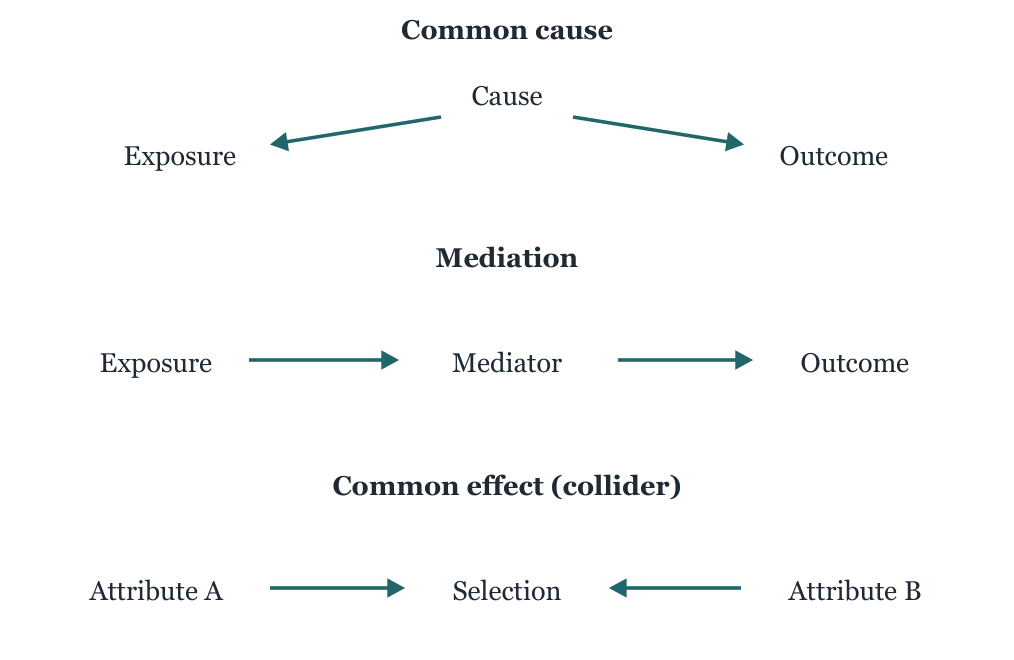
Figure 2. Three causal structures. Arrows represent assumed causal directions. Adjusting for a common cause, a mediator, or a collider has different implications; the diagram must match the question.
Example 119. Does volunteering improve trust?
A researcher compares volunteers with nonvolunteers and finds higher trust among volunteers. One possible diagram includes prior trust influencing both volunteering and later trust. Another includes neighborhood stability influencing both. Either can produce an association without volunteering causing the whole difference.
Random assignment to an invitation can help estimate the effect of offering that invitation. It does not automatically estimate the effect of actually volunteering, because some invited people decline and some uninvited people volunteer elsewhere. Comparing participants after assignment can reintroduce selection. The intervention, compliance, and outcome must be distinguished.
An evolutionary hypothesis about cooperation might motivate the study, but the causal result concerns the tested intervention. Evidence that an invitation changes trust is not direct evidence for the historical selection of a specialized volunteering mechanism.
Why more statistical controls can make inference worse
Adjusting for a genuine confounder can help under appropriate assumptions. Adjusting for a mediator can remove part of the effect one intended to estimate. Adjusting for a collider can introduce an association that was absent before selection. Choosing controls solely because they predict the outcome is therefore unreliable. Hernan and colleagues distinguish common-cause confounding from bias induced by conditioning on common effects. (54)
Example 120. Studying only admitted applicants
Consider an invented program that admits applicants with either excellent grades or an exceptional portfolio. In the full applicant pool, suppose grades and portfolio quality are independent. Within the admitted group, applicants with weaker grades generally need stronger portfolios to qualify, while high grades allow admission with a less exceptional portfolio.
The selected sample can therefore show a negative association between grades and portfolio quality even though neither causes the other and no such relationship existed in the full pool. Admission is a common effect of the two attributes. Conditioning on it changes the association.
An evolutionary researcher studying only unusually successful people could encounter a similar selection problem. An apparent trade-off among traits may partly reflect who entered the sample. The solution begins with understanding recruitment and the target population, rather than inventing a biological trade-off to explain every observed correlation.
Measurement connects theory to data
A latent construct such as threat sensitivity cannot be observed directly in the same way as a recorded button press. Researchers infer it through measures. A task may reflect several processes: attention, comprehension, motivation, motor speed, and the proposed sensitivity. Measurement validity concerns whether the evidence supports the intended interpretation.
A manipulation can also change more than its intended target. A mortality reminder might affect mood, perceived expectations, or attention as well as thoughts about death. Demonstrating an effect of the manipulation is not sufficient to identify which changed process produced the outcome.
Converging evidence is valuable when methods have different weaknesses. Similar findings from several versions of the same questionnaire may share the same bias. Agreement between independent behavioral measures, carefully designed interventions, and longitudinal observations can be more informative, provided their predictions genuinely concern the same mechanism.
From possibility to explanation
A model establishes what follows under stated assumptions. A measurement study assesses whether observations represent the intended construct. A causal design tests the consequences of a defined change. An evolutionary explanation adds claims about selection, inheritance, historical conditions, or other evolutionary processes.
These steps need not occur in a rigid sequence, but none can be silently substituted for another. A strong explanation links them and identifies what evidence could break the link. That discipline makes evolutionary psychology more than a collection of plausible stories: it turns explanations into claims that can be compared, revised, and rejected.
31. Replication, cross-cultural research, and scientific criticism
Evaluate claims at the right scale
Evolutionary psychology contains broad principles, models, proposed mechanisms, and individual empirical findings. These do not all stand or fall together. A failed experiment on a particular preference does not refute natural selection. The general truth of natural selection does not rescue that experiment's claim.
Criticism is most useful when it identifies the exact proposition at issue. Is a measure unreliable? Is an association absent? Does the proposed mechanism fail to explain the association? Is the historical inference unsupported? Each challenge calls for different evidence.
An explanation can also be partly right. A predicted association might exist but arise through a different process. A mechanism might operate in some contexts while its claimed universality fails. Scientific revision often changes the scope of a claim rather than replacing an entire field with a single verdict.
What replication tests
A replication collects new observations to assess a previous claim. A close replication preserves important features of the original design. A conceptual extension changes features to test a broader interpretation. Both can be valuable, but they answer different questions.
If a changed task produces a different result, the difference may concern the phenomenon or the measurement. If a close replication fails, explanations involving context still need evidence. Inventing an unmeasured contextual difference after every failure makes a claim difficult to challenge.
The Open Science Collaboration replicated 100 studies from three psychology journals and found substantially weaker effects overall, with results differing across criteria for replication success. That project concerned a selected set of psychological studies; it was not an estimate of the failure rate of evolutionary psychology as a whole. (90)
Example 121. The same effect, different significance labels
Two hypothetical studies estimate almost the same positive effect. The smaller study has a wide uncertainty interval that includes zero; the larger study has a narrower interval that excludes zero. Calling one a failure and the other a success solely from their significance labels hides their agreement about the estimated effect.
Now consider two studies with precise estimates in opposite directions. That disagreement deserves investigation even if a researcher can describe both as evidence that context matters. Comparison should examine effect sizes, uncertainty, procedures, and a direct assessment of differences. A significant result in one study and a nonsignificant result in another do not, by themselves, establish a significant difference between them.
A flexible analysis can manufacture confidence
Researchers often face reasonable choices: how to score a measure, which observations to exclude, whether to transform a variable, and which outcomes to emphasize. Trying many options and reporting only the favorable one changes the meaning of the resulting statistical evidence.
Simmons and colleagues demonstrated how undisclosed flexibility in collection and analysis can inflate false-positive findings. The problem does not require deliberate fabrication. Selective decisions can accumulate while each individual choice appears defensible. (110)
A simple calculation illustrates the issue. If 20 independent tests each have a 5% false-positive probability under their null hypotheses, the probability of at least one false positive is 1 - 0.95 raised to the twentieth power, approximately 64%. Real analyses are often dependent, so this number is not a universal correction. It explains why a single reported threshold crossing cannot be interpreted without knowing the search that produced it.
Example 122. Finding a status effect after many comparisons
A hypothetical study measures five status cues and four preferences. The researcher examines all 20 pairings, highlights one small association, and writes as though that exact association had been the prediction from the beginning.
The association may be worth investigating, but its discovery should be reported as exploratory. A stronger follow-up specifies the prediction and analysis in advance and collects suitable new evidence. The other comparisons remain relevant to understanding the original search. Hiding them makes the selected result appear more surprising under chance than it actually was.
Preregistration makes the sequence visible
Preregistration records questions and planned analyses before the relevant outcomes are examined. Its central contribution is distinguishing predictions from explanations developed after seeing results. Nosek and colleagues describe this distinction and the practical use of preregistration, including situations involving existing data. (86)
A preregistration is not a quality certificate. A weak theory can be preregistered. A measure can be invalid. An analysis can be underpowered. Researchers can deviate from a plan for good reasons, but they should disclose what changed and why. The timestamp and the investigators' prior access to data matter.
Exploration remains essential. Unexpected patterns can reveal better questions, faulty assumptions, or new mechanisms. The problem is not discovering a hypothesis in data; it is presenting that discovery as an independent test of the same hypothesis.
Precision, power, and informative absence
A nonsignificant result can be compatible with a substantial effect when uncertainty is wide. It can also be informative when a precise estimate rules out effects large enough to matter for the theory. Sample size alone is not enough: measurement reliability, design, and the expected effect influence precision.
Researchers should specify what magnitude the explanation requires. If a theory can accommodate an effect arbitrarily close to zero, large studies may detect tiny associations without establishing the mechanism's practical importance. Conversely, a precise near-zero result can challenge a proposed strong effect even though exact absence is difficult to prove.
Equivalence testing formalizes a related question: is the effect sufficiently small to fall within prespecified bounds? Those bounds need justification. Selecting them after seeing the result simply moves the flexibility problem to another part of the analysis.
Cross-cultural evidence tests scope
A claim about humans requires evidence beyond the easiest available participants. Rad and colleagues criticized the mismatch between narrow sampling and broad language in psychological research. Their argument concerns both who participates and how authors describe the reach of their findings. (97)
Recruiting in many countries is useful, but country count is not a measure of representativeness. Samples may consist of similar university students, internet users, or urban volunteers. A large geographic spread can coexist with a narrow range of education, wealth, age, and subsistence conditions.
Example 123. A survey in twenty countries
A study distributes an English-language online questionnaire through university mailing lists in twenty countries. It finds a similar association in most samples. This supports a claim about the sampled respondents under that measurement procedure; it does not automatically establish the same pattern among all residents of those countries.
A stronger extension identifies missing populations, adapts the measure collaboratively, and tests whether respondents interpret it comparably. If the association differs, researchers investigate measurement, local conditions, and the proposed mechanism. Treating every country as a uniform cultural unit would conceal variation within it.
Generality is not identical expression
A universal capacity can generate different behaviors under different inputs. Yet this flexibility cannot be invoked without limits. A theory should identify relevant inputs and predict the direction or structure of variation before all outcomes are known.
Cross-cultural differences can challenge claims about fixed preferences while supporting a more conditional mechanism. They can also challenge the proposed mechanism itself. Distinguishing these possibilities requires measures of the hypothesized conditions, rather than adding a cultural explanation whenever predictions fail.
Measurement equivalence is central. If a scale measures different constructs in different settings, comparing means can be misleading. Local qualitative knowledge can help identify the problem, while statistical analyses can test aspects of comparability. Neither translation alone nor statistical fit alone guarantees that a construct has the same meaning.
Meta-analysis is evidence synthesis, not automatic truth
A meta-analysis combines estimates under a specified model. Its interpretation depends on search coverage, eligibility decisions, study quality, dependence among effects, and the handling of variation between studies. A precise average of biased studies can remain biased.
When effects differ across settings, an average can conceal the conditions that matter. Researchers should examine whether differences are predictable and whether apparent moderators were specified or discovered during analysis. Small collections of studies may provide little power to distinguish genuine moderation from noise.
Publication bias is another concern: studies or outcomes with attractive results may be easier to find. Statistical checks can help, but none guarantees that missing evidence has been recovered. Transparent searches, inclusion of accessible unpublished results, and sensitivity analyses make the limits more visible.
Example 124. Two reviews reach different conclusions
Two fictional reviews examine whether a preference changes with a biological state. One includes indirect calendar estimates of that state; the other requires direct repeated measurements. They also differ in whether multiple results from the same participants count as independent evidence.
Their pooled estimates differ. Counting which review includes more papers will not resolve the disagreement. Readers should compare the target question, measurement validity, eligibility rules, dependence handling, and uncertainty. A useful new study targets the disputed assumption rather than merely adding another loosely related estimate.
Criticism should produce a better test
Calling an account a just-so story is a starting criticism, not a complete analysis. Identify what evidence would discriminate it from alternatives. Calling a finding replicated likewise requires specifying what was repeated and what remained uncertain.
The most constructive criticism connects a weakness to a test: improve measurement, collect a less selective sample, compare explicit models, or examine a prediction under conditions where rival explanations diverge. Researchers should state what would make them revise a claim. Readers should reward that clarity rather than interpreting every revision as a failure of science.
Evolutionary psychology earns confidence through this process of correction. Its strongest explanations connect formal possibilities to reliable observations, identify their boundaries, and survive tests designed to expose mistakes. Its weakest claims remain plausible regardless of what happens. The difference is evidential discipline, not how compelling the story sounds.
32. Using evolutionary psychology responsibly
From explanation to a decision
An evolutionary explanation can change how a problem is framed. It can draw attention to incentives, information, learning, developmental conditions, or conflicts among interests. It does not, on its own, determine what anyone should do. Decisions also require goals, evidence about available actions, and consideration of their consequences for the people affected.
The distinction is practical. Suppose a behavior helped solve a recurrent ancestral problem. It does not follow that encouraging the behavior now will improve well-being. Suppose a behavior is culturally learned. It does not follow that changing it will be easy. Historical origin, present malleability, and desirability are different questions.
This chapter applies the book's reasoning to four original scenarios. Each begins with a plausible hypothesis, identifies what remains unknown, and asks how to evaluate an intervention. The scenarios are not reports of demonstrated applications.
Technology: distinguish attraction from benefit
Digital systems can present social information at a scale and frequency unlike ordinary face-to-face encounters. A designer might hypothesize that visible approval counts engage concerns about reputation or belonging. That hypothesis can suggest measurements, but it does not establish that every user experiences the same motive or that a particular interface exploits a specialized adaptation.
Example 125. Removing public approval counts
A fictional discussion platform considers hiding public approval totals while retaining private feedback. Its designers predict that this will reduce competitive posting without reducing useful participation. Several mechanisms could produce a change: less social comparison, different expectations about audience judgment, or simply reduced visual distraction.
The platform can compare interface versions using clearly specified outcomes. Time spent is not sufficient if the intended goal is better discussion. Measures might include whether users receive useful answers, report unwanted pressure, or return because the service meets a need. The study should also examine differences among users rather than relying only on an average.
If hiding counts helps, the result supports that design choice under the tested conditions. It does not prove the ancestral origin of reputation sensitivity. If it harms participation, designers should investigate the function the counts served, such as helping users identify useful contributions. Evolutionary reasoning supplies hypotheses; observed consequences guide the decision.
Relationships: a theory is not access to another mind
The book has discussed attachment, jealousy, mate preferences, kinship, and reciprocity. These concepts describe possible mechanisms and population patterns. They do not allow someone to infer a partner's intentions from a brief incident or assign a fixed strategy to a person.
One danger is circular interpretation. A person is labeled insecure because they seek reassurance; their reassurance seeking is then explained by the label. The label adds little unless it connects to independently assessed patterns and improves understanding beyond the observed behavior.
Example 126. A delayed reply
Someone feels distressed when a partner does not answer a message. Possible explanations include concern about the relationship, uncertainty about safety, past experiences, or an expectation about response time. An evolutionary account of relationship monitoring cannot decide among these possibilities from the delay alone.
A constructive next step is to clarify the actual situation and expectations. The partners might agree on how to communicate during busy periods and later assess whether that reduces misunderstanding. This is a concrete change that can be evaluated without claiming that either person's behavior reveals an ancestral strategy.
Understanding a possible origin of jealousy also does not authorize surveillance or coercion. Explanation concerns why a response occurs; acceptable conduct depends on consent, rights, and the consequences of actions. A feeling can be understandable while a proposed response to it is unacceptable.
Institutions: change the interaction, then measure it
Cooperation research emphasizes that behavior depends partly on how interactions are organized. Information, monitoring, repeated contact, and opportunities for repair can alter consequences. An institution can therefore change behavior without changing people's basic capacities.
But a mechanism that helps in one setting can fail elsewhere. Public monitoring can support accountability or encourage performance for an audience. Punishment can deter exploitation or become a tool of retaliation. The appropriate design depends on the actual problem and the power to enforce rules fairly.
Example 127. Sharing equipment in an apartment building
Residents want to share gardening equipment. Some worry about damage and unequal contributions. One proposal requires a large deposit; another uses a booking record, clear responsibility for maintenance, and an inexpensive repair fund.
A deposit may deter careless use but also exclude residents who cannot afford it. A booking record may improve accountability but create privacy concerns if it reveals unnecessary information. The residents should identify the failure they want to prevent, choose a proportionate arrangement, and review actual damage, access, and maintenance costs.
An evolutionary perspective helps identify incentives and repeated relationships. It does not imply that distrust is universal or that the strictest rule is best. The successful arrangement is the one that meets the community's goals under its conditions, with a workable way to resolve errors and disagreements.
Education: support mechanisms without labeling students
Learning depends on prior knowledge, attention, feedback, motivation, and opportunities to practice. Evolutionary questions can help distinguish constraints and possible functions, but they do not establish that all useful education should resemble an imagined ancestral environment.
School subjects often involve culturally accumulated tools and concepts. Reading, algebra, and formal scientific reasoning require learning systems to work with content that is historically recent. Their novelty does not make them unnatural in a sense that determines whether they are valuable or learnable.
Example 128. Teaching probability through social decisions
A teacher uses examples involving promises and cooperation to introduce conditional probability. Students find the stories engaging. The teacher hypothesizes that social content makes the underlying relationships easier to understand.
To assess learning, the teacher also uses structurally equivalent problems about nonsocial events and checks whether students can transfer the method. Better performance only on familiar social stories may reflect background knowledge or cues in the wording. Transfer would provide stronger evidence that students learned the abstract relationship.
The teaching method can be useful even if its evolutionary explanation remains uncertain. Conversely, an engaging story is not enough if it leaves students unable to apply the principle elsewhere. Educational success and a claim about evolved specialization need separate evidence.
Do not turn averages into destinies
Population differences are distributions, not scripts for individuals. Even when an average difference is reliable, groups can overlap extensively. A decision about a particular person should use relevant individual information and appropriate standards rather than treating group membership as a complete description.
The same applies to age, personality, developmental history, and social background. The book's examples illustrate possible processes; they are not tools for diagnosing strangers. A broad theory can suggest questions while remaining unable to answer them for a particular person.
Scientific language can make weak judgments sound authoritative. Terms such as fitness, strategy, and adaptation should earn their place by making a claim more precise. If replacing them with ordinary language leaves the explanation unchanged, the technical vocabulary may be adding prestige rather than information.
A disciplined path from hypothesis to application
Begin with the problem and the desired outcome. Specify the proposed mechanism and plausible alternatives. Identify an intervention that actually changes the relevant condition. Measure both intended benefits and important costs. Check whether effects persist, transfer, and differ among the people affected.
Historical claims require their own evidence. A successful present-day intervention does not prove an ancestral function, just as an uncertain ancestral function does not invalidate a well-tested intervention. Maintaining this distinction allows useful applications without overstating what they explain.
Participation also matters. People affected by an intervention often know constraints absent from the designer's model. Their experience can reveal that the assumed problem is wrong, that a proposed benefit is unwanted, or that an apparently minor cost is substantial. Incorporating that knowledge improves both the ethics and the empirical adequacy of the design.
What the whole framework contributes
Evolutionary psychology asks how minds became capable of their characteristic activities and why those capacities have the organization they do. It connects behavior to problems of survival, reproduction, cooperation, development, and information. It also asks why those capacities vary, conflict, and sometimes produce harmful outcomes.
Its core reasoning is strongest when several distinctions remain visible: function and mechanism; selection and other evolutionary processes; adaptation and byproduct; inherited variation and developmental response; a population pattern and an individual prediction; a useful model and a demonstrated explanation.
Culture is part of this account. People learn from others, transform environments, and inherit institutions as well as genes. Development is part of it too: evolved capacities do not emerge independently of experience. These interactions make human behavior more complex than a list of fixed ancestral instructions, but they also provide concrete research questions.
The standard for a persuasive explanation is therefore demanding. It should identify what the mechanism does, how it develops and operates, why the proposed evolutionary process would produce it, and what observations distinguish that account from alternatives. Where evidence supports only one part, the conclusion should remain at that level.
Learning this framework is not learning to find an adaptive story for everything. It is learning to ask better questions about minds, behavior, and history—and to recognize when the available evidence cannot yet answer them.
Glossary
Evolution and explanation
Adaptation: a feature shaped by selection because its effects contributed to reproductive success in relevant past conditions. Present usefulness alone does not establish adaptation. See Chapters 2–4.
Adaptive: beneficial relative to a specified outcome and environment. In evolutionary arguments, specify whether the outcome is fitness; in everyday language it often means useful or helpful. These meanings are not interchangeable.
Byproduct: a feature arising as a consequence of other features or processes, rather than being selected for its own effects. A byproduct can later become useful.
Exaptation: use of a feature for a function different from the one for which it originally evolved, or recruitment of a previously nonadaptive feature into a function.
Fitness: contribution to subsequent generations, measured in a way appropriate to the model and population. It is not strength, health, happiness, or moral worth.
Genetic drift: changes in genetic variant frequencies due to chance sampling across generations. Its importance depends partly on population size and structure.
Natural selection: systematic differences in the transmission of heritable variants associated with their consequences for survival and reproduction in a given environment.
Proximate explanation: an account of mechanisms or development producing a trait or behavior. It complements rather than replaces an evolutionary explanation.
Ultimate explanation: an account concerning evolutionary history or functional consequences. The term does not mean more important, more certain, or morally authoritative.
Trade-off: a relationship in which improving one outcome carries a cost to another under specified constraints. An observed negative correlation is not sufficient to establish an evolved trade-off.
Development and variation
Developmental plasticity: production of different phenotypes in response to conditions during development. Plasticity can be adaptive, constrained, or harmful; its existence does not settle which interpretation applies.
Gene–environment correlation: association between genetic variation and environmental exposure. Selection into activities, responses evoked from others, and family processes can contribute.
Gene–environment interaction: variation in the effect associated with a genotype across environments, or variation in an environmental effect across genotypes.
Heritability: a proportion of phenotypic variance attributed to genetic variance under a specified model and population. It is not the fraction of an individual's trait caused by genes. See Chapter 28.
Life history: the schedule and allocation of growth, maturation, reproduction, and survival. Psychological uses of life-history language require explicit links to the processes being modeled.
Phenotype: an observable or measurable characteristic produced through development, including physiological and behavioral characteristics.
Polygenic score: a predictor combining information from many genetic variants using estimated associations. Its accuracy and interpretation depend on the population, outcome, and study design.
Reaction norm: the pattern of phenotypes a genotype can produce across environments. It represents responsiveness rather than a single fixed outcome.
Cognition, emotion, and culture
Domain specificity: specialization with respect to particular information or problems. It does not necessarily imply a single brain location, complete independence, or absence of learning.
Mismatch: a proposed discrepancy between conditions relevant to the evolution of a mechanism and conditions in which it currently operates. A mismatch claim needs a specified change and causal pathway.
Modularity: a family of claims about functional specialization and organization of cognitive processes. Authors differ in which properties they require; always check the intended definition.
Social learning: learning influenced by observing or interacting with others or their products. It includes processes with different levels of copying fidelity and understanding.
Cumulative culture: cultural change in which successive modifications build on earlier contributions. Criteria for demonstrating accumulation must be distinguished from mere transmission.
Gene–culture coevolution: reciprocal evolutionary interaction between genetic variation and culturally transmitted practices. Cultural change alone is not evidence of genetic evolution.
Niche construction: modification of environmental conditions by organisms, potentially changing development or selection. Ecological inheritance concerns environmental legacies affecting later generations.
Social evolution
Altruism: in evolutionary usage, behavior that benefits a recipient while imposing a fitness cost on the actor. Psychological altruism concerns motives; the definitions answer different questions.
Direct reciprocity: conditional cooperation involving repeated interaction with the same partner. It differs from helping that yields a return through reputation with others.
Inclusive fitness: a framework accounting for effects on reproduction through the actor and through effects on others weighted by genetic relatedness, with appropriate accounting assumptions.
Kin selection: selection involving fitness consequences mediated through genetically related individuals. Kinship labels and genetic relatedness are not always equivalent.
Relatedness: a measure of genetic association relative to an appropriate population reference. In elementary pedigree examples it is often expressed as expected genetic similarity through shared ancestry.
Sexual selection: selection arising from differences in success in obtaining fertilizations, including competition and choice. Its effects depend on ecology, parental investment, and other conditions.
Signaling: communication through a feature or action that affects receivers. Reliability requires an explanation; cost by itself does not guarantee honesty.
Models and evidence
Causal effect: a contrast between outcomes under specified interventions or exposure conditions for a defined target population. Association alone does not identify it.
Collider: a variable caused by two other variables in a causal diagram. Conditioning on it can induce an association between its causes. See Example 120.
Confounder: a common cause relevant to the exposure–outcome relationship in a specified causal model. Its role depends on the question and diagram.
Effect size: a quantitative measure of the magnitude of a difference or association. Statistical significance does not determine whether an effect is large or practically important.
Evolutionarily stable strategy: a strategy resistant to invasion by sufficiently rare alternatives under the defined game's assumptions. Stability is not collective optimality or proof of historical evolution.
Mediator: a variable through which an exposure affects an outcome in a causal model. Adjusting for it changes which effect is being estimated.
Nash equilibrium: a strategy combination in which no player can improve their payoff by changing strategy alone, given the others' strategies.
Preregistration: a record of research questions and planned analyses made before examining the relevant outcomes. It clarifies prediction versus exploration but does not guarantee a valid design.
Replication: assessment of a prior empirical claim using new observations. The interpretation depends on what was preserved or changed and on the precision of the evidence.
Selection bias: distortion arising from how observations enter or remain in an analysis. It can occur even when all measured values are accurate.
Statistical power: the probability that a specified testing procedure rejects its null hypothesis under a particular alternative. It depends on effect magnitude, design, variability, and other assumptions.
WEIRD: Western, educated, industrialized, rich, and democratic. The label highlights sampling limitations; it is not a claim that everyone within or outside those categories is psychologically alike.
Study-design exercises and answer commentary
1. Separate the four questions
A researcher asks why people become attentive when someone says their name. Propose one question about mechanism, development, evolutionary function, and evolutionary history. What would be wrong with treating a neural response as a complete answer to all four?
Answer commentary: mechanism might concern which processing steps distinguish one's name from other sounds. Development might concern how familiarity and learning change the response. A functional question might ask whether prioritizing personally relevant signals improves action in defined contexts. A historical question might compare relevant capacities across species or lineages. A neural correlate can inform mechanism without establishing developmental origin, selected function, or phylogeny. The functional proposal remains a hypothesis until tested against alternatives.
2. Identify the missing inference
A survey finds that people remember threatening headlines better than neutral headlines. An author concludes that humans possess a specialized adaptation for remembering online threats. Identify at least three alternative explanations or missing steps.
Answer commentary: the headlines may differ in emotional intensity, familiarity, surprise, or reading difficulty. General attention or memory processes could generate the difference. Online headlines are historically recent, so any adaptation claim must concern a more general ancestral problem rather than that exact medium. A stronger study matches competing features, tests a specified mechanism, and asks which predictions distinguish specialization from broader learning and attention processes.
3. Check a cooperation calculation
Use the repeated donation-game assumptions in Chapter 19. If helping costs 3 units, benefits the partner by 8 units, and the continuation probability is 0.5, compare continued mutual cooperation with a single defection followed by permanent noncooperation. What changes if the continuation probability is 0.2?
Answer commentary: continued cooperation yields (8 - 3)/(1 - 0.5) = 10 units, while the specified defection yields 8. At continuation probability 0.2, cooperation yields 5/0.8 = 6.25, below 8. These comparisons concern the stated response rule, accurate observation, constant continuation probability, and payoff structure. They do not establish a universal rule for friendship or compare every possible strategy.
4. Distinguish a preference from an opportunity
An urban sample forms partnerships later than a rural sample. List information needed before interpreting the difference as an evolved difference in mating preferences.
Answer commentary: relevant information includes education, work, housing, local partner availability, legal and social constraints, intentions, and the timing of measurement. Observed partnership timing combines preferences with opportunities and constraints. Differences in age distributions or sampling can also matter. Evidence for a historical evolutionary explanation requires more than a present-day group contrast; a genetic explanation is not implied by either geography or persistence.
5. Interpret heritability
A trait's estimated heritability is 0.70 in one sample. Does this imply that 70% of each person's trait is genetic, that the trait cannot change, or that a mean difference between two populations is genetic? Explain.
Answer commentary: none follows. The estimate concerns variance in the sampled population under the model's assumptions. It does not partition an individual, estimate the effect of an intervention, or identify causes of a between-population difference. Ask how the trait was measured, which genetic component was estimated, what environments varied, and how uncertain the estimate is. Chapter 28's numerical example shows how changing environmental variance alone can change the ratio.
6. Design a test of developmental calibration
A hypothesis proposes that unpredictable childhood schedules produce greater flexibility in switching tasks. What would distinguish this from current stress, general cognitive differences, or measurement artifacts?
Answer commentary: define unpredictability separately from average hardship and measure its timing. Use reliable tasks that distinguish flexibility from speed, accuracy, and familiarity. Measure current conditions and compare explicit causal alternatives. Longitudinal data help establish sequence but do not remove every confounder. A calibration account should predict where the proposed response helps and where it costs something; a single association with adversity is insufficient.
7. Recognize selection into a sample
A study recruits only highly followed content creators and finds a negative association between production quality and posting frequency. Why might this fail to demonstrate a psychological trade-off?
Answer commentary: suppose either quality or frequency helps a creator gain followers. Conditioning on high follower counts can induce a negative association between the two routes to selection, even if they were independent in the broader population. A genuine time-budget trade-off is also possible. Distinguishing them requires information about the recruitment process and observations beyond the selected group, not just a biological narrative about the observed correlation.
8. Make a replication informative
A small study reports a strong association between a hormone measure and a preference. A follow-up reports a nonsignificant association. What must you inspect before deciding whether they disagree?
Answer commentary: inspect estimates and uncertainty, reliability and timing of hormone measurements, preference measures, inclusion rules, sample characteristics, and analysis choices. A wide interval in the follow-up may include the original estimate; a narrow interval near zero may challenge it. Repeated measurements may answer a within-person question different from a between-person comparison. A direct comparison of estimates is more informative than contrasting significance labels.
9. Test a cultural-transmission explanation
A useful technique spreads through a workplace. What evidence would distinguish copying successful colleagues from independent discovery or copying prestigious colleagues regardless of success?
Answer commentary: document who observed whom, what performance information was available, and when adoption occurred. Where feasible, separate cues to success from cues to prestige and compare predictions. Independent discovery predicts adoption without the relevant transmission exposure. Mere clustering among colleagues does not establish which learning process operated. The spread of a practice also does not, by itself, demonstrate cumulative culture or genetic change.
10. Evaluate an application
A team proposes public rankings to increase contributions to a shared project, citing evolved concern for reputation. What should be tested before declaring the intervention successful?
Answer commentary: specify the desired contribution, not just activity counts. Measure quality, exclusion, strategic gaming, unwanted pressure, and persistence after the ranking system is removed or changed. Compare an appropriate alternative and examine differences among participants. Even if rankings improve outcomes, the intervention result does not prove a particular evolutionary origin of reputation concern. If rankings fail, that does not refute every role for reputation in cooperation.
Annotated reading routes
Building a foundation
Read Chapters 1–6 in order before using evolutionary terms to explain a particular behavior. The crucial distinctions are between levels of explanation, selection and other processes, and adaptation and present usefulness. Revisit the four-question exercise after reading a later empirical chapter: identify which questions the evidence actually answers.
Tinbergen's classic paper provides the historical starting point for separating questions about behavior. Laland and colleagues reconsider the relationship among those questions. The former is a foundational reference, not a modern empirical review; this book's access to the original was limited, as described in the research scope. (114; 69)
Cognition and learning
Read Chapters 7–12 together. Compare specialization claims with accounts emphasizing learning, development, and cultural experience. Barrett and Kurzban articulate a functional approach to modularity; Heyes discusses how learning and development contribute to human cognitive capacities. Read them as positions that help formulate discriminating questions, rather than treating either vocabulary as a complete explanation. (9; 56)
For each proposed specialization, write down the relevant input, computation, output, developmental pathway, and alternative mechanism. If two explanations predict the same result in the current experiment, identify a condition under which their predictions would diverge.
Relationships and reproduction
Read Chapters 13–18 with particular attention to the distinction between a reported preference and a realized choice. Trivers's parental-investment chapter supplies a historical theoretical foundation. Walter and colleagues offer a large cross-national preference study; its sampling and measurement boundaries are as important as its scale. (117; 120)
Jones and colleagues provide a useful contrast between a widely discussed hormonal preference hypothesis and a specific repeated-measures test. The result concerns its measured outcome and design, not every possible effect of reproductive physiology. Reading the prediction beside the measurement helps prevent an overly broad interpretation. (61)
Cooperation and social organization
Read Chapters 19–24, then work through the donation-game exercise. Nowak's review organizes several routes to cooperation. Ostrom directs attention to social–ecological systems and institutions. These sources operate at different levels; neither reduces cooperation to a single motive. (87; 92)
When reading a cooperation study, distinguish the actor's motive, the immediate payoff, and the proposed evolutionary consequence. Ask whether interaction structure, partner choice, reputational information, or enforcement changed. Do not infer one mechanism merely because the final outcome was cooperative.
Culture, development, and variation
Read Chapters 25–28 as a sequence. Mesoudi and Thornton clarify what researchers mean by cumulative culture. Laland and colleagues examine gene–culture coevolution. Nettle and Frankenhuis compare evolutionary and psychological uses of life-history theory. Together they show why similar terms can concern different processes and time scales. (77; 68; 83)
For genetic interpretation, read Rosenberg and colleagues alongside Chapter 28. Focus on the distinction between variation within populations, differences between populations, prediction, and causal explanation. A numerical score is not self-interpreting merely because its inputs are genetic. (101)
Evaluating evidence independently
Read Chapters 29–32 before using an evolutionary claim to recommend an intervention. Border and colleagues illustrate the need to reassess plausible biological hypotheses using stronger evidence. Nosek and colleagues explain why the timing of predictions and analyses matters. Rad and colleagues address the gap between narrow samples and claims about humanity. (12; 86; 97)
For a paper you select, prepare a short evidence map: the exact claim, its operational measures, the design, the principal alternative explanation, the result with uncertainty, and the remaining inference. Then read a replication, criticism, or competing account where available. The purpose is not to collect agreement; it is to understand what the evidence can discriminate.
Reading beyond this book
Follow the linked references to publisher or repository records. Check publication date, corrections, retractions, supplementary methods, and later work before treating a paper as the last word. A review is useful for orientation; a primary study is necessary when the conclusion depends on its exact design. This reading guide is selective and does not rank every available source or imply that all cited full texts were read completely.
Research scope and access
What this book is
This book is an original educational synthesis based on a selective narrative review. It is not a systematic review, a meta-analysis, or an exhaustive reading of the internet. No claim is made that every evolutionary-psychology paper was located or read. The literature is too large and its boundaries too open for that claim to be credible.
Selection was guided by the chapter questions: foundational evolutionary principles; competing explanations of cognition and behavior; empirical research on relationships, cooperation, culture, and variation; and methodological criticism. Historical sources establish the development of ideas. Later studies, reviews, and critiques qualify their application. Inclusion in the references is not an endorsement of every claim in a source.
The book was prepared with OpenAI Codex and has not undergone independent peer review. Its worked examples are teaching constructions unless explicitly identified as findings. Their plausibility is not empirical evidence that the proposed evolutionary account is true.
Search and verification approach
Research began on 15 October 2026. Topic searches covered evolutionary psychology and its criticisms, cultural evolution, life-history theory, kin selection, cooperation, mate preferences, cross-cultural sampling, and replication. Follow-up searches used author names, article titles, and identifiers to locate relevant records and distinguish originals from corrections or similarly titled papers.
Wikipedia was permitted as an orientation map, including its evolutionary-psychology links. Empirical attributions in the book rely on the identified scholarly sources or, for the limited general treatment statement, the National Institute of Mental Health. Wikipedia was not treated as proof of individual empirical claims.
Bibliographic metadata and abstracts were checked through Europe PMC, PubMed-linked records, publisher pages, and accessible author or institutional repositories. Where possible, public full texts were retrieved and selected sections or main texts read. Access barriers, failed downloads, and browser-verification pages were not treated as successful reading.
This process did not use a preregistered search protocol, independent duplicate screening, or a complete record of every excluded search result. It therefore cannot support claims about the proportion of the entire literature favoring an explanation. Nor does the preparation date imply that all publications available by that date were included.
Reading depth varies by source
Many source-specific summaries are based on verified abstracts. These support limited statements about the stated question, design, or principal result. They do not permit independent evaluation of every analytic choice, supplementary result, or limitation. Claims requiring finer detail need the relevant methods and results, not a more confident paraphrase of the abstract.
More detailed reading was completed for selected sources. The main text of Walter and colleagues' cross-national preference study and the main extracted body of Jones and colleagues' hormone-preference study were reviewed; their supplements were not fully reviewed. Heyes's 2012 discussion of human cognition was read through its main text. These are examples of deeper access, not a claim that every reference received equivalent scrutiny. (120; 61; 56)
Other sources were read in selected sections. These include the opening conceptual discussion of Mesoudi and Thornton on cumulative culture, the comparison of research programs in Nettle and Frankenhuis, and the initial modeling discussion in Stearns and Rodrigues. Rosenberg and colleagues were read through the conceptual limitations and the beginning of statistical limitations. These sources are not described as having been read in their entirety. (77; 83; 112; 101)
Historical access was uneven. Tinbergen's original paper was located as a scan, but the available extraction did not provide a usable complete text for this review. Its inclusion acknowledges a foundational source; it is not evidence of a complete reading of that scan. Some other historical sources were accessible only through summaries or selected pages. (114)
The accompanying project research record retains source identifiers, retrieved metadata, and more specific access notes. Retrieval and reading are separate events: the presence of a downloaded article does not establish that its full contents were reviewed. Where early notes and later updates differ, the later explicit reading entry describes the updated access state.
How to interpret citations and uncertainty
A numbered citation identifies the source supporting the associated attribution. It does not mean that the surrounding original teaching example was tested in that paper. General conceptual explanations sometimes combine established definitions with original derivations or hypothetical scenarios; invented numbers are labeled accordingly.
The text distinguishes theoretical proposals from empirical findings and narrows findings to their measured outcomes. A null result on facial-masculinity preferences, for example, is not a null result for every effect of reproductive physiology. A failure of particular candidate-gene hypotheses is not evidence that all genetic contributions are absent.
Corrections and retractions matter. A correction to Evershed and colleagues' dairy-history paper was inspected; the corrected dietary self-report percentage is not used in the book. Retracted work should not be used as ordinary affirmative evidence. Readers following a reference should check the current publisher record because article status and subsequent evidence can change. (30)
Limits of the synthesis
The book offers breadth from introductory principles to advanced reasoning, not equal depth on every subfield. Source selection may omit important work, and abstract-level access limits appraisal. Cross-cultural coverage in the underlying literature remains uneven. Some concepts are well established while particular evolutionary explanations remain disputed or underdetermined.
The appropriate use of the book is as a structured starting point: learn the distinctions, inspect the cited evidence, and pursue competing explanations. The page count and number of examples describe the artifact's scope; they are not measures of evidential certainty.
Example index
Each entry links to its numbered teaching scenario in this web edition.
- Example 001. The unread group message
- Example 002. The tempting delivery-app photograph
- Example 003. Learning a video-meeting norm
- Example 004. The generous anonymous donor
- Example 005. The promotion is not a fitness measurement
- Example 006. Helping a sibling through an exam
- Example 007. The always-available friend
- Example 008. The taste for a new snack
- Example 009. A presentation alarm
- Example 010. A child learns to distrust a sales pitch
- Example 011. The comforting household dog
- Example 012. A team adopts a public checklist
- Example 013. Enjoying a horror film
- Example 014. The compulsive spreadsheet sorter
- Example 015. Reading tiny text on a phone
- Example 016. Remembering the colleague who took credit
- Example 017. Two siblings, different study habits
- Example 018. Heritable vision and corrective lenses
- Example 019. The musician's expanding environment
- Example 020. Learning a second language as an adult
- Example 021. The claim that an open-plan office is ancestral
- Example 022. Reconstructing a vanished online community
- Example 023. A modern camping trip as a test of ancient life
- Example 024. The supposedly universal ancestral diet
- Example 025. Recognizing a colleague behind a mask
- Example 026. Learning a new game interface
- Example 027. Checking a subscription entitlement
- Example 028. Ignoring a tempting notification
- Example 029. Updating a commute estimate
- Example 030. Choosing an unfamiliar software tool
- Example 031. Remembering an emergency-kit list
- Example 032. Recalling a shared project conversation
- Example 033. Two reactions to the same feedback
- Example 034. Anger over unequal workload
- Example 035. Choosing a lunch place during a short break
- Example 036. Scheduling a distraction-free work session
- Example 037. A suspicious login alert
- Example 038. Hearing a noise at night
- Example 039. A child notices a spider in a cartoon
- Example 040. Preparing for a severe-weather warning
- Example 041. The harmless stain on a cafeteria tray
- Example 042. Encountering an unfamiliar fermented food
- Example 043. Calling an unfair decision disgusting
- Example 044. A misleading rumor about a neighborhood
- Example 045. Notifications without a natural stopping point
- Example 046. A popularity counter mistaken for expertise
- Example 047. The larger default snack portion
- Example 048. Comparing an ordinary day with curated highlights
- Example 049. Two parents arranging leave
- Example 050. A dating event with uneven attendance
- Example 051. A profile that advertises commitment
- Example 052. Organizing a community event
- Example 053. The ideal-partner checklist
- Example 054. An unexpectedly enjoyable conversation
- Example 055. A distance filter on a dating service
- Example 056. A promising first date and a difficult schedule
- Example 057. The person who becomes attractive over time
- Example 058. Calling after a difficult day
- Example 059. Coordinating a move
- Example 060. A headline about an attraction hormone
- Example 061. An ambiguous message notification
- Example 062. Two survey answers that look contradictory
- Example 063. Similar behavior, different agreements
- Example 064. A survey that confuses identity and experience
- Example 065. A school-pickup network
- Example 066. The caregiver who is absent from the observation
- Example 067. Grandparent help during an exam period
- Example 068. Teaching a younger sibling a game
- Example 069. Sharing help before two examinations
- Example 070. Two urgent requests in a family chat
- Example 071. A newly discovered biological relative
- Example 072. A cousin and a nearby friend
- Example 073. Neighbors lending tools
- Example 074. A missed shift in a volunteer group
- Example 075. Choosing a project collaborator
- Example 076. Helping a friend through a difficult month
- Example 077. Demonstrating a skill in an interview
- Example 078. A freelancer's public work history
- Example 079. Two influential people in a meeting
- Example 080. A famous creator recommends a technical product
- Example 081. Maintaining shared project documentation
- Example 082. A moderation rule used for retaliation
- Example 083. Sharing a community garden's water
- Example 084. A recycling station with confusing labels
- Example 085. A cross-department emergency team
- Example 086. Allocating volunteer time
- Example 087. A rumor about a rival neighborhood
- Example 088. A shared task across two student clubs
- Example 089. Dividing a team award
- Example 090. A child learning a family observance
- Example 091. Comparing two community fundraisers
- Example 092. A choir rehearsal and a bonding claim
- Example 093. Explaining a new workplace term
- Example 094. A delay in a video call
- Example 095. A changed meeting room
- Example 096. Instructions with missing background knowledge
- Example 097. Learning a recipe from a relative
- Example 098. An online tutorial with an outdated step
- Example 099. Improving a shared repair guide
- Example 100. Several teams solving the same design problem
- Example 101. A new reading practice in a family
- Example 102. Different ways of using dairy foods
- Example 103. A neighborhood builds walking routes
- Example 104. A craft tradition clustered by region
- Example 105. Training, paid work, and family care
- Example 106. Two meanings of an improved environment
- Example 107. Accepting money today
- Example 108. A scheduling task with changing rules
- Example 109. The quiet employee
- Example 110. Exploring a new supplier
- Example 111. A more equal training environment
- Example 112. A score travels to another population
- Example 113. Worry before a presentation
- Example 114. Avoiding every unfamiliar meeting
- Example 115. Replaying a conflict
- Example 116. A test advertised as a stress gene
- Example 117. Two teams choose a shared platform
- Example 118. Searching for overlooked opportunities
- Example 119. Does volunteering improve trust?
- Example 120. Studying only admitted applicants
- Example 121. The same effect, different significance labels
- Example 122. Finding a status effect after many comparisons
- Example 123. A survey in twenty countries
- Example 124. Two reviews reach different conclusions
- Example 125. Removing public approval counts
- Example 126. A delayed reply
- Example 127. Sharing equipment in an apartment building
- Example 128. Teaching probability through social decisions
References
-
Anderson C, Hildreth JAD, Howland L. (2015). Is the desire for status a fundamental human motive? A review of the empirical literature. https://doi.org/10.1037/a0038781
-
Andrews PW, Thomson JA. (2009). The bright side of being blue: depression as an adaptation for analyzing complex problems. https://doi.org/10.1037/a0016242
-
Atwood S, Schachner A, Mehr SA. (2022). Expectancy Effects Threaten the Inferential Validity of Synchrony-Prosociality Research. https://doi.org/10.1162/opmi_a_00067
-
Axelrod R, Hamilton WD. (1981). The evolution of cooperation. https://doi.org/10.1126/science.7466396
-
Bailey JM, Vasey PL, Diamond LM, Breedlove SM, Vilain E, Epprecht M. (2016). Sexual Orientation, Controversy, and Science. https://doi.org/10.1177/1529100616637616
-
Balliet D, Wu J, De Dreu CK. (2014). Ingroup favoritism in cooperation: a meta-analysis. https://doi.org/10.1037/a0037737
-
Barclay P (2016). Biological markets and the effects of partner choice on cooperation and friendship https://doi.org/10.1016/j.copsyc.2015.07.012
-
Barker JL, Power EA, Heap S, Puurtinen M, Sosis R. (2019). Content, cost, and context: A framework for understanding human signaling systems. https://doi.org/10.1002/evan.21768
-
Barrett HC, Kurzban R. (2006). Modularity in cognition: framing the debate. https://doi.org/10.1037/0033-295x.113.3.628
-
Bogin B, Bragg J, Kuzawa C. (2014). Humans are not cooperative breeders but practice biocultural reproduction. https://doi.org/10.3109/03014460.2014.923938
-
Bolhuis JJ, Brown GR, Richardson RC, Laland KN. (2011). Darwin in mind: new opportunities for evolutionary psychology. https://doi.org/10.1371/journal.pbio.1001109
-
Border R, Johnson EC, Evans LM, Smolen A, Berley N, Sullivan PF, Keller MC. (2019). No Support for Historical Candidate Gene or Candidate Gene-by-Interaction Hypotheses for Major Depression Across Multiple Large Samples. https://doi.org/10.1176/appi.ajp.2018.18070881
-
Burkart JM, Cerrito P, Natalucci G, van Schaik CP. (2025). Cooperative Breeding as a Likely Early Catalyst of Human Evolution. https://doi.org/10.1002/evan.70016
-
Buss DM, Haselton MG, Shackelford TK, Bleske AL, Wakefield JC. (1998). Adaptations, exaptations, and spandrels. https://doi.org/10.1037//0003-066x.53.5.533
-
Chaudhary N, Page AE, Salali GD, Dyble M, Major-Smith D, Migliano AB, Vinicius L, Thompson J, Viguier S. (2024). Hunter-Gatherer children's close-proximity networks: Similarities and differences with cooperative and communal breeding systems. https://doi.org/10.1017/ehs.2024.1
-
Cheng JT, Tracy JL, Foulsham T, Kingstone A, Henrich J. (2013). Two ways to the top: evidence that dominance and prestige are distinct yet viable avenues to social rank and influence. https://doi.org/10.1037/a0030398
-
Confer JC, Easton JA, Fleischman DS, Goetz CD, Lewis DM, Perilloux C, Buss DM. (2010). Evolutionary psychology. Controversies, questions, prospects, and limitations. https://doi.org/10.1037/a0018413
-
Cosmides L. (1989). The logic of social exchange: has natural selection shaped how humans reason? Studies with the Wason selection task. https://doi.org/10.1016/0010-0277(89)90023-1
-
Cowen AS, Keltner D. (2017). Self-report captures 27 distinct categories of emotion bridged by continuous gradients. https://doi.org/10.1073/pnas.1702247114
-
Creanza N, Kolodny O, Feldman MW. (2017). Cultural evolutionary theory: How culture evolves and why it matters. https://doi.org/10.1073/pnas.1620732114
-
Cressman R, Tao Y. (2014). The replicator equation and other game dynamics. https://doi.org/10.1073/pnas.1400823111
-
Curry OS, Mullins DA, Whitehouse H (2019). Is It Good to Cooperate? Testing the Theory of Morality-as-Cooperation in 60 Societies https://doi.org/10.1086/701478
-
Curtis V, Aunger R, Rabie T. (2004). Evidence that disgust evolved to protect from risk of disease. https://doi.org/10.1098/rsbl.2003.0144
-
Dehaene S, Pegado F, Braga LW, Ventura P, Ventura P, Nunes Filho G, Jobert A, Dehaene-Lambertz G, Kolinsky R, Morais J, Cohen L. (2010). How learning to read changes the cortical networks for vision and language. https://doi.org/10.1126/science.1194140
-
Eastwick PW, Finkel EJ. (2008). Sex differences in mate preferences revisited: do people know what they initially desire in a romantic partner? https://doi.org/10.1037/0022-3514.94.2.245
-
Eastwick PW, Joel S. (2025). How Do People Feel About Mates? https://doi.org/10.1146/annurev-psych-012224-025712
-
Eastwick PW, Luchies LB, Finkel EJ, Hunt LL. (2014). The predictive validity of ideal partner preferences: a review and meta-analysis. https://doi.org/10.1037/a0032432
-
Ellis BJ, Abrams LS, Masten AS, Sternberg RJ, Tottenham N, Frankenhuis WE. (2022). Hidden talents in harsh environments. https://doi.org/10.1017/s0954579420000887
-
Ellis BJ, Figueredo AJ, Brumbach BH, Schlomer GL. (2009). Fundamental Dimensions of Environmental Risk : The Impact of Harsh versus Unpredictable Environments on the Evolution and Development of Life History Strategies. https://doi.org/10.1007/s12110-009-9063-7
-
Evershed RP, et al. (2022). Dairying, diseases and the evolution of lactase persistence in Europe. https://doi.org/10.1038/s41586-022-05010-7
-
Fassi L, Thomas K, Parry DA, Leyland-Craggs A, Ford TJ, Orben A. (2024). Social Media Use and Internalizing Symptoms in Clinical and Community Adolescent Samples: A Systematic Review and Meta-Analysis. https://doi.org/10.1001/jamapediatrics.2024.2078
-
Fehr E, Gächter S. (2002). Altruistic punishment in humans. https://doi.org/10.1038/415137a
-
Fitch WT, Hauser MD, Chomsky N. (2005). The evolution of the language faculty: clarifications and implications. https://doi.org/10.1016/j.cognition.2005.02.005
-
Fletcher GJ, Simpson JA, Campbell L, Overall NC. (2015). Pair-bonding, romantic love, and evolution: the curious case of Homo sapiens. https://doi.org/10.1177/1745691614561683
-
Fraley RC, Hudson NW, Heffernan ME, Segal N. (2015). Are adult attachment styles categorical or dimensional? A taxometric analysis of general and relationship-specific attachment orientations. https://doi.org/10.1037/pspp0000027
-
Fraley RC. (2019). Attachment in Adulthood: Recent Developments, Emerging Debates, and Future Directions. https://doi.org/10.1146/annurev-psych-010418-102813
-
Ganna A, Verweij KJH, Nivard MG, Maier R, Wedow R, Busch AS, Abdellaoui A, Guo S, Sathirapongsasuti JF, 23andMe Research Team, Lichtenstein P, Lundström S, Långström N, Auton A, Harris KM, Beecham GW, Martin ER, Sanders AR, Perry JRB, Neale BM, Zietsch BP. (2019). Large-scale GWAS reveals insights into the genetic architecture of same-sex sexual behavior. https://doi.org/10.1126/science.aat7693
-
Gendron M, Roberson D, van der Vyver JM, Barrett LF. (2014). Perceptions of emotion from facial expressions are not culturally universal: evidence from a remote culture. https://doi.org/10.1037/a0036052
-
Gettler LT, McDade TW, Feranil AB, Kuzawa CW. (2011). Longitudinal evidence that fatherhood decreases testosterone in human males. https://doi.org/10.1073/pnas.1105403108
-
Gigerenzer G, Gaissmaier W. (2011). Heuristic decision making. https://doi.org/10.1146/annurev-psych-120709-145346
-
Gould SJ, Lewontin RC. (1979). The spandrels of San Marco and the Panglossian paradigm: a critique of the adaptationist programme. https://doi.org/10.1098/rspb.1979.0086
-
Grebe NM, Sarafin RE, Strenth CR, Zilioli S. (2019). Pair-bonding, fatherhood, and the role of testosterone: A meta-analytic review. https://doi.org/10.1016/j.neubiorev.2019.01.010
-
Griffiths PE, Bourrat P. (2023). Integrating evolutionary, developmental and physiological mismatch. https://doi.org/10.1093/emph/eoad023
-
Gurven M, von Rueden C, Massenkoff M, Kaplan H, Lero Vie M. (2013). How universal is the Big Five? Testing the five-factor model of personality variation among forager-farmers in the Bolivian Amazon. https://doi.org/10.1037/a0030841
-
Hall KD, et al. (2019). Ultra-Processed Diets Cause Excess Calorie Intake and Weight Gain: An Inpatient Randomized Controlled Trial of Ad Libitum Food Intake. https://doi.org/10.1016/j.cmet.2019.05.008
-
Hallett EY, Leonardi M, Cerasoni JN, Will M, Beyer R, Krapp M, Kandel AW, Manica A, Scerri EML. (2025). Major expansion in the human niche preceded out of Africa dispersal. https://doi.org/10.1038/s41586-025-09154-0
-
Hamilton WD. (1964). The genetical evolution of social behaviour. I. https://doi.org/10.1016/0022-5193(64)90038-4
-
Harris CR. (2003). A review of sex differences in sexual jealousy, including self-report data, psychophysiological responses, interpersonal violence, and morbid jealousy. https://doi.org/10.1207/s15327957pspr0702_102-128
-
Hazan C, Shaver P. (1987). Romantic love conceptualized as an attachment process. https://doi.org/10.1037//0022-3514.52.3.511
-
Henrich J, Boyd R, Bowles S, Camerer C, Fehr E, Gintis H, McElreath R, Alvard M, Barr A, Ensminger J, Henrich NS, Hill K, Gil-White F, Gurven M, Marlowe FW, Patton JQ, Tracer D. (2005). "Economic man" in cross-cultural perspective: behavioral experiments in 15 small-scale societies. https://doi.org/10.1017/s0140525x05000142
-
Henrich J, Ensminger J, McElreath R, Barr A, Barrett C, Bolyanatz A, Cardenas JC, Gurven M, Gwako E, Henrich N, Lesorogol C, Marlowe F, Tracer D, Ziker J. (2010). Markets, religion, community size, and the evolution of fairness and punishment. https://doi.org/10.1126/science.1182238
-
Henrich J, Gil-White FJ. (2001). The evolution of prestige: freely conferred deference as a mechanism for enhancing the benefits of cultural transmission. https://doi.org/10.1016/s1090-5138(00)00071-4
-
Henrich J, Heine SJ, Norenzayan A. (2010). The weirdest people in the world? https://doi.org/10.1017/s0140525x0999152x
-
Hernán MA, Hernández-Díaz S, Robins JM. (2004). A structural approach to selection bias. https://doi.org/10.1097/01.ede.0000135174.63482.43
-
Herrmann B, Thöni C, Gächter S. (2008). Antisocial punishment across societies. https://doi.org/10.1126/science.1153808
-
Heyes C. (2012). New thinking: the evolution of human cognition. https://doi.org/10.1098/rstb.2012.0111
-
Heyes C. (2014). False belief in infancy: a fresh look. https://doi.org/10.1111/desc.12148
-
Howard MC, Davis MM, Serviss E. (2026). A meta-analysis of perceived infectability, germ aversion, disgust and outgroup perceptions: Evaluating research on the behavioural immune system. https://doi.org/10.1111/bjop.70076
-
Janicke T, Häderer IK, Lajeunesse MJ, Anthes N. (2016). Darwinian sex roles confirmed across the animal kingdom. https://doi.org/10.1126/sciadv.1500983
-
Joel S, et al. (2020). Machine learning uncovers the most robust self-report predictors of relationship quality across 43 longitudinal couples studies. https://doi.org/10.1073/pnas.1917036117
-
Jones BC, Hahn AC, Fisher CI, Wang H, Kandrik M, Han C, Fasolt V, Morrison D, Lee AJ, Holzleitner IJ, O'Shea KJ, Roberts SC, Little AC, DeBruine LM. (2018). No Compelling Evidence that Preferences for Facial Masculinity Track Changes in Women's Hormonal Status. https://doi.org/10.1177/0956797618760197
-
Kaltefleiter LJ, Schuwerk T, Wiesmann CG, Kristen-Antonow S, Jarvers I, Sodian B. (2022). Evidence for goal- and mixed evidence for false belief-based action prediction in 2- to 4-year-old children: A large-scale longitudinal anticipatory looking replication study. https://doi.org/10.1111/desc.13224
-
Kazanas SA, Altarriba J. (2015). The survival advantage: Underlying mechanisms and extant limitations. https://pmc.ncbi.nlm.nih.gov/articles/PMC10515320/
-
Kelly JM, Kramer SR, Shariff AF. (2024). Religiosity predicts prosociality, especially when measured by self-report: A meta-analysis of almost 60 years of research. https://doi.org/10.1037/bul0000413
-
Kirby S, Cornish H, Smith K. (2008). Cumulative cultural evolution in the laboratory: an experimental approach to the origins of structure in human language. https://doi.org/10.1073/pnas.0707835105
-
Kokko H, Jennions MD. (2008). Parental investment, sexual selection and sex ratios. https://doi.org/10.1111/j.1420-9101.2008.01540.x
-
Kurzban R, Tooby J, Cosmides L. (2001). Can race be erased? Coalitional computation and social categorization. https://doi.org/10.1073/pnas.251541498
-
Laland KN, Odling-Smee J, Myles S. (2010). How culture shaped the human genome: bringing genetics and the human sciences together. https://doi.org/10.1038/nrg2734
-
Laland KN, Sterelny K, Odling-Smee J, Hoppitt W, Uller T. (2011). Cause and effect in biology revisited: is Mayr's proximate-ultimate dichotomy still useful? https://doi.org/10.1126/science.1210879
-
Laland KN, Uller T, Feldman MW, Sterelny K, Müller GB, Moczek A, Jablonka E, Odling-Smee J. (2015). The extended evolutionary synthesis: its structure, assumptions and predictions. https://doi.org/10.1098/rspb.2015.1019
-
Levinson SC. (2016). Turn-taking in Human Communication--Origins and Implications for Language Processing. https://doi.org/10.1016/j.tics.2015.10.010
-
Lieberman D, Tooby J, Cosmides L. (2007). The architecture of human kin detection. https://doi.org/10.1038/nature05510
-
LoBue V, Adolph KE. (2019). Fear in infancy: Lessons from snakes, spiders, heights, and strangers. https://doi.org/10.1037/dev0000675
-
Martin AR, Kanai M, Kamatani Y, Okada Y, Neale BM, Daly MJ. (2019). Clinical use of current polygenic risk scores may exacerbate health disparities. https://doi.org/10.1038/s41588-019-0379-x
-
Meacham F, T Bergstrom C. (2016). Adaptive behavior can produce maladaptive anxiety due to individual differences in experience. https://doi.org/10.1093/emph/eow024
-
Mehr SA, Singh M, Knox D, Ketter DM, Pickens-Jones D, Atwood S, Lucas C, Jacoby N, Egner AA, Hopkins EJ, Howard RM, Hartshorne JK, Jennings MV, Simson J, Bainbridge CM, Pinker S, O'Donnell TJ, Krasnow MM, Glowacki L. (2019). Universality and diversity in human song. https://doi.org/10.1126/science.aax0868
-
Mesoudi A, Thornton A. (2018). What is cumulative cultural evolution? https://doi.org/10.1098/rspb.2018.0712
-
Morgan TJH, Feldman MW. (2025). Human culture is uniquely open-ended rather than uniquely cumulative. https://doi.org/10.1038/s41562-024-02035-y
-
Muthukrishna M, Bell AV, Henrich J, Curtin CM, Gedranovich A, McInerney J, Thue B. (2020). Beyond Western, Educated, Industrial, Rich, and Democratic (WEIRD) Psychology: Measuring and Mapping Scales of Cultural and Psychological Distance. https://doi.org/10.1177/0956797620916782
-
Nairne JS, Thompson SR, Pandeirada JN. (2007). Adaptive memory: survival processing enhances retention. https://doi.org/10.1037/0278-7393.33.2.263
-
National Institute of Mental Health (accessed 2026). Psychotherapies https://www.nimh.nih.gov/health/topics/psychotherapies
-
Nesse, R. M. (2018). The smoke detector principle: Signal detection and optimal defense regulation https://doi.org/10.1093/emph/eoy034
-
Nettle D, Frankenhuis WE. (2020). Life-history theory in psychology and evolutionary biology: one research programme or two? https://doi.org/10.1098/rstb.2019.0490
-
Nettle D. (2006). The evolution of personality variation in humans and other animals. https://doi.org/10.1037/0003-066x.61.6.622
-
Nichols R, Charbonneau M, Chellappoo A, Davis T, Haidle M, Kimbrough EO, Moll H, Moore R, Scott-Phillips T, Purzycki BG, Segovia-Martin J. (2024). Cultural evolution: A review of theoretical challenges. https://doi.org/10.1017/ehs.2024.2
-
Nosek BA, Ebersole CR, DeHaven AC, Mellor DT. (2018). The preregistration revolution. https://doi.org/10.1073/pnas.1708274114
-
Nowak MA. (2006). Five rules for the evolution of cooperation. https://doi.org/10.1126/science.1133755
-
Odgers CL, Jensen MR. (2020). Annual Research Review: Adolescent mental health in the digital age: facts, fears, and future directions. https://doi.org/10.1111/jcpp.13190
-
Ohman A, Mineka S. (2001). Fears, phobias, and preparedness: toward an evolved module of fear and fear learning. https://doi.org/10.1037/0033-295x.108.3.483
-
Open Science Collaboration. (2015). PSYCHOLOGY. Estimating the reproducibility of psychological science. https://doi.org/10.1126/science.aac4716
-
Orben A, Przybylski AK. (2019). The association between adolescent well-being and digital technology use. https://doi.org/10.1038/s41562-018-0506-1
-
Ostrom E. (2009). A general framework for analyzing sustainability of social-ecological systems. https://doi.org/10.1126/science.1172133
-
Paolini S, Gibbs M, Sales B, Anderson D, McIntyre K. (2024). Negativity bias in intergroup contact: Meta-analytical evidence that bad is stronger than good, especially when people have the opportunity and motivation to opt out of contact. https://doi.org/10.1037/bul0000439
-
Pettigrew TF, Tropp LR. (2006). A meta-analytic test of intergroup contact theory. https://doi.org/10.1037/0022-3514.90.5.751
-
Polderman TJ, Benyamin B, de Leeuw CA, Sullivan PF, van Bochoven A, Visscher PM, Posthuma D. (2015). Meta-analysis of the heritability of human traits based on fifty years of twin studies. https://doi.org/10.1038/ng.3285
-
Purzycki BG, Apicella C, Atkinson QD, Cohen E, McNamara RA, Willard AK, Xygalatas D, Norenzayan A, Henrich J. (2016). Moralistic gods, supernatural punishment and the expansion of human sociality. https://doi.org/10.1038/nature16980
-
Rad MS, Martingano AJ, Ginges J. (2018). Toward a psychology of Homo sapiens: Making psychological science more representative of the human population. https://doi.org/10.1073/pnas.1721165115
-
Ragsdale AP, Weaver TD, Atkinson EG, Hoal EG, Möller M, Henn BM, Gravel S. (2023). A weakly structured stem for human origins in Africa. https://doi.org/10.1038/s41586-023-06055-y
-
Rennung M, Göritz AS. (2016). Prosocial Consequences of Interpersonal Synchrony: A Meta-Analysis. https://doi.org/10.1027/2151-2604/a000252
-
Richerson P, Baldini R, Bell AV, Demps K, Frost K, Hillis V, Mathew S, Newton EK, Naar N, Newson L, Ross C, Smaldino PE, Waring TM, Zefferman M. (2016). Cultural group selection plays an essential role in explaining human cooperation: A sketch of the evidence. https://doi.org/10.1017/s0140525x1400106x
-
Rosenberg NA, Edge MD, Pritchard JK, Feldman MW. (2019). Interpreting polygenic scores, polygenic adaptation, and human phenotypic differences. https://doi.org/10.1093/emph/eoy036
-
Rossetti CSL, Hilbe C (2024). Direct reciprocity among humans https://doi.org/10.1111/eth.13407
-
Sagarin BJ, Martin AL, Coutinho SA, Edlund JE, Patel L, Skowronski JJ, Zengel B (2012). Sex differences in jealousy: a meta-analytic examination https://doi.org/10.1016/j.evolhumbehav.2012.02.006
-
Sandel AA. (2025). The Search for Love in Human Evolution: Primate Social Bonds and a New Science of Emotion. https://doi.org/10.1002/ajpa.70078
-
Scelza BA, Prall SP, Blumenfield T, Crittenden AN, Gurven M, Kline M, Koster J, Kushnick G, Mattison SM, Pillsworth E, Shenk MK, Starkweather K, Stieglitz J, Sum CY, Yamaguchi K, McElreath R. (2020). Patterns of paternal investment predict cross-cultural variation in jealous response. https://doi.org/10.1038/s41562-019-0654-y
-
Scerri EML, Thomas MG, Manica A, Gunz P, Stock JT, Stringer C, Grove M, Groucutt HS, Timmermann A, Rightmire GP, d'Errico F, Tryon CA, Drake NA, Brooks AS, Dennell RW, Durbin R, Henn BM, Lee-Thorp J, deMenocal P, Petraglia MD, Thompson JC, Scally A, Chikhi L. (2018). Did Our Species Evolve in Subdivided Populations across Africa, and Why Does It Matter? https://doi.org/10.1016/j.tree.2018.05.005
-
Schaller M. (2011). The behavioural immune system and the psychology of human sociality. https://doi.org/10.1098/rstb.2011.0029
-
Sear, R., and Mace, R. (2008). Who keeps children alive? A review of the effects of kin on child survival https://doi.org/10.1016/j.evolhumbehav.2007.10.001
-
Sell A, Tooby J, Cosmides L. (2009). Formidability and the logic of human anger. https://doi.org/10.1073/pnas.0904312106
-
Simmons JP, Nelson LD, Simonsohn U. (2011). False-positive psychology: undisclosed flexibility in data collection and analysis allows presenting anything as significant. https://doi.org/10.1177/0956797611417632
-
Smith D. (2020). Cultural group selection and human cooperation: a conceptual and empirical review. https://doi.org/10.1017/ehs.2020.2
-
Stearns, S. C., and Rodrigues, A. M. M. (2020). On the use of life history theory in evolutionary psychology https://doi.org/10.1016/j.evolhumbehav.2020.02.001
-
Számadó S, Zachar I, Czégel D, Penn DJ. (2023). Honesty in signalling games is maintained by trade-offs rather than costs. https://doi.org/10.1186/s12915-022-01496-9
-
Tinbergen, N. (1963). On aims and methods of Ethology https://doi.org/10.1111/j.1439-0310.1963.tb01161.x
-
Tomasello M, Carpenter M, Call J, Behne T, Moll H. (2005). Understanding and sharing intentions: the origins of cultural cognition. https://doi.org/10.1017/s0140525x05000129
-
Trivers, R. L. (1971). The Evolution of Reciprocal Altruism https://doi.org/10.1086/406755
-
Trivers, R. L. (1972). Parental investment and sexual selection https://www2.nau.edu/~shuster/shustercourses/BIO%20698/Literature/Trivers%201972.pdf
-
Trivers, R. L. (1974). Parent-Offspring Conflict https://doi.org/10.1093/icb/14.1.249
-
Tybur JM, Lieberman D, Griskevicius V. (2009). Microbes, mating, and morality: individual differences in three functional domains of disgust. https://doi.org/10.1037/a0015474
-
Walter KV, et al. (2020). Sex Differences in Mate Preferences Across 45 Countries: A Large-Scale Replication. https://doi.org/10.1177/0956797620904154